All species › Waders, gulls and terns › Gulls and terns › Black-Legged Kittiwake
Black-Legged Kittiwake | Rissa tridactyla
Drieteenmeeuw | Gaviota Tridáctila
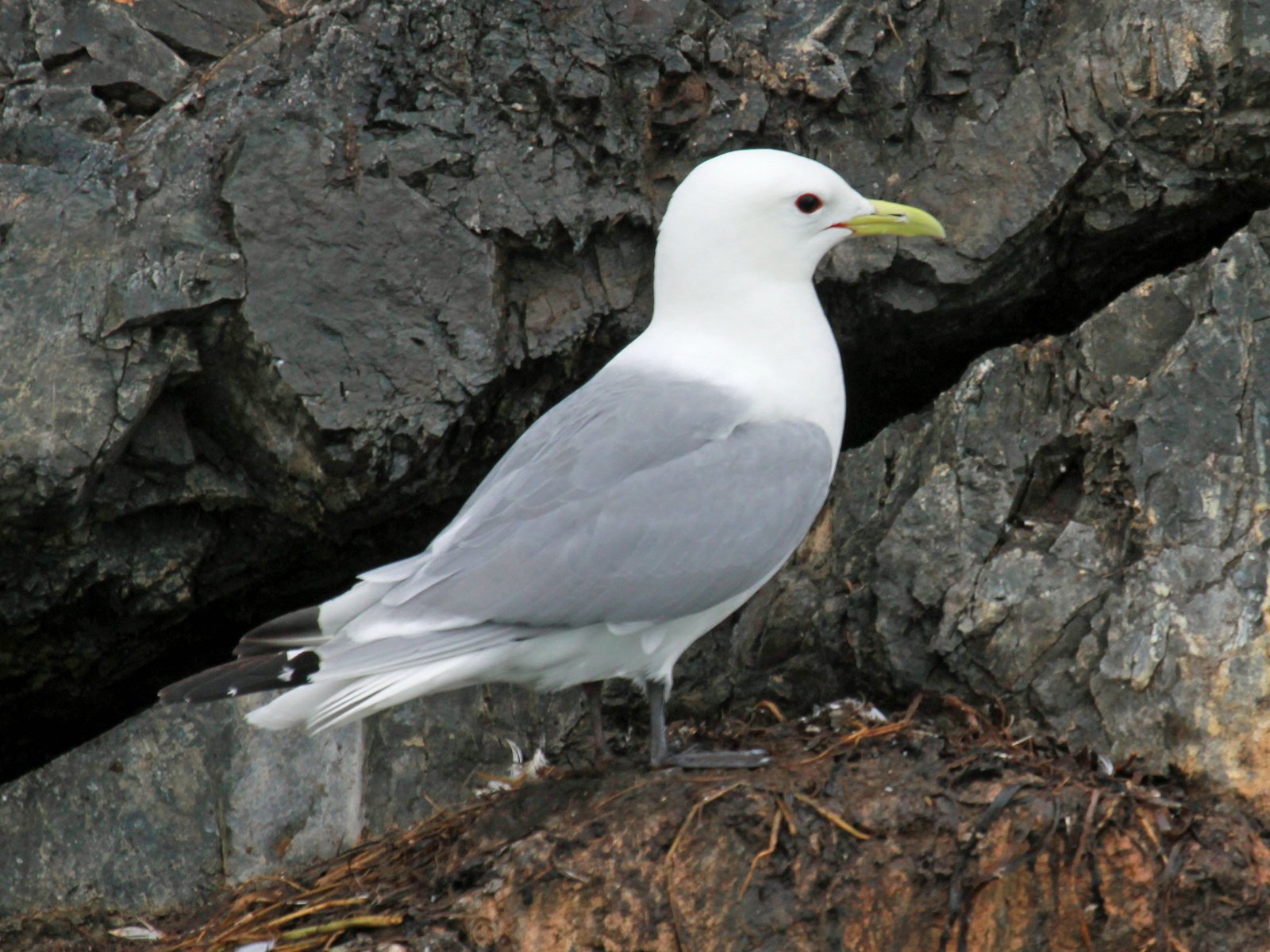
The Black-Legged Kittiwake is a medium-sized, truly oceanic gull of the northern oceans that lives far out at sea outside the breeding season. It is one of the rarest gulls in southern Africa: there are only three records, all at the Cape.
Voice
Largely silent away from the colony. At the colony the well-known nasal kitti-wee-eek that gives the English name.
Recording: Stanislas Wroza — CC BY-NC-SA 4.0 · converted to mono · xeno-canto
Identification
38–41 cm. Adults have a white head and underparts, mid-grey upperparts and wings that pale towards the tip, and sharply cut, pure black wingtips without white spots, as if dipped in ink. The bill is plain yellow, the legs short and black. In non-breeding plumage a grey spot behind the eye and a grey hind neck. Juveniles have a striking black W-pattern across the upperwings, a black collar, a black tail band and a black bill. The flight is light and buoyant, with fast, stiff wingbeats, and in strong wind it shears over the waves.
Confusion species
Hartlaub's Gull Chroicocephalus hartlaubii and Grey-Headed Gull Chroicocephalus cirrocephalus have a red or dark bill, red legs and white forewings with black and white in the wingtip. Sabine's Gull Xema sabini is smaller, with a forked tail and a sharp tricoloured wing pattern; juveniles of the two species can be confused at distance. Little Gull Hydrocoloeus minutus also has a W-pattern in juvenile plumage but is much smaller.
Habitat
Open ocean, outside the breeding season far beyond the continental shelf. It eats small fish, crustaceans and other zooplankton picked from the surface or taken in short dives, and follows fishing vessels for offal. It rests on the water and comes ashore only in storms.
Where the bird is most at home, classified by the vegetation units of southern Africa.
Range and movements
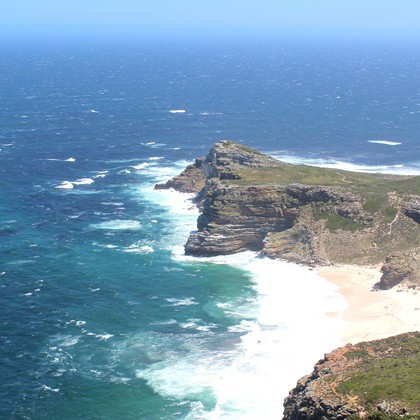
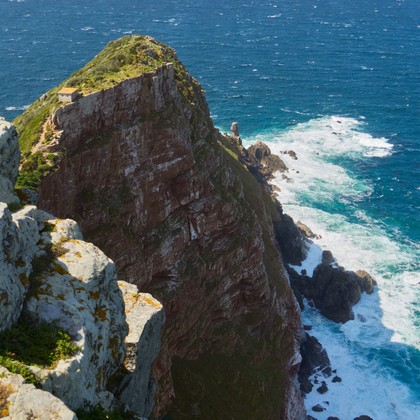
In the region recorded twice at sea off the coast of the south-western Cape and once on land, at Hermanus in the Western Cape (November 1987). It breeds in colonies on cliffs around the northern Atlantic and Pacific and winters at sea to about the tropics, rarely into waters off West Africa.
How and when to look
There is a chance only on pelagic trips out of Cape Town or at a seawatch point after severe storms. Look among the Hartlaub's and Sabine's Gulls for a gull with black, dipped wingtips or, in a juvenile, a black W and black collar.
Conservation status
Globally Vulnerable because of a steep decline in the North Atlantic, where breeding success has collapsed through changes in the food chain linked to ocean warming and fishing for sandeels. Of no conservation significance for southern Africa.
Scientific name
Rissa tridactyla | (Linnaeus, 1758)
Linnaeus described the species in 1758 as Larus tridactylus; because it was later moved to another genus, the author and year stand in brackets. The genus Rissa was introduced in 1826 by Stephens. Rissa goes back to the Icelandic rita, the local name for the black-legged kittiwake. tridactyla is Greek for 'three-toed', from tri- 'three' and daktylos 'toe': in this gull the hind toe is reduced to a stub. The specimen the first description was based on came from Great Britain.