All species › Pelicans, herons and ibises › Herons and bitterns › Black Heron
Black Heron | Egretta ardesiaca
Zwarte reiger | Garceta Azabache
The Black Heron is an all slate-black heron with a characteristic hunting technique: it spreads its wings like an umbrella over its head and fishes in the shade this creates. It often lives in small groups in shallow water.

Voice
Usually silent. During squabbles or on take-off a low, hoarse kraak.
Recording: Julien Birard — CC BY-NC-SA 4.0 · converted to mono · xeno-canto
Identification
60–66 cm, wingspan 90 to 95 cm. Wholly dark slate-black, with long loose plumes on the nape, mantle and breast when breeding. The bill is black and dagger-shaped, the eye yellow. The legs are black with conspicuous yellow to orange toes; in breeding birds the toes may turn red. Juveniles are duller and browner grey, without plumes. In flight a small all-dark heron with retracted neck and projecting legs with pale feet.
Confusion species
The Slaty Egret Egretta vinaceigula is greyer, with a rufous throat and foreneck, yellow legs and feet, and fishes without the wing canopy. The Little Egret Egretta garzetta has the same black legs with yellow feet but is white. The Reed Cormorant Microcarbo africanus can look similar in silhouette at distance, but swims and dives.
Habitat
Shallow margins of lakes, pans, floodplains, rivers and dams, also lagoons, estuaries and tidal pools. It wades and walks quickly about, then spreads its wings in a dome over its head and stands like that for a while; the shade attracts small fish and cuts glare on the water. It breeds in mixed colonies with other herons in reeds, bushes or trees over water.
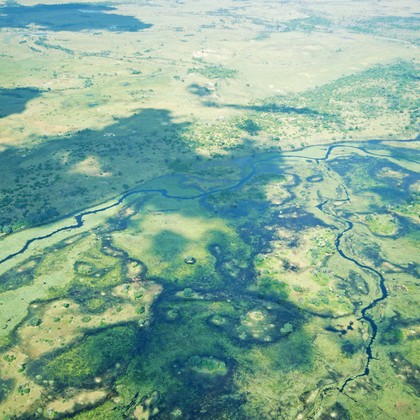
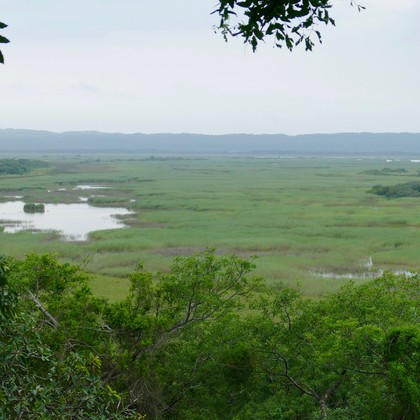
Where the bird is most at home, classified by the vegetation units of southern Africa.
Range and movements
Local and variable in numbers, mainly in the north and east of the region: the Okavango Delta and Chobe in Botswana, the Caprivi and northern Namibia, the Zambezi and lowveld of Zimbabwe, Zambia, Malawi, Mozambique and Angola; in South Africa most frequent in northern KwaZulu-Natal, particularly around Lake St Lucia, and otherwise wandering across the east and north, rarely to the Western Cape. Beyond the region in sub-Saharan Africa, especially the Sahel and East Africa, and on Madagascar.
- Resident
- Summer visitor (c. Oct–Mar)
- Winter visitor (c. Apr–Sep)
- Passage (Mar–Apr, Oct–Nov)
- dark = core range, pale = thinly spread
How and when to look
Look for groups on the shallow margins of the Okavango and Chobe or around Lake St Lucia and the pans of Zululand. The umbrella behaviour is best seen in the morning, when a group hunts together in shallow water.
Conservation status
Not threatened and fairly common across its range, though scarce and nomadic in the south of the region. The draining and pollution of shallow wetlands reduces its habitat locally.
Scientific name
Egretta ardesiaca | (Wagler, 1827)
Wagler described the species in 1827 as Ardea ardesiaca; because it was later moved to another genus, the author and year stand in brackets. The genus Egretta was introduced in 1817 by Forster. Egretta comes from Provençal aigrette, the name for the little egret, a diminutive of aigron 'heron'. ardesiaca is modern Latin for 'slate-coloured' — for the uniform slate-grey to black plumage. The specimen the first description was based on came from Senegambia.