All species › Passerines › Waxbills › Black-Faced Waxbill
Black-Faced Waxbill | Brunhilda erythronotos
Elfenastrild | Estrilda Carinegra Sureña
The Black-Faced Waxbill is a long-tailed waxbill of dry thorn savanna, finely barred grey, with a black mask and a crimson rump. Pairs and small groups feed unobtrusively in acacias and often come to waterholes.
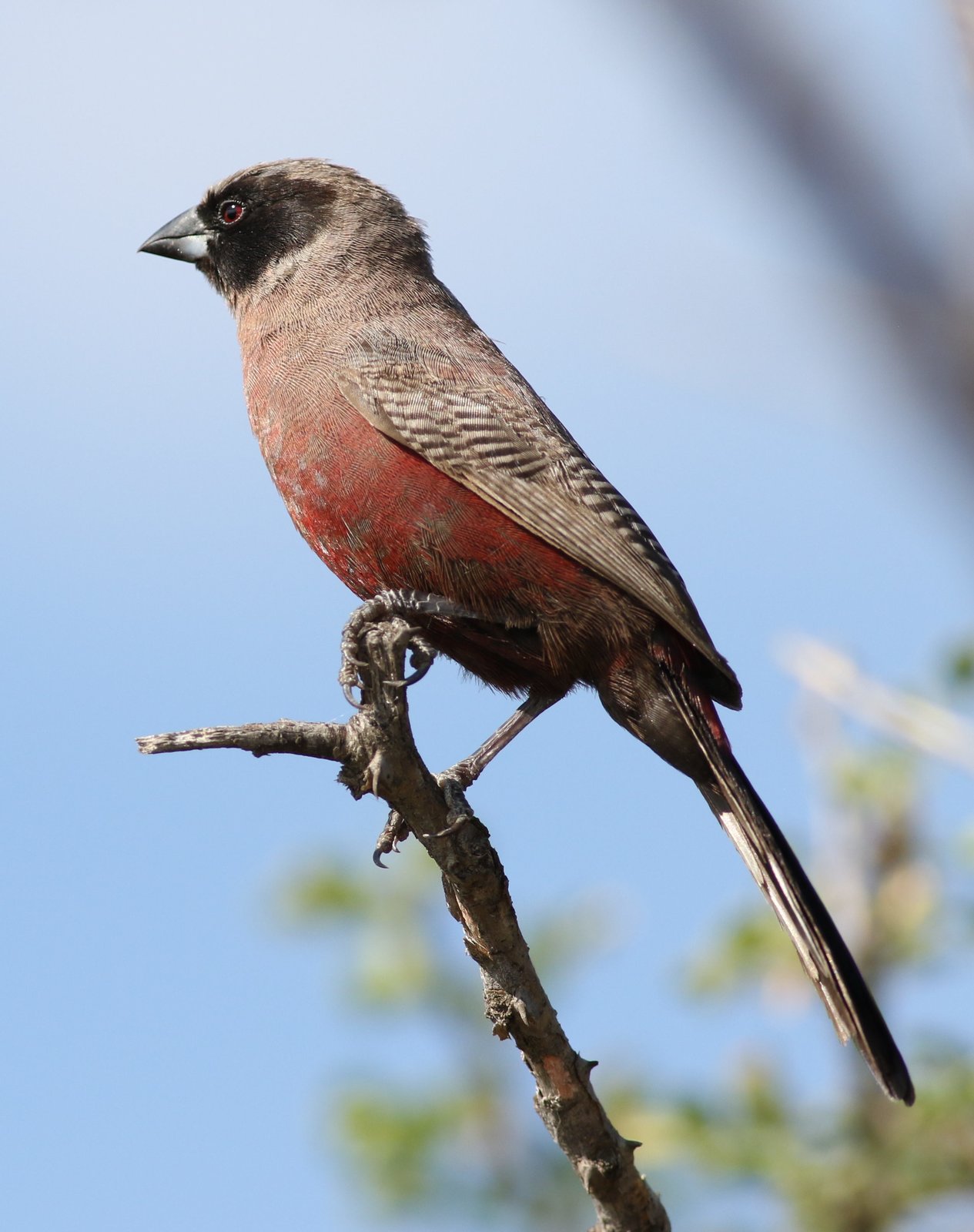
Click a thumbnail to switch the photo above.
Voice
A soft, plaintive whistled fwee-fwee-fweeoo or tsee-tsee-tsoo, rising and falling; also a short tsip while feeding. The song is a soft, fine series of whistles.
Recording: Tony Archer — CC BY-NC-SA 4.0 · converted to mono · xeno-canto
Identification
12 to 13 cm, slender with a long black tail. Male: head, back and wings grey to grey-brown, finely barred darker; face and throat form a black mask. Breast and flanks are pinkish-grey, the flanks washed crimson; rump and uppertail coverts bright crimson. Belly and undertail coverts black. The bill is blue-grey with a black tip. Female: like the male but duller, with a smaller mask and a grey rather than black belly. Juveniles are plain grey-brown with less red on the rump and hardly any barring.
Confusion species
The Grey Waxbill (Glaucestrilda perreini) is plain blue-grey without barring, has only a black eye-stripe and lives in dense forest edges in the east and north. The Cinderella Waxbill (Glaucestrilda thomensis) of north-western Namibia and south-western Angola is also blue-grey with a red rump, but has a red base to the bill, no black mask and no barring. The Common Waxbill (Estrilda astrild) is brown with a red eye-stripe and red bill. The combination of barred back, black mask and long black tail is diagnostic.
Habitat
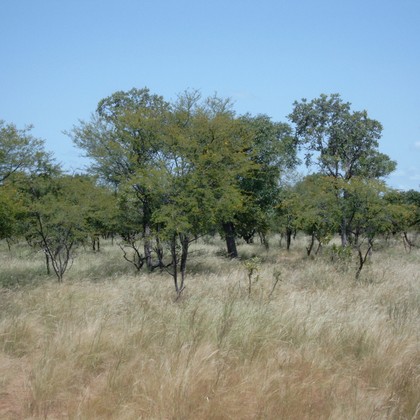
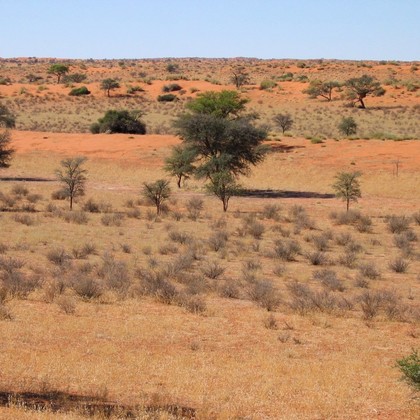
Dry acacia savanna, Kalahari thornveld and dry mixed woodland, often along dry riverbeds and in dense thorn scrub, sometimes in mopane. It forages in pairs or small groups in acacias and bushes for insects, aphids and grass seeds, and much less on the ground than most waxbills. It depends on water nearby.
Where the bird is most at home, classified by the vegetation units of southern Africa.
Range and movements
Within the region in central and northern Namibia, almost all of Botswana, northern South Africa (Northern Cape, North West, Limpopo and the fringes of Gauteng and the Free State), western and southern Zimbabwe, southern Angola and southern and western Zambia, marginally in south-western Mozambique. Hardly beyond the region; the closely related East African sister species (Brunhilda charmosyna) was formerly included in this species.
- Resident
- Summer visitor (c. Oct–Mar)
- Winter visitor (c. Apr–Sep)
- Passage (Mar–Apr, Oct–Nov)
- dark = core range, pale = thinly spread
How and when to look
Best at waterholes and water points in the Kalahari, Etosha and Kgalagadi, where pairs come to drink in the morning. Listen in thorn scrub for a subdued whistled fwee-fwee; the birds are tame but often overlooked because of their grey tones until the red rump flashes.
Conservation status
Not threatened. Fairly common but unobtrusive in dry savanna, with no evidence of decline.
Scientific name
Brunhilda erythronotos | (Vieillot, 1817) (GBIF: Estrilda erythronotos)
Vieillot described the species in 1817 as Fringilla erythronotos; because it was later moved to another genus, the author and year stand in brackets. The genus Brunhilda was introduced in 1862 by Reichenbach. Brunhilda refers to Brunhild (Brünnhilde), a female figure of Germanic and Norse legend. erythronotos comes from the Greek eruthros, 'red', and nōtos, 'back' — for the wine-red back and rump. The specimen the first description was based on came from Kurrichane, North West Province, South Africa (originally India in error).