All species › Passerines › Weavers › Black Bishop
Black Bishop | Euplectes gierowii
Zwarte vuurwever | Obispo Negro
The Black Bishop is a large, mainly black bishop with an orange-red collar and breast band. Within the region it occurs only in northern Angola, in tall elephant grass and rank growth at forest edges.

Voice
A grating, sizzling song of buzzing and chirping notes, chi-chi-zzzzzz, from a tall grass stem. The call is a hard chak.
Recording: GABRIEL LEITE — CC BY-NC-SA 4.0 · converted to mono · xeno-canto
Identification
14–16 cm, the largest bishop in the region, with a short tail and a heavy black bill. The breeding male is velvety black with a broad orange-red band over the hindcrown and nape that continues as a collar down the sides of the neck, and an orange-red band across the upper breast; back and wings are blackish brown. The female is large, tawny and heavily dark-streaked, with a pale supercilium and a brown-streaked breast. The non-breeding male resembles the female but is larger and darker, with blackish wings.
Confusion species
Black-Winged Red Bishop (Euplectes hordeaceus) is smaller and has a red crown and red back; only face, belly, wings and tail are black. Southern Red Bishop (Euplectes orix) barely occurs in northern Angola and is mainly red with a black head and belly. Yellow Bishop (Euplectes capensis) is also black, but with a yellow rump and yellow shoulders rather than red. Females are very similar; the bulky build and heavy bill help.
Habitat
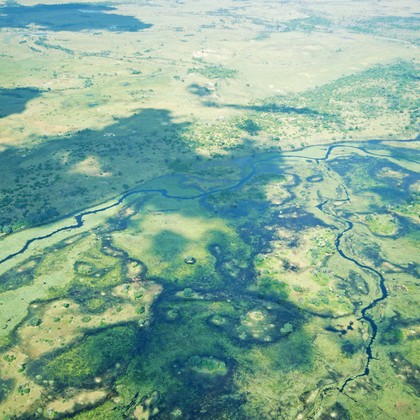
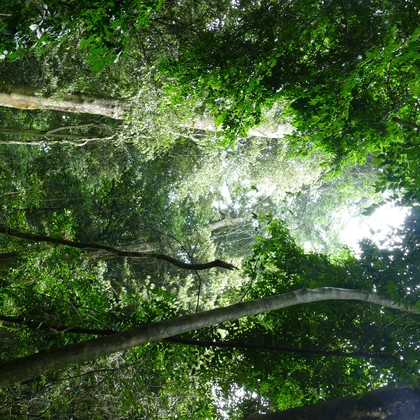
Tall grass, especially elephant grass, rank growth at forest edges, clearings, abandoned fields and damp hollows with bushes, in a wetter and more wooded setting than other bishops. Outside the breeding season it lives in small groups, often with other bishops.
Where the bird is most at home, classified by the vegetation units of southern Africa.

Range and movements
Within the region only in northern and north-western Angola, south to about 13° S; there are no confirmed records from Zambia or the rest of the region. Beyond it ranges from Cameroon and Gabon east through DR Congo to South Sudan, Ethiopia, Uganda, Kenya and Tanzania.
How and when to look
In Angola, search in the wet season along roads through elephant grass in the northern provinces, where males sit on the tops of tall stems. Black with a red collar is distinctive even at distance.
Conservation status
Not threatened; locally fairly common in its core range, but in Angola only patchily distributed and little studied.
Scientific name
Euplectes gierowii | Cabanis, 1880
Cabanis described the species in 1880 and placed it straight away in the genus where it still stands. The genus Euplectes was introduced in 1829 by Swainson. Euplectes joins Greek eu 'fine, good' to New Latin plectes 'weaver'. gierowii honours the German architect and naturalist Paul Gierow (1840–?), who collected in Angola with Otto Schütt in the late 1870s. The specimen the first description was based on came from Malanje, northern Angola.