All species › Bustards › Bustards and korhaans › Black-Bellied Bustard
Black-Bellied Bustard | Lissotis melanogaster
Zwartbuiktrap | Sisón Ventrinegro Común
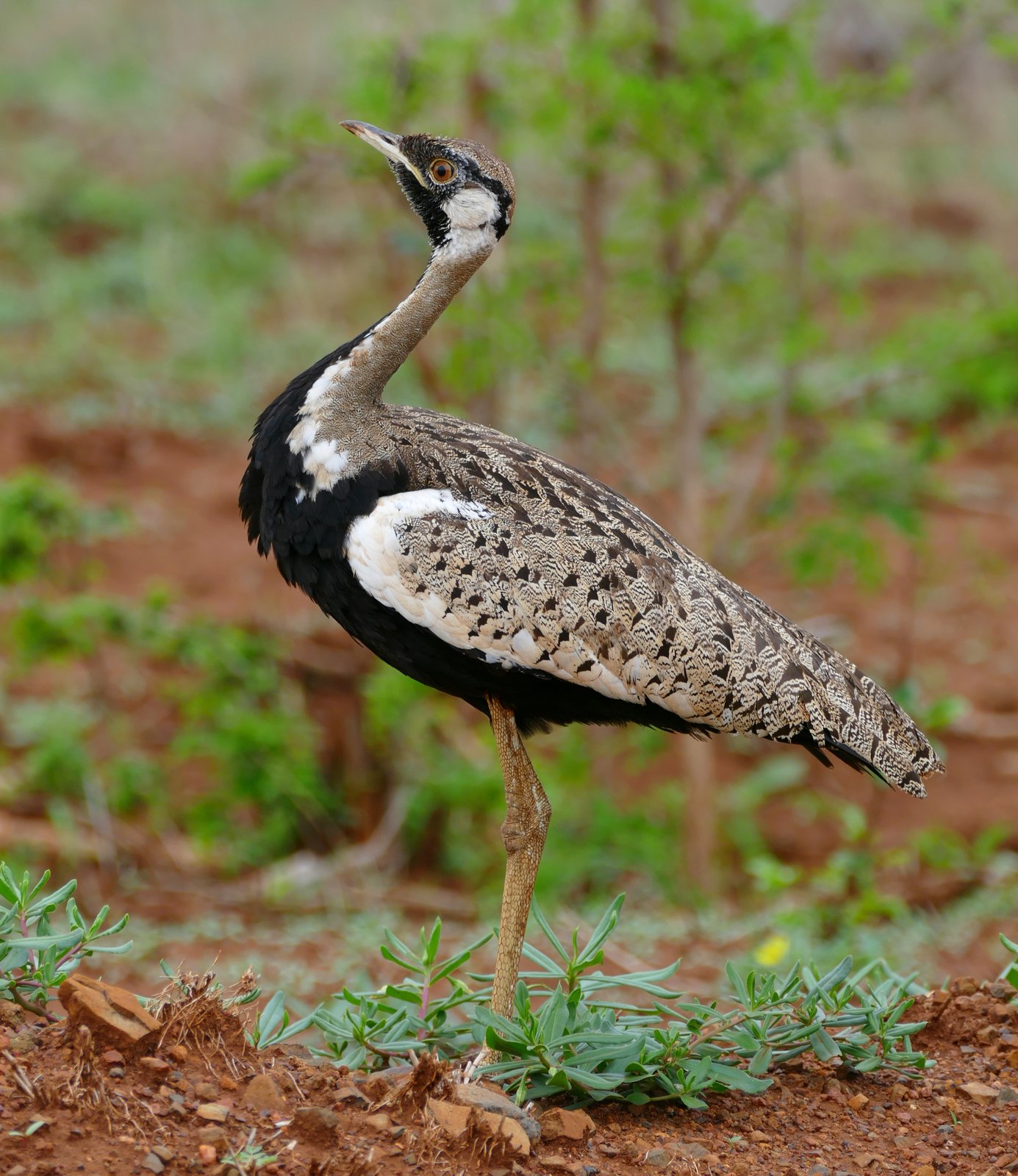
The Black-Bellied Bustard is a slender, long-necked bustard of tall grass in moist savannas. It remains largely hidden while it skulks through the grass, but the male gives itself away with its peculiar call, a sharp whistle followed by a dull pop, and with a display flight in which it glides over the grass on slow, deep wingbeats with its neck puffed out.
Voice
The male stretches its neck and gives a short, sharp, rising whistle, kwick, then draws in its head and after a pause of a few seconds produces a dull pop, like a cork drawn from a bottle. The call carries far and is given mainly in the rainy season.
Recording: Santiago Caballero Carrera — CC BY-NC-SA 4.0 · converted to mono · xeno-canto
Identification
58–65 cm, with long legs and a long, thin neck. The upperparts are tawny with black spots and arrowhead marks. The male has wholly black underparts and a narrow black stripe running from the throat down the foreneck to the breast, a grey-brown head with a dark crown and a finely marked neck. In flight the largely white wings with black primary tips stand out. The female has a whitish belly, a finely streaked tawny neck and breast and much less white in the wing. Bill yellowish horn, legs yellowish.
Confusion species
The White-Bellied Bustard (Eupodotis senegalensis) is smaller and more compact, with a blue-grey neck and white belly. The Red-Crested Korhaan (Lophotis ruficrista) and Northern Black Korhaan (Afrotis afraoides) are smaller and shorter-necked; the male of the latter has an all-black head and neck. Denham's Bustard (Neotis denhami) is much larger and has a rufous hindneck. The female resembles that of Denham's Bustard but is much smaller and slimmer.
Habitat
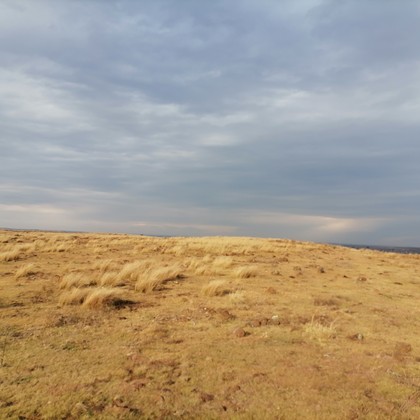
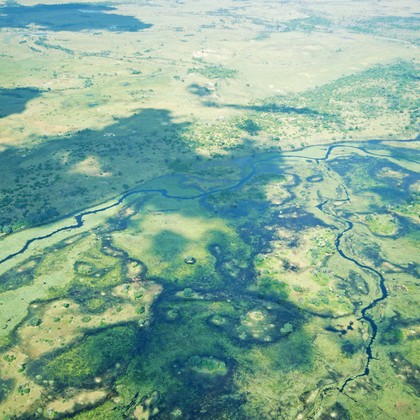
Tall, moist grassland in open savanna and woodland, grassy clearings and openings in miombo, edges of floodplains and dambos, and fallow fields. It prefers ranker, taller grass than most other bustards of the region. It eats insects, especially grasshoppers and beetles, as well as seeds, flowers and other plant material.
Where the bird is most at home, classified by the vegetation units of southern Africa.

Range and movements
The north and east of the region: most of Angola, Zambia, Malawi and Mozambique, northern and eastern Zimbabwe, northern Botswana (Okavango, Chobe), the Zambezi Region and Kavango in Namibia, and in South Africa scarce and local in northern KwaZulu-Natal, the Mpumalanga lowveld and Limpopo; also in Eswatini. Beyond the region widespread in the savanna belt of Africa, from Senegal to Ethiopia and Kenya.
- Resident
- Summer visitor (c. Oct–Mar)
- Winter visitor (c. Apr–Sep)
- Passage (Mar–Apr, Oct–Nov)
- dark = core range, pale = thinly spread
How and when to look
Best found in the rainy season, when males call and display. Watch over tall grass for a bird gliding low over the veld on slow, almost owl-like wingbeats, or listen from a roadside for the whistle and pop. Good places are the grasslands of Kafue National Park, Liuwa Plain and Gorongosa.
Conservation status
Not threatened and widespread across its African range. In South Africa it is rare and has declined locally through the conversion of grassland to sugarcane and forestry plantations. Elsewhere in the region it suffers from hunting and agricultural intensification, but its large range keeps the species as a whole secure.
Scientific name
Lissotis melanogaster | (Rüppell, 1835)
Rüppell described the species in 1835 as Otis melanogaster; because it was later moved to another genus, the author and year stand in brackets. The genus Lissotis was introduced in 1848 by Reichenbach. Lissotis comes from the Greek lissos, 'smooth', and ōtis, 'bustard' — for the uncrested head of the Black-bellied Bustard. melanogaster comes from the Greek melas, 'black', and gastēr, 'belly' — for the male's black underparts. The specimen the first description was based on came from Lake Tana, Ethiopia.