All species › Passerines › Bushshrikes › Black-Backed Puffback
Black-Backed Puffback | Dryoscopus cubla
Poederdonsklauwier | Cubla Dorsinegra
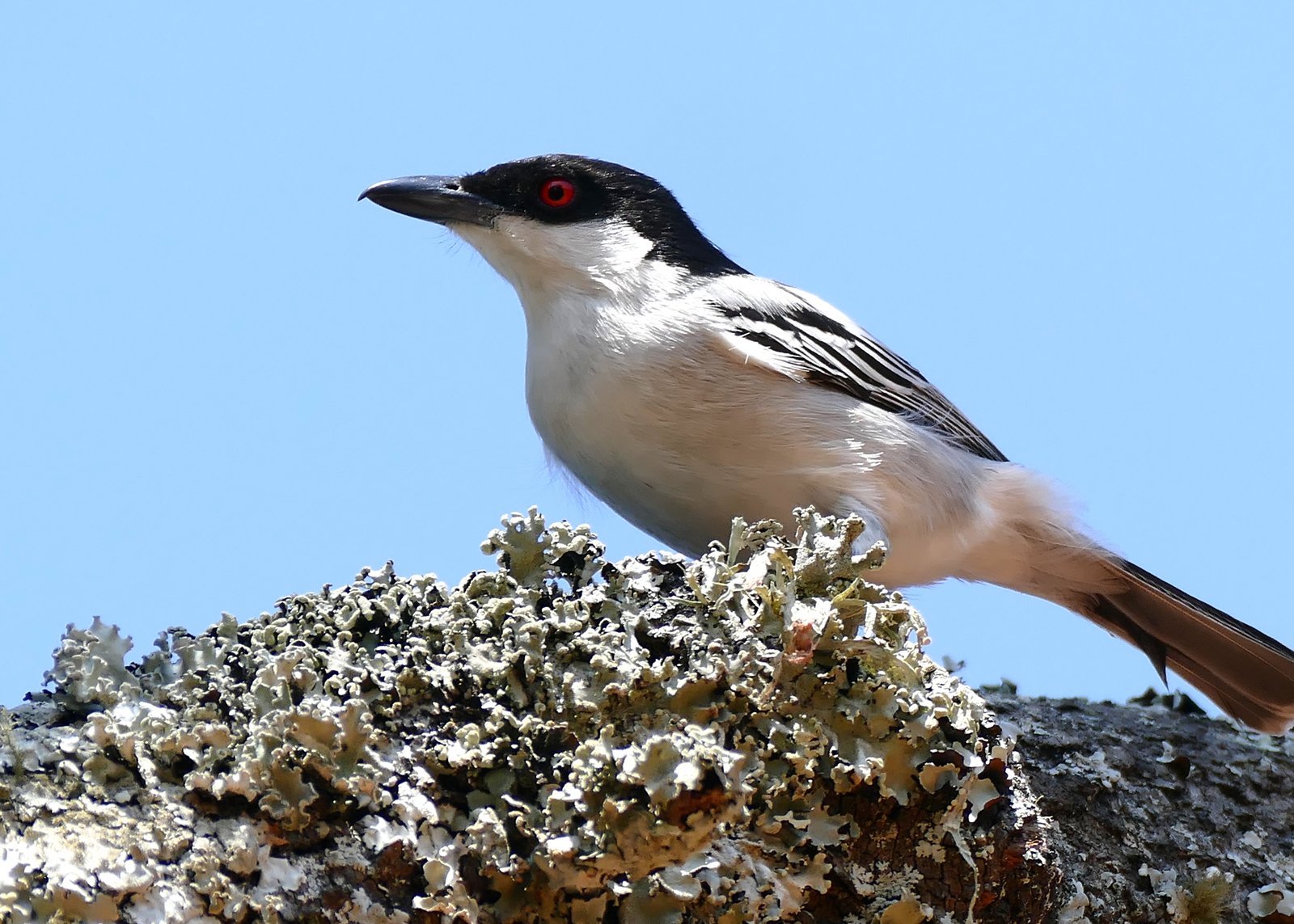
The Black-Backed Puffback is a black-and-white shrike of the canopy, named for the long, fluffy white rump feathers that the male raises in display into a powder-puff ball on its back. The red eye and sharp clicking call make it quickly recognisable in woodland and forest edge.
Voice
A sharp, repeated chik-weeoo and a dry clicking chak or click, often in series. In display flight a crackling, whirring wing sound is heard. Pairs keep in contact with soft clicks and rasping notes.
Recording: Walter Wallner — CC BY-NC-SA 4.0 · converted to mono · xeno-canto
Identification
16–18 cm. The male is glossy black on the crown, mantle and tail, with broad white edges to the wing coverts and tertials and a pale grey to white rump. The underparts are grey-white. The eye is bright red, and the bill black and heavy with a hook. In display he fluffs out the loose white feathers of the lower back into a conspicuous white ball. The female is greyer and browner on the back, with white lores and a short white supercilium, and an orange-red eye. Juveniles are browner with a dark eye and buff edges to the wing feathers.
Confusion species
Brubru Nilaus afer has a broad white supercilium and a rufous flank stripe. Pink-Footed Puffback Dryoscopus angolensis of northern Angola has a grey mantle, pink legs and warm-toned underparts in the female. Chinspot Batis Batis molitor is much smaller, with a grey back and a yellow eye. Tropical Boubou Laniarius major and Southern Boubou Laniarius ferrugineus are larger and dark-eyed, and keep low in cover.
Habitat
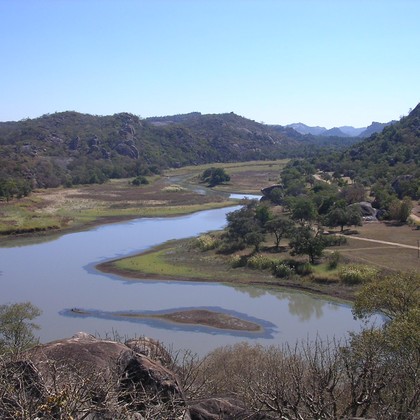
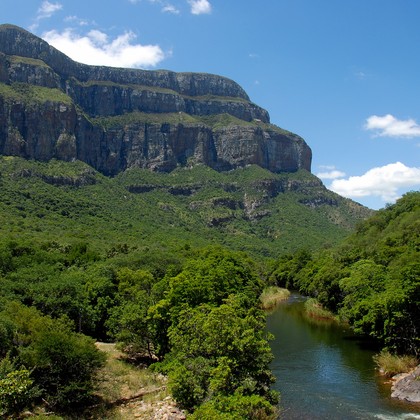
The canopy of miombo, mixed woodland, acacia savanna with tall trees, riverine woodland, coastal forest and forest edge, as well as parks and gardens with old trees. It forages actively among leaves and twigs for insects and spiders, often in mixed foraging flocks. The nest is a compact cup of bark and cobweb in a tree fork.
Where the bird is most at home, classified by the vegetation units of southern Africa.

Range and movements
Throughout the north and east of the region: Angola, Zambia, Malawi, Mozambique, Zimbabwe, northern and eastern Botswana and northern Namibia, and in South Africa from Limpopo and Mpumalanga through KwaZulu-Natal to the Eastern Cape; also in Eswatini. Absent from the arid west, the Karoo, Lesotho and the Western Cape. Beyond the region it ranges from Tanzania and Kenya west to southern DR Congo.
- Resident
- Summer visitor (c. Oct–Mar)
- Winter visitor (c. Apr–Sep)
- Passage (Mar–Apr, Oct–Nov)
- dark = core range, pale = thinly spread
How and when to look
Year-round. The clicking call gives it away sooner than its appearance; then look high in the canopy. In spring (September–November) there is a good chance of seeing a male in full display, with the white back feathers fluffed out like a powder puff. It readily joins mixed flocks.
Conservation status
Not threatened; common in woodland and forest edge over a large range. It adapts well to gardens and parks with old trees. No large-scale threats are known.
Scientific name
Dryoscopus cubla | (Latham, 1801)
Latham described the species in 1801 as Lanius cubla; because it was later moved to another genus, the author and year stand in brackets. The genus Dryoscopus was introduced in 1826 by Boie. Dryoscopus comes from the Greek drus, 'tree', and skopos, 'watcher': 'tree-watcher'. cubla goes back to Levaillant's 'Le Cubla', derived from an indigenous southern African name containing a click sound. The specimen the first description was based on came from Knysna, Western Cape, South Africa.