All species › Passerines › Sunbirds › Bates's Sunbird
Bates's Sunbird | Cinnyris batesi
Bates' honingzuiger | Suimanga de Bates
Bates's Sunbird is a small, inconspicuously olive sunbird of the canopy of Central African rainforest. It reaches only the extreme northern edge of the region, in northern Angola and north-western Zambia, and is one of the least frequently recorded sunbirds in the region.

Voice
High, thin tsip and tchit calls, and a short, fast, high twitter as song, from the canopy. Often overlooked because of the high pitch.
Recording: Dries Van de Loock — CC BY-NC-SA 4.0 · converted to mono · xeno-canto
Identification
Very small, 9 to 10 cm, with a short, fairly straight bill and a short, square tail. Both sexes are dull olive-green above and paler grey-olive below, with a faint yellowish wash on the belly and a slightly darker tail with narrow pale tips. The male's pectoral tufts are pale yellow but usually hidden. There are no metallic colours. Its behaviour is typical of a canopy dweller: restless among foliage and flowering mistletoe, often in mixed flocks.
Confusion species
Little Green Sunbird (Anthreptes seimundi) is just as small and olive, but yellower below, with a straight, even shorter bill and a pale eye-ring. Olive Sunbird (Cyanomitra olivacea) is much larger, about 13 to 15 cm, with a long, strongly curved bill. Females of other sunbirds, such as Olive-Bellied Sunbird (Cinnyris chloropygius), have a longer, more curved bill and often a pale supercilium. Safe identification needs a good view of bill and underparts, or a sound recording.
Habitat
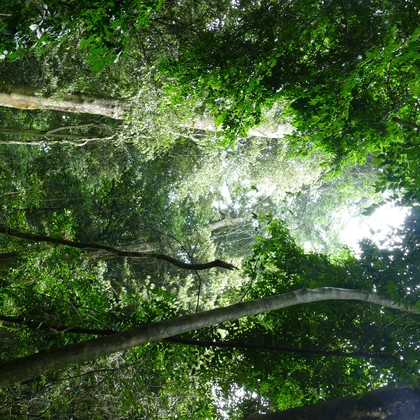
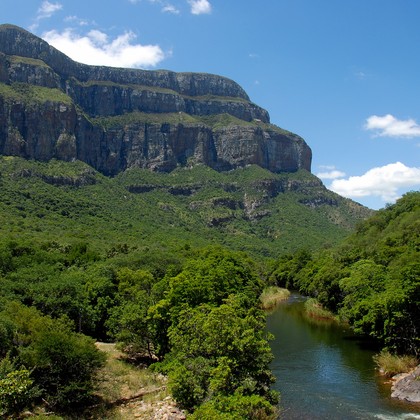
The canopy and edges of moist lowland forest, gallery forest along rivers and transitions to woodland; it comes lower at flowering trees along forest edges and in clearings. It feeds on nectar of mistletoe and tree blossom and on small insects.
Where the bird is most at home, classified by the vegetation units of southern Africa.
Range and movements
Within the region only in northern Angola (Cabinda and the northern provinces with gallery and rainforest) and in extreme north-western Zambia, in Mwinilunga District. Records are scarce. Beyond the region it occurs in the Central African rainforest belt from Cameroon and Gabon to eastern DR Congo and western Uganda, with scattered populations further west.
- Resident
- dark = core range, pale = thinly spread
How and when to look
In the gallery forests around Mwinilunga, such as along the headwaters of the Zambezi and the Mwinilunga rivers, look for flowering mistletoe in the canopy and scan small olive sunbirds patiently with binoculars. A recording of the call helps to separate it from Little Green Sunbird.
Conservation status
Not threatened. Widespread across its range but little noticed. In the region it is local and depends on the survival of gallery forest, which is under pressure from logging and farming.
Scientific name
Cinnyris batesi | Ogilvie-Grant, 1908
Ogilvie-Grant described the species in 1908 and placed it straight away in the genus where it still stands. The genus Cinnyris was introduced in 1816 by Cuvier, GLCFD. Cinnyris derives from the Greek kinnuris, the name of a small bird mentioned by the lexicographer Hesychius that cannot be identified further. batesi honours the American naturalist George Latimer Bates (1863–1940), who collected birds in Cameroon for many years. The specimen the first description was based on came from Dja River (Cameroon) and Camma River (Gabon).