All species › Birds of prey › Hawks, eagles and kites › Bat Hawk
Bat Hawk | Macheiramphus alcinus
Vleermuiswouw | Milano Murcielaguero
The Bat Hawk is a dark, falcon-like raptor that hunts almost exclusively during the brief twilight, taking bats emerging from their roosts as well as swallows and swifts. It seizes prey in full flight and swallows it whole in the air, usually within seconds.
Voice
Usually silent. Around the nest a high, whistling kwik-kwik-kwik-kwik, recalling a large falcon or a wader; in display also a soft, plaintive kee-hee.
Recording: Mike Nelson — CC BY-NC-SA 4.0 · converted to mono · xeno-canto
Identification
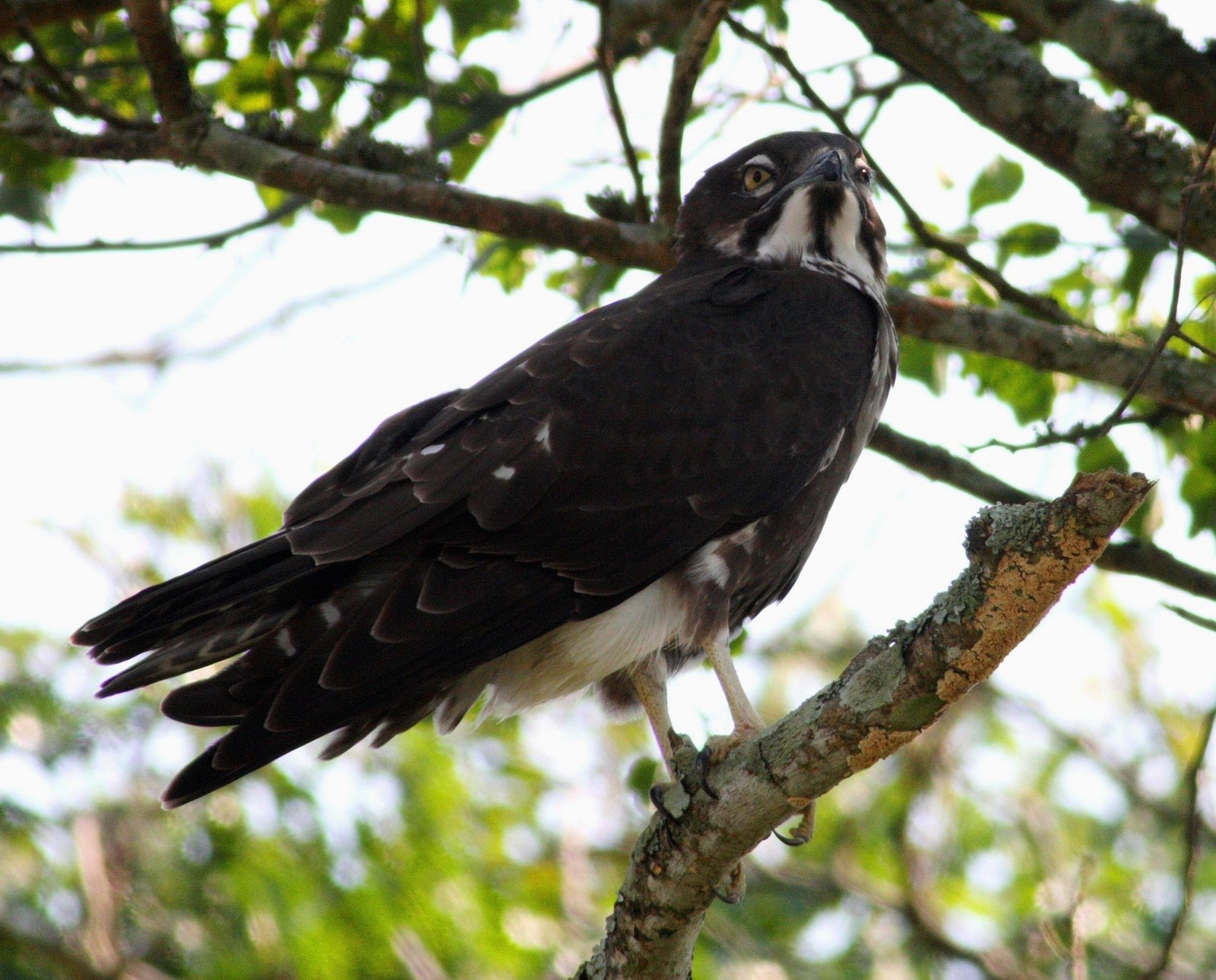
About 45 cm, wingspan 95–120 cm. Almost wholly dark chocolate to blackish-brown, with a white throat crossed by a dark central stripe; many birds show a white spot above and below the eye and a small, flat nape crest. The eyes are large and yellow, the bill small with a very wide gape. In flight it resembles a large falcon: long, pointed wings with a broad base, fast, supple wingbeats and a medium-length tail. At close range faint barring on the flight feathers and tail can be seen. Juveniles are paler below, with more white on the breast and belly.
Confusion species
Peregrine Falcon Falco peregrinus and Lanner Falcon Falco biarmicus also hunt at dusk, but are pale below and show a clear moustachial stripe. Sooty Falcon Falco concolor is smaller and uniform slate-grey, and African Hobby Falco cuvierii is rufous below. The dark morph of Wahlberg's Eagle Hieraaetus wahlbergi has broader, parallel-edged wings and flies by day.
Habitat
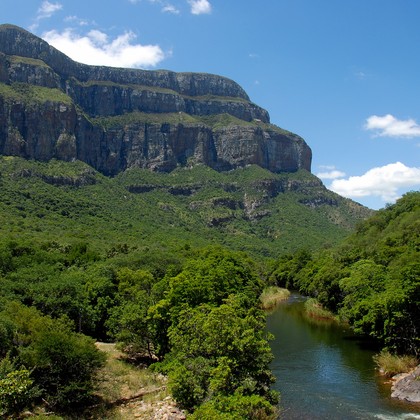
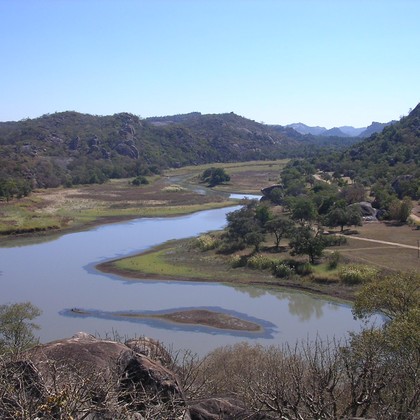
Wooded riverbanks, woodland with tall trees and forest edges, often near water, caves, bridges or buildings where bats roost. By day the bird rests hidden in the dense canopy of a tall tree, often a eucalyptus or an evergreen riverine tree, which also holds the nest.
Where the bird is most at home, classified by the vegetation units of southern Africa.

Range and movements
Widespread but scarce in the north and east of the region: Angola, Zambia, Malawi, Mozambique, Zimbabwe, northern Botswana (Okavango, Chobe), the Caprivi Strip and north-eastern Namibia, Eswatini and north-eastern South Africa, from Limpopo and the Mpumalanga lowveld to northern KwaZulu-Natal. Beyond the region it occurs in sub-Saharan Africa, on Madagascar and from South-East Asia to New Guinea.
- Resident
- Summer visitor (c. Oct–Mar)
- Winter visitor (c. Apr–Sep)
- Passage (Mar–Apr, Oct–Nov)
- dark = core range, pale = thinly spread
How and when to look
Find a known bat roost or a swallow roost and wait there for the last half hour before dark. Hunting bouts often last only twenty minutes. In the Kruger National Park, bridges with bat colonies, such as those over the Sabie, are well-known sites; city parks with tall eucalyptus are sometimes used too.
Conservation status
Not threatened, but scarce throughout the region and often overlooked. It can benefit from bat colonies in buildings and bridges and from planted eucalyptus; felling of tall riverine trees and disturbance of bat roosts are local threats.
Scientific name
Macheiramphus alcinus | Bonaparte, 1850
Bonaparte described the species in 1850 and placed it straight away in the genus where it still stands. He introduced the genus Macheiramphus in that same work. Macheiramphus comes from the Greek makhaira, 'knife', and rhamphos, 'bill' — for the small, sharp bill. alcinus means 'auk-like', from the genus Alca — a reference to the Bat Hawk's thin bill. The specimen the first description was based on came from Malacca, Malaysia.