All species › Turacos › Turacos › Bare-Faced Go-Away-Bird
Bare-Faced Go-Away-Bird | Crinifer personatus
Maskertoerako | Turaco Enmascarado
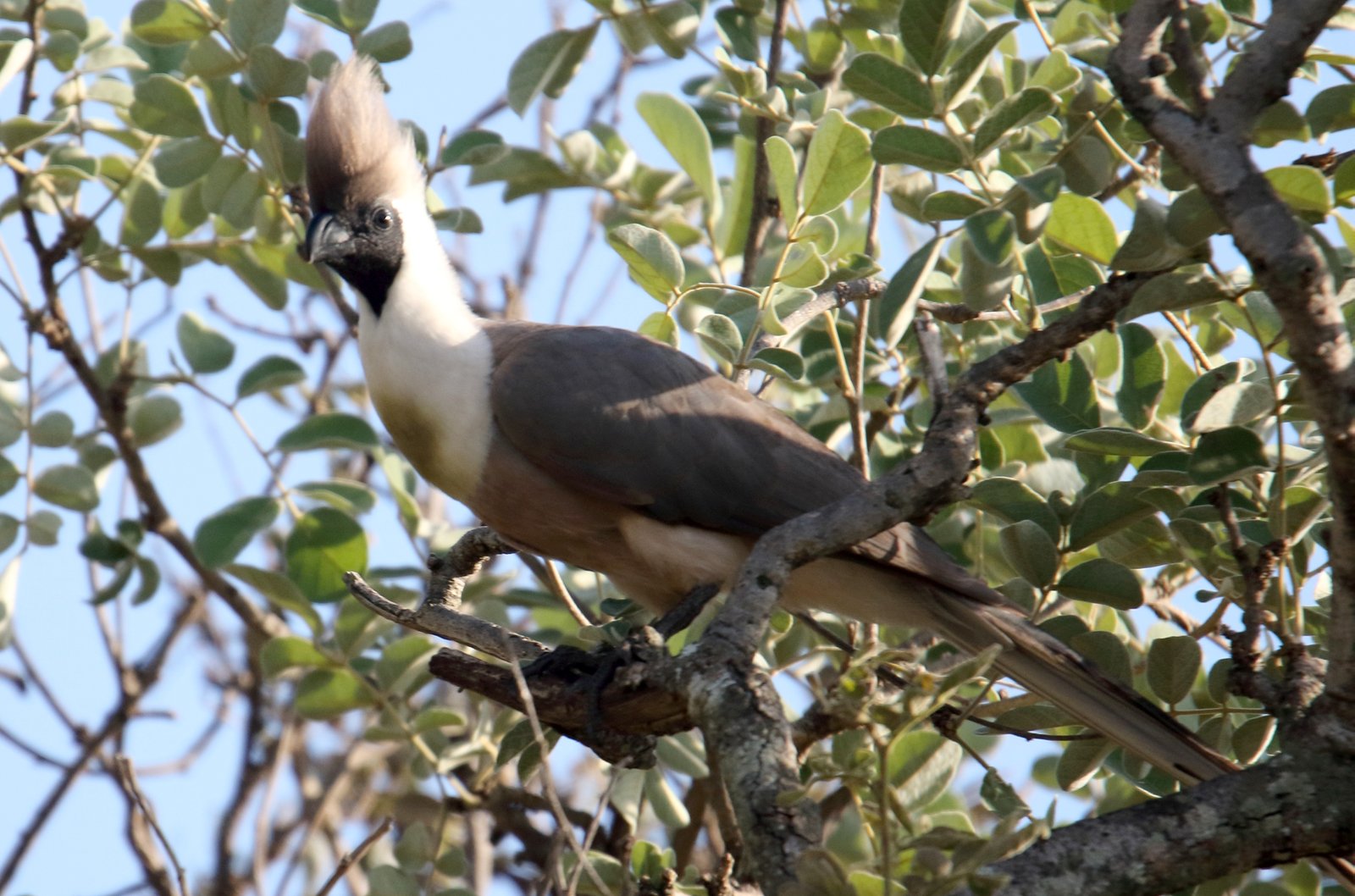
The Bare-Faced Go-Away-Bird is a grey-brown savanna turaco with a bare black face and a white neck, the eastern counterpart of Grey Go-Away-Bird. Within the region it occurs only on the far northern edge of Zambia.
Voice
A nasal, bleating gaa-waa or haa-haa-haa, higher and more laughing than the go-waaay of Grey Go-Away-Bird, often by a small group at once.
Recording: Bernard BOUSQUET — CC BY-NC-SA 4.0 · shortened to the first 60 s, mono · xeno-canto
Identification
About 48 to 50 cm, with a long tail. The face around eye and bill is bare and black, like a mask. The crest is long, shaggy and grey-brown. Neck and upper breast are white or creamy white, the rest of the body grey-brown, the belly slightly pinker brown. The southern subspecies leopoldi lacks the green breast patch of the Ethiopian nominate form. Bill and legs are black. No red in the wing. Sexes alike. It lives in pairs and small groups and likes to perch openly on treetops.
Confusion species
Grey Go-Away-Bird (Crinifer concolor) is uniformly grey, without a bare black face or white neck, and replaces Bare-faced further south in Zambia. Other turacos in the region are green, blue or violet with red primaries.
Habitat
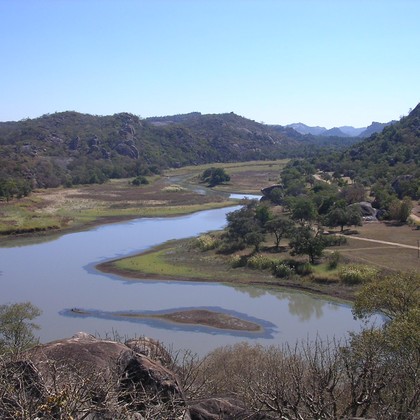
Open woodland, wooded savanna and thickets on hills, miombo edges and farmland with scattered trees, often near water. It eats fruit, leaves, buds and flowers.
Where the bird is most at home, classified by the vegetation units of southern Africa.

Range and movements
Within the region only in the far north of Zambia, around Lake Tanganyika and the Mweru Wantipa area near Mbala; rare and poorly known there. Beyond the region in eastern DR Congo, Rwanda, Burundi, Uganda, western Kenya and Tanzania; the nominate form lives in isolation in south-western Ethiopia.
- Resident
- Passage (Mar–Apr, Oct–Nov)
- dark = core range, pale = thinly spread
How and when to look
In the region a rarity that has to be looked for specifically in northern Zambia. Listen for the bleating laugh and scan treetops; the white front and black mask show from afar.
Conservation status
Not threatened and locally common in East Africa. At the southern edge of its range it is scarce, but there is no evidence of a clear decline.
Scientific name
Crinifer personatus | (Rüppell, 1842) (GBIF: Corythaixoides personatus)
Rüppell described the species in 1842 as Chizaerhis personata; because it was later moved to another genus, the author and year stand in brackets. The genus Crinifer was introduced in 1821 by Jarocki. Crinifer comes from the Latin crinis, 'hair', and -fer, 'bearing' — 'hair-bearer', for the shaggy crest. personatus is Latin for 'masked', from persona 'actor's mask', for the dark mask around the eye. The specimen the first description was based on came from southern Ethiopia.