All species › Passerines › Swallows and martins › Banded Martin
Banded Martin | Neophedina cincta
Witbrauwzwaluw | Avión Cinchado
The Banded Martin is the largest martin in the region: a brown swallow with white underparts, a brown breast band and a small white eyebrow. Its slow, rather floppy flight over grassland and its white underwing are distinctive.

Voice
A dry, twittering chip-chip-cherr, mainly in flight and at the nest; the song is a series of rattling and twittering notes.
Recording: Raphaël Nussbaumer — CC BY-NC-SA 4.0 · converted to mono · xeno-canto
Identification
16–17 cm, with a square or slightly notched tail. Upperparts uniform dark grey-brown. A short white line above the lores in front of the eye forms the eyebrow. Underparts white with a broad brown breast band, sometimes with a narrow brown line running down the centre from the band. The underwing coverts are white and contrast sharply with the dark flight feathers, a good feature in flight. The sexes are alike; juveniles have pale fringes to the feathers of the upperparts and a more diffuse breast band. Flight is slow and fluttering, with short glides, often low over the grass.
Confusion species
The Sand Martin Riparia riparia is much smaller, without a white eyebrow, with a dark underwing and a notched tail; it is a Palearctic summer visitor that hunts mainly over water. The Brown-Throated Martin Riparia paludicola is smaller and has a brown throat and breast without a separate breast band. The Large Rock Martin Ptyonoprogne fuligula lacks a breast band and shows white spots in the spread tail. The Mascarene Martin Phedina borbonica is heavily streaked below.
Habitat
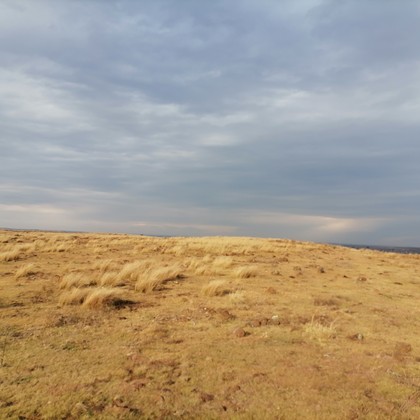
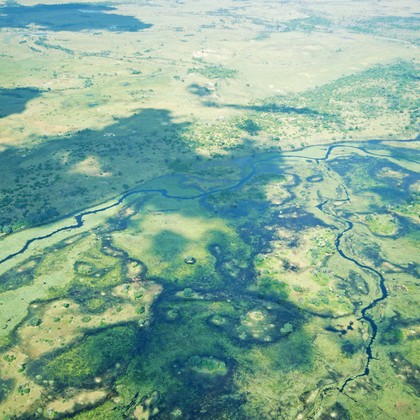
Open grassland, pastures and fallow land, often near water, from lowlands to above 2000 m. It nests singly or in small groups in a self-excavated tunnel in an earth bank, riverbank, erosion gully or road cutting.
Where the bird is most at home, classified by the vegetation units of southern Africa.
Range and movements
In South Africa a breeding summer visitor to the Highveld (Gauteng, Free State, Mpumalanga and North West), KwaZulu-Natal and the Eastern Cape, and also in Lesotho and Eswatini; absent from the arid west. Further in Zimbabwe, Mozambique, Malawi, Zambia, Angola, northern Botswana and north-eastern Namibia, where populations are partly resident and southern birds pass through to Central Africa in winter. Beyond the region to East Africa and Ethiopia, and scattered in West Africa.
- Resident
- Summer visitor (c. Oct–Mar)
- Winter visitor (c. Apr–Sep)
- Passage (Mar–Apr, Oct–Nov)
- dark = core range, pale = thinly spread
How and when to look
From September to April in high-altitude grassland, for example around Wakkerstroom, Dullstroom and in Golden Gate Highlands National Park. Look for a large brown martin fluttering slowly over the grass and showing its white underwing as it turns; it readily rests on wires and fences.
Conservation status
Not threatened and fairly common. Conversion of grassland to crops and timber plantations reduces habitat locally, but road cuttings and erosion gullies provide extra nest sites.
Scientific name
Neophedina cincta | (Boddaert, 1783) (GBIF: Riparia cincta)
Boddaert described the species in 1783 as Hirundo Cincta; because it was later moved to another genus, the author and year stand in brackets. The genus Neophedina was introduced in 1922 by Roberts. Neophedina comes from the Greek neos, 'new', and the genus name Phedina — a 'new Phedina'. cincta comes from the Latin cinctus, 'girdled, banded' — for the dark breast band. The specimen the first description was based on came from Cape of Good Hope.