All species › Tubenoses › Northern storm petrels › Band-Rumped Storm Petrel
Band-Rumped Storm Petrel | Hydrobates castro
Madeirastormvogeltje | Paíño de Madeira
The Band-Rumped Storm Petrel is a dark storm petrel of tropical and subtropical oceans, seen in the region only rarely and usually far offshore. It probably comprises several cryptic species that breed on the same islands in different seasons; which populations reach southern Africa is unknown.

Voice
Silent at sea. In the breeding colony a squeaky, chattering kair-wi-kir-kir-kir-a in flight and a soft purring churr from the burrows.
Recording: Ben Porter — CC BY-NC-SA 4.0 · converted to mono · xeno-canto
Identification
About 20 cm, blackish-brown with a faint grey-brown bar across the upperwing coverts that is less conspicuous than on Leach's Storm Petrel. The white rump is narrow but clean and forms a straight band that wraps slightly onto the sides of the undertail. The wings are fairly long and slightly angled, the tail is square or only slightly notched, and the feet do not reach beyond the tail. The sexes are alike. The flight is fairly flat and regular, with shallow wingbeats alternating with long glides on slightly bowed wings, like that of a small shearwater.
Confusion species
Leach's Storm Petrel (Hydrobates leucorhous) has a more clearly forked tail, an often divided, V-shaped rump with dark undertail sides, a paler wing bar and a more erratic, bounding flight. Wilson's Storm Petrel (Oceanites oceanicus) is smaller, with rounder wings, a broader white rump wrapping further around, a paler wing bar and feet projecting beyond the tail. With such rarities, photographs of the upper- and underside and of the wing shape are essential.
Habitat
Warm, deep ocean waters far beyond the continental shelf. Feeds singly on zooplankton, small squid and fish larvae at the surface and rarely follows ships. Breeds in burrows and rock crevices on remote oceanic islands.
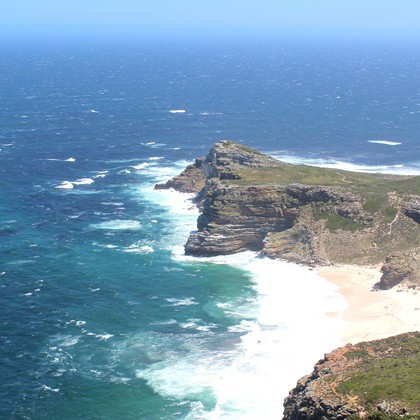
Where the bird is most at home, classified by the vegetation units of southern Africa.
Range and movements
A rare visitor to the waters of the region, with records off Angola, Namibia, the Western Cape, KwaZulu-Natal and Mozambique, almost always far offshore. Breeds on islands in the tropical and subtropical Atlantic, including the Azores, Madeira, the Canary Islands, Cape Verde, the islands of the Gulf of Guinea, Ascension and St Helena, and on a few islands in the Pacific.
How and when to look
Only to be expected on trips well beyond the shelf edge, and rare even there. A dark, white-rumped storm petrel that flies flat with much gliding and ignores the boat deserves a closer look. Try to obtain photographs and report the sighting to the national rarities committee.
Conservation status
Not threatened globally, but the individual island populations are often small and vulnerable to introduced rats, cats and mice and to lights that disorient fledglings. If the cryptic populations are recognised as separate species, some of them will probably be given threatened status.
Scientific name
Hydrobates castro | (Harcourt, 1851) (GBIF: Oceanodroma castro)
Harcourt described the species in 1851 as Thalassidroma castro; because it was later moved to another genus, the author and year stand in brackets. The genus Hydrobates was introduced in 1822 by Boie. Hydrobates is Greek, from hudro- 'water' and batēs 'walker': 'water walker'. castro is not Latin but the bird's local name: the original description records the petrel as the roque de castro of the Madeirans, and that word was taken over as the epithet. The specimen the first description was based on came from the Desertas Islands, Madeira.