All species › Waders, gulls and terns › Sandpipers and snipes › Baird's Sandpiper
Baird's Sandpiper | Calidris bairdii
Bairds strandloper | Correlimos de Baird
Baird's Sandpiper is an American tundra breeder that normally migrates to southern South America and has been recorded in southern Africa only a handful of times. It is a slender, long-bodied sandpiper recognised by its exceptionally long wings.

Voice
A low, rolling kreep or preet, somewhat harsh, mostly on take-off.
Recording: Alvaro Rivera Rojas — CC BY-NC-SA 4.0 · converted to mono · xeno-canto
Identification
14–17 cm. A small sandpiper with a long, horizontal silhouette: the primaries project well beyond the tail tip on the standing bird, giving it an elongated, flattened rear end. The bill is short, straight and black, with a fine tip; the legs are black. The colour is warm buffy brown: a pale buff breast with fine streaks, sharply demarcated from the white belly. Juveniles, the most likely age in the region, look scaly because the brown mantle feathers and coverts have broad pale fringes. In flight a weak wingbar and a dark central stripe across the rump, without a white rump.
Confusion species
Little Stint Calidris minuta is smaller and more compact, with shorter wings that barely pass the tail and a whiter face. White-Rumped Sandpiper Calidris fuscicollis has equally long wings but is greyer, with streaked flanks and a white rump. Curlew Sandpiper Calidris ferruginea is larger, with a long decurved bill and a white rump. Pectoral Sandpiper Calidris melanotos is larger, with yellowish legs and more sharply cut-off breast streaking.
Habitat
The drier margins of fresh water and pans: muddy and grassy shores, dried-out mud and short vegetation just above the waterline. It feeds with rapid pecking, more often on dry ground than most other sandpipers.
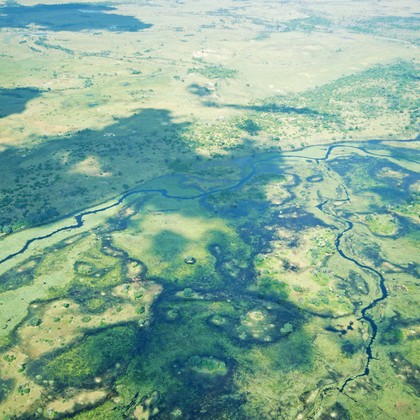
Where the bird is most at home, classified by the vegetation units of southern Africa.

Range and movements
A handful of records in the region, mainly in South Africa and Namibia, usually of single juveniles at dams, pans and sewage works. It winters in western and southern South America, south to Tierra del Fuego, and breeds on the high Arctic tundra of north-eastern Siberia, Alaska, northern Canada and north-western Greenland.
How and when to look
Check flocks of Little Stints at the dry edges of pans and sewage works for a slightly larger, pale buffy bird with strikingly long wings and a horizontal stance. Take photographs and note the wing projection; a sighting must be submitted to the rarities committee.
Conservation status
Not threatened, with a large and stable world population in remote breeding areas. In southern Africa an extremely rare vagrant with no significance for the population.
Scientific name
Calidris bairdii | (Coues, 1861)
Coues described the species in 1861 as Actodromas (Actodromas) Bairdii; because it was later moved to another genus, the author and year stand in brackets. The genus Calidris was introduced in 1804 by Merrem. Calidris goes back to Ancient Greek kalidris or skalidris, a name Aristotle used for an unidentified grey waterside bird. bairdii honours the American naturalist Spencer Fullerton Baird (1823–1887), assistant secretary of the Smithsonian Institution. The specimen the first description was based on came from Fort Resolution, Great Slave Lake.