All species › Passerines › Weavers › Baglafecht Weaver
Baglafecht Weaver | Ploceus baglafecht
Baglafechtwever | Tejedor Baglafecht
The Baglafecht Weaver is a weaver of the East African highlands that in the region occurs only on and around the Nyika Plateau. The male has a black mask, a yellow forehead and a yellow throat, and a pale eye.

Voice
A short, dry, scratchy song with sizzling and rattling elements, chip-chip-churrrr-cheep, and a sharp chik contact call. Pairs often keep up constant contact.
Recording: Guilherme Melo — CC BY-NC-SA 4.0 · converted to mono · xeno-canto
Identification
14–15 cm, with a strong black bill and a pale yellow eye. The male has a black mask from the bill through the eye onto the ear-coverts, a bright yellow forehead and forecrown and a yellow throat; the upperparts are yellowish green with dark streaking, the underparts yellow, paler on the lower belly. The female has a greener crown, a weaker or absent mask with dusky lores, and otherwise the same pattern. Birds on Nyika wear much the same plumage all year. Juveniles are duller, with a darker eye.
Confusion species
Bertram's Weaver (Ploceus bertrandi) has a black chin and throat below the mask and a black spot on the hindcrown in the male; the female has an all-black head. Spectacled Weaver (Ploceus ocularis) has only a narrow black eyestripe, a finer bill and an orange-yellow head. Males of Village Weaver (Ploceus cucullatus) have a red eye and a black-blotched back. The yellow throat below the black mask and the pale eye settle it.
Habitat
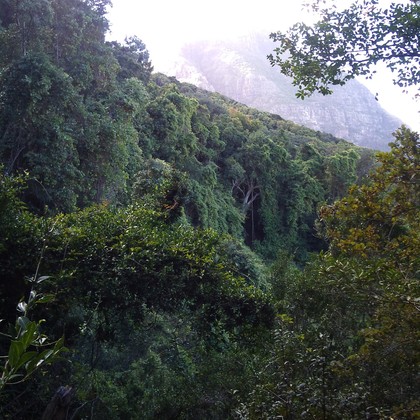
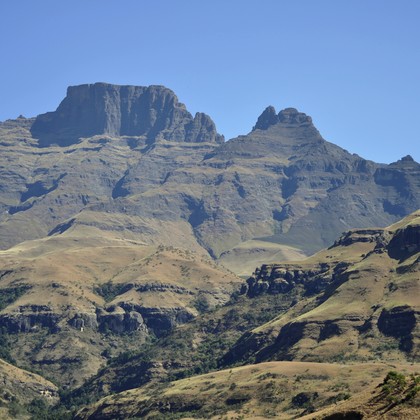
Afromontane forest edges, bracken and bramble scrub, wooded ravines and copses in montane grassland, also around buildings and gardens on the plateau, above about 1,800 metres. It lives in pairs and nests solitarily, with a loosely woven nest in the foliage of a bush or tree. It eats insects, seeds and fruit.
Where the bird is most at home, classified by the vegetation units of southern Africa.
Range and movements
Within the region only on the Nyika Plateau and adjacent highlands in northern Malawi and eastern Zambia (subspecies nyikae). A single report from Namibia is almost certainly an error. Beyond the region in the highlands of East Africa, from Tanzania and Kenya to Ethiopia and Eritrea, and west to Uganda, eastern DR Congo, Cameroon and Nigeria.
- Resident
- Summer visitor (c. Oct–Mar)
- Passage (Mar–Apr, Oct–Nov)
- dark = core range, pale = thinly spread
How and when to look
On the Nyika Plateau around Chelinda and along the forest edges and copses in the grassland. The birds are fairly tame and give good views; with every masked bird check the throat: yellow in Baglafecht Weaver, black in Bertram's Weaver, which occurs lower on the slopes.
Conservation status
Not threatened; widespread and locally common in the East African highlands. In the region the population is small and restricted to the Nyika Plateau, which is largely protected as a national park.
Scientific name
Ploceus baglafecht | (Daudin, 1802)
Daudin described the species in 1802 as Loxia baglafecht; because it was later moved to another genus, the author and year stand in brackets. The genus Ploceus was introduced in 1816 by Cuvier, GLCFD. Ploceus comes from the Greek plokeus, 'plaiter, weaver', for the tightly woven, ball-shaped nest that gives weavers their name. baglafecht is Buffon's name 'le Baglafecht d'Abyssinie', probably a corrupted local Ethiopian name; its exact origin and meaning are unknown. The specimen the first description was based on came from Ethiopia (not specified).