All species › Tubenoses › Petrels and shearwaters › Atlantic Petrel
Atlantic Petrel | Pterodroma incerta
Schlegels stormvogel | Petrel de Schlegel
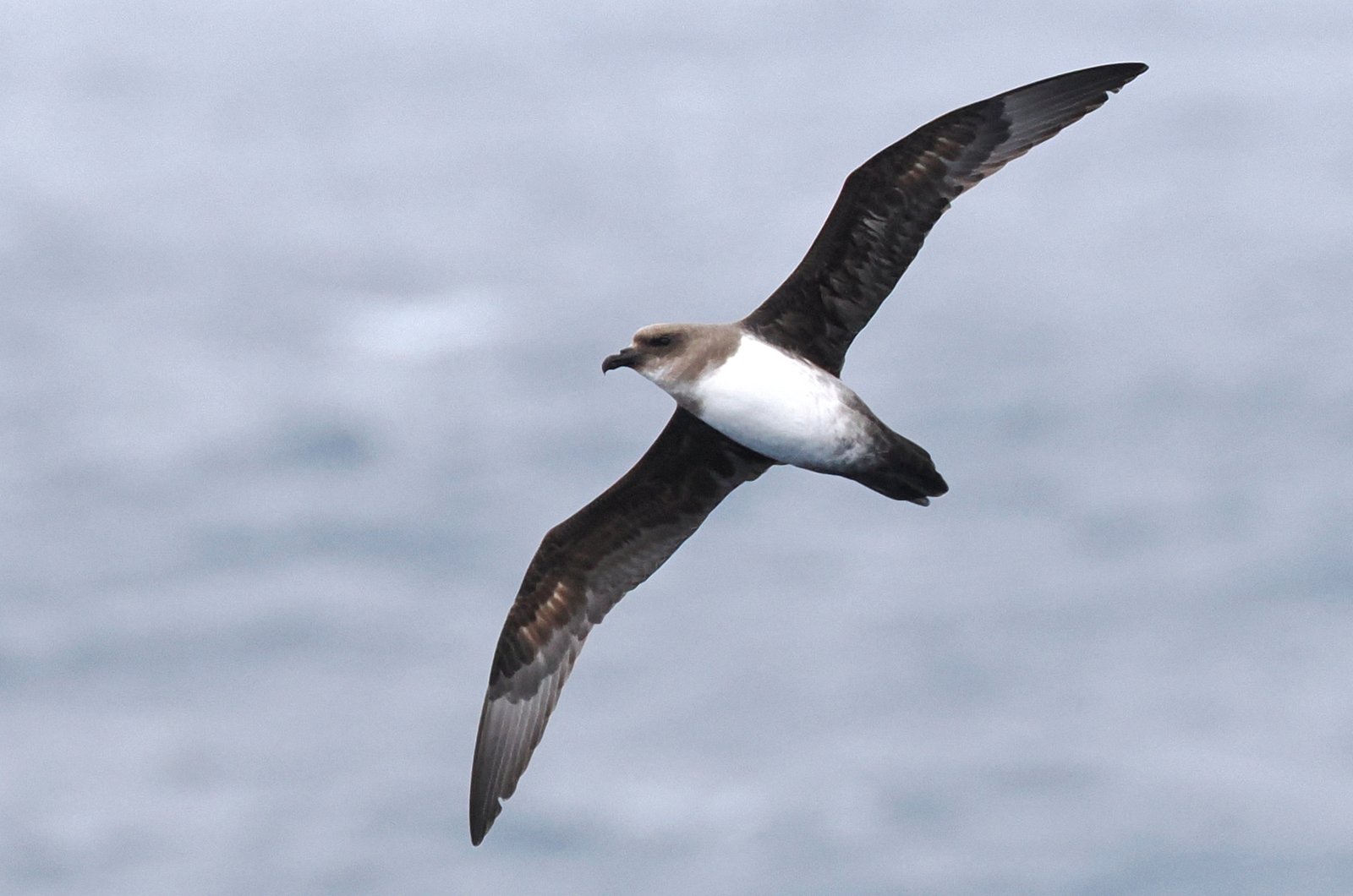
The Atlantic Petrel is a large, dark brown Pterodroma with a white belly that breeds only on Gough and Tristan da Cunha in the South Atlantic. For birders in southern Africa it is a rare but sought-after species of the deep water south-west of the Cape.
Voice
Silent at sea. At the colonies at night a drawn-out, whistling and wailing seee-oo and cackling calls from the burrows.
Recording: Chris Taylor — CC BY-NC-SA 4.0 · shortened to the first 60 s, mono · xeno-canto
Identification
About 44 cm, bulky and long-winged, with a thick head and a heavy black bill. Head, neck, breast and all upperparts are uniform dark chocolate-brown; the belly and undertail coverts are bright white and sharply demarcated from the brown breast. With wear the throat sometimes becomes paler and mottled. The underwing is wholly dark brown, the tail long and wedge-shaped. The legs are flesh-coloured with dark toes. The sexes and ages are alike. It flies powerfully in high, swinging arcs, with deep wingbeats between long glides.
Confusion species
Soft-Plumaged Petrel (Pterodroma mollis) is smaller and greyer, with a white throat and a grey rather than wholly brown breast. Great Shearwater (Ardenna gravis) has a black cap with a white collar and a white underwing. Great-Winged Petrel (Pterodroma macroptera) is all dark, without a white belly; the dark-bellied morph of Trindade Petrel (Pterodroma arminjoniana) is a far vagrant with pale primary bases on the underwing.
Habitat
Deep open ocean in the subtropical and subantarctic South Atlantic, especially along fronts where cold and warm water meet. It feeds mainly on squid, as well as fish and crustaceans, often at night. It breeds in the austral winter in burrows on wooded and vegetated slopes of Gough and Tristan.
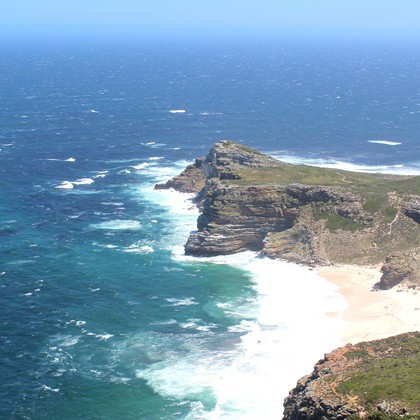
Where the bird is most at home, classified by the vegetation units of southern Africa.
Range and movements
In the region a rare visitor far offshore, with most records south-west of the Cape of Good Hope; there are also a few records off central Namibia and off the south coast of South Africa. Most birds are seen from July to November. Beyond the region it breeds almost exclusively on Gough, with small numbers on Tristan da Cunha, and forages across the South Atlantic from South America to off southern Africa.
- Passage (Mar–Apr, Oct–Nov)
- dark = core range, pale = thinly spread
How and when to look
The chance is greatest on long pelagic trips beyond the shelf edge out of Cape Town, in late winter and spring. It rarely comes to trawlers; look for a large dark petrel with a white belly towering high in the distance. A photograph of the head and breast helps separate it from Soft-Plumaged Petrel.
Conservation status
Endangered. Almost the entire world population breeds on Gough, where introduced house mice eat chicks alive and breeding success is very low. An attempt to eradicate the mice has been carried out; recovery of the colonies depends on its success. Bycatch in longline fisheries is an additional threat.
Scientific name
Pterodroma incerta | (Schlegel, 1863)
Schlegel described the species in 1863 as Procellaria incerta; because it was later moved to another genus, the author and year stand in brackets. The genus Pterodroma was introduced in 1856 by Bonaparte. Pterodroma is Greek, from pteron 'wing' and dromos 'runner', after the fast, sweeping flight. incerta is Latin for 'uncertain, doubtful'. Schlegel could not assign the bird to any described species, so he gave it a new name to avoid errors. The specimen the first description was based on came from southern oceans (not specified).