All species › Passerines › Sunbirds › Amethyst Sunbird
Amethyst Sunbird | Chalcomitra amethystina
Amethisthoningzuiger | Suimanga Amatista
The Amethyst Sunbird is the large, velvet-black sunbird of woodland, forest edges and gardens in the east and north of the region. Only in good light does one see the male's glossy green crown and amethyst throat.

Click a thumbnail to switch the photo above.
Voice
A sharp, repeated tcheek or tchip contact and alarm call. The song is a long, fast and rather rambling twitter, interspersed with imitations of other birds, often delivered from a tall tree.
Recording: Dries Van de Loock — CC BY-NC-SA 4.0 · converted to mono · xeno-canto
Identification
A large, robust sunbird of 14 to 15 cm with a long, decurved bill and a fairly short tail. The male is velvet-black with a metallic green forecrown and a purple-violet to amethyst throat and shoulder patch; in poor light it looks wholly black. The female is olive-brown above, with a pale supercilium and a pale moustachial stripe framing a dark throat, and yellowish below with dark mottling and streaking. Immature males resemble the female with a black throat and scattered black feathers.
Confusion species
The male Scarlet-Chested Sunbird (Chalcomitra senegalensis) has a green throat and a bright scarlet breast; the female has a darker, more heavily mottled breast. In Angola, the male Carmelite Sunbird (Chalcomitra fuliginosa) has a brown ground colour and a violet crown, and the male Green-Throated Sunbird (Chalcomitra rubescens) a green throat. Dusky Sunbird (Cinnyris fuscus) of the arid west is smaller, the male with a white belly.
Habitat
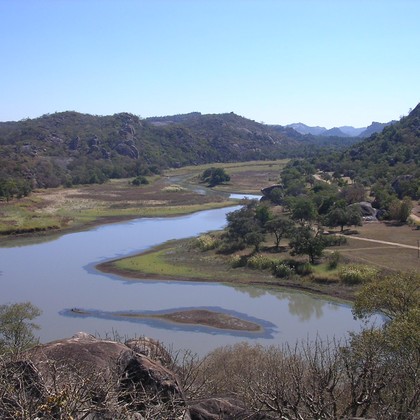
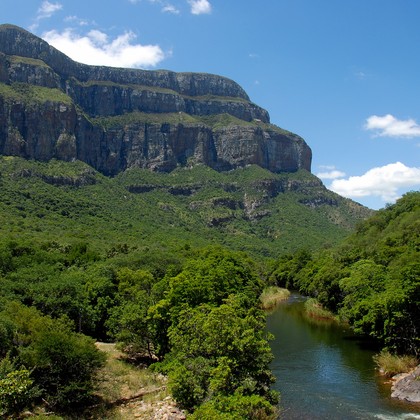
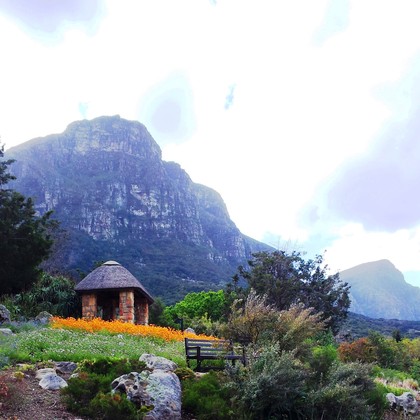
Moist and dry woodland, indigenous forest edges, riverine forest, coastal forest, plantations, parks and gardens; absent from open grassland and dry karoo. It visits coral trees, aloes, Schotia and garden plants, and also catches insects. It follows the flowering and partly moves to lower, warmer ground in winter.
Where the bird is most at home, classified by the vegetation units of southern Africa.
Range and movements
Widespread in eastern and southern South Africa, from the Western Cape east along the coast to KwaZulu-Natal, Mpumalanga, Limpopo and Gauteng, and in Eswatini, Lesotho (locally), Zimbabwe, Mozambique, Malawi, Zambia and Angola, northern and eastern Botswana and north-eastern Namibia. Beyond the region north to DR Congo, Gabon, Kenya and Ethiopia.
- Resident
- Summer visitor (c. Oct–Mar)
- Winter visitor (c. Apr–Sep)
- Passage (Mar–Apr, Oct–Nov)
- dark = core range, pale = thinly spread
How and when to look
In gardens and parks in Pretoria, Johannesburg and Durban it is often at flowering coral trees and aloes, especially from May to September. The male first registers as an all-black sunbird; get the binoculars on it as soon as it sits in the sun to see the green crown and purple throat.
Conservation status
Not threatened. The species is common and benefits greatly from gardens and plantings of exotic and indigenous flowering trees, so that it is numerous in towns as well.
Scientific name
Chalcomitra amethystina | (Shaw, 1812)
Shaw described the species in 1812 as Certhia amethystina; because it was later moved to another genus, the author and year stand in brackets. The genus Chalcomitra was introduced in 1854 by Reichenbach. Chalcomitra comes from the Greek khalkos, 'bronze, copper', and mitra, 'headband, diadem' — for the metallic sheen on the males' head and throat. amethystina is Latin for 'amethyst-coloured', for the purple gloss on the male's throat and shoulders. The specimen the first description was based on came from Cape of Good Hope.