All species › Waders, gulls and terns › Plovers and lapwings › American Golden Plover
American Golden Plover | Pluvialis dominica
Amerikaanse goudplevier | Chorlito Dorado Americano
The American Golden Plover breeds on the North American tundra and winters on the pampas of South America; in southern Africa it is an exceptional vagrant. Every golden plover in the region should therefore be checked carefully against Pacific Golden Plover.

Voice
A disyllabic, sharp kwee-dl or klee-ee, stressed on the first syllable; less soft and melodious than the call of Pacific Golden Plover.
Recording: Doug Hynes — CC BY-SA 4.0 · converted to mono · xeno-canto
Identification
24–28 cm. Slender and long-winged. In non-breeding plumage grey-brown, less golden than Pacific Golden Plover, with fine pale and golden spotting on the upperparts, a greyish, faintly streaked breast, a prominent white supercilium and a dark crown. The primaries project far beyond the tertials, with four or five visible tips, and well beyond the tail tip. In flight a narrow wing bar and a plain grey underwing. In breeding plumage black from face to undertail coverts, with a broad white band from the forehead down the side of the neck that ends at the breast side.
Confusion species
Pacific Golden Plover Pluvialis fulva is smaller and more compact, tinged warmer golden-yellow, with longer legs, long tertials and a shorter primary projection of two or three tips that barely reaches past the tail. Grey Plover Pluvialis squatarola is larger and more heavily built, greyer, and has black axillaries and a white rump.
Habitat
Short grassland, sports fields and airfields, cultivated land and drying shores of lakes and pans; less tied to the coast than Pacific Golden Plover. It runs and pecks like other plovers and sometimes joins lapwings or other waders.
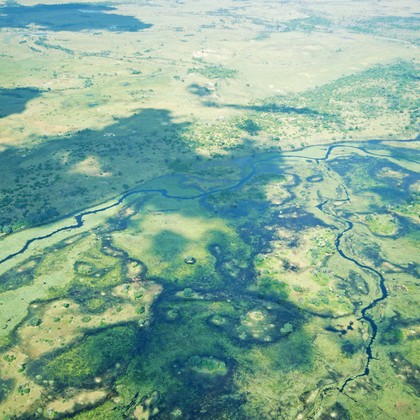
Where the bird is most at home, classified by the vegetation units of southern Africa.

Range and movements
Only a few records in the region, mainly from South Africa; almost unknown elsewhere, although the species could turn up wherever waders gather. It breeds in Alaska and northern Canada and winters in southern South America; vagrants regularly reach western Europe and rarely Africa.
How and when to look
A record in the region is a rarity, so note the primary projection, tertial length and leg length, and photograph the bird at rest and in flight. Listen to the call of every golden plover too. A golden plover on a grass field or airfield inland is more likely American than Pacific.
Conservation status
Not threatened, although the world population never fully recovered from the mass hunting of the nineteenth century and numbers are falling again through loss of grassland along the migration route. As a vagrant it has no significance for southern Africa.
Scientific name
Pluvialis dominica | (Müller, 1776)
Müller described the species in 1776 as Charadrius Dominicius; because it was later moved to another genus, the author and year stand in brackets. The genus Pluvialis was introduced in 1760 by Brisson. Pluvialis is Latin for 'relating to rain', from pluvia 'rain', from the old belief that these plovers flocked when rain was imminent. dominica refers to Santo Domingo, the island now called Hispaniola, in the West Indies. The specimen the first description was based on came from Hispaniola.