All species › Passerines › Thrushes › African Thrush
African Thrush | Turdus pelios
Afrikaanse lijster | Zorzal Africano
The African Thrush is the everyday, dull Turdus thrush of West and Central Africa, which only reaches the northern edge of the region. It lives in forest edges, gallery forest and village gardens, where it is often the first songster of the morning.
Voice
The song is a varied series of clear, whistled phrases, each repeated two to four times and interspersed with scratchy notes, like a Song Thrush but less full; often before sunrise. The call is a sharp chuk, and when agitated a rattling chak-chak-chak; in flight a thin tseep.
Recording: Kiros Welegrima — CC BY-NC-SA 4.0 · converted to mono · xeno-canto
Identification
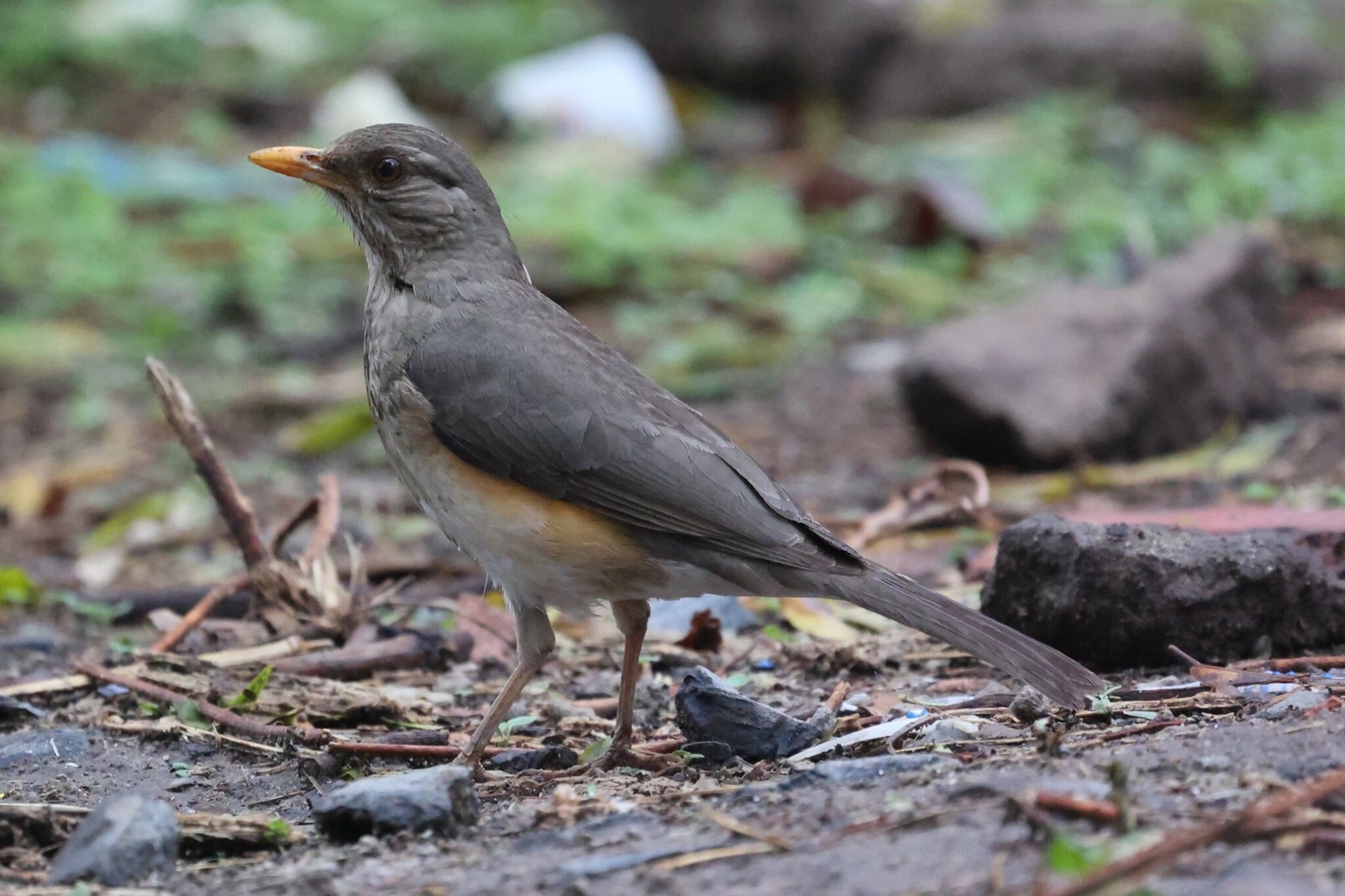
22–23 cm. A rather plain thrush: upperparts grey-brown to olive-brown, breast paler grey-brown, belly off-white with a limited, pale orange-brown wash on the flanks. The throat is pale with faint dark streaks. The bill is yellow to orange-yellow and the legs pale brown; a narrow yellowish eye-ring. The sexes are alike. Juveniles have pale spots on the back and dark spots on the breast. Behaviour is that of a typical blackbird-type thrush: hopping across lawns with pauses and a cocked head.
Confusion species
Kurrichane Thrush (Turdus libonyana) is warmer, with bright orange flanks, a white belly and black malar stripes, and has a brighter orange bill; it lives mainly in open woodland. Olive Thrush (Turdus olivaceus) and Abyssinian Thrush (Turdus abyssinicus) are darker, with much more orange on belly and flanks and an orange bill; in the region they occur only in montane forest, not in the lowlands of northern Zambia and Angola.
Habitat
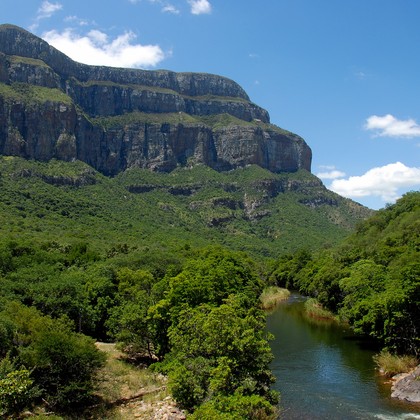
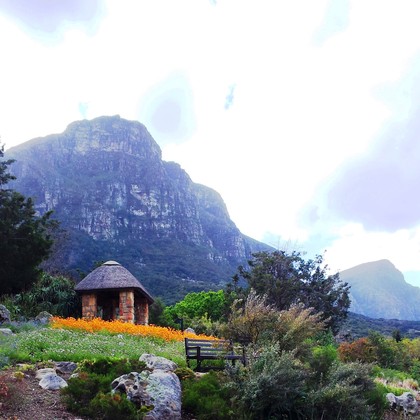
Forest edges, riverine gallery forest, open woodland with a dense shrub layer, overgrown plantations, village gardens, parks and yards. In the region mainly at the transition from miombo to evergreen gallery forest. Forages on the ground for worms, insects and snails and also eats fruit.
Where the bird is most at home, classified by the vegetation units of southern Africa.

Range and movements
In the region only in the north: northern and central Angola (including Cabinda) and northern and north-western Zambia (including Mwinilunga, Solwezi, the Copperbelt fringe and the Lake Mweru and Lake Tanganyika area). Resident. Beyond, widespread in West and Central Africa from Senegal to Ethiopia, Uganda, western Kenya and southern DR Congo.
- Resident
- dark = core range, pale = thinly spread
How and when to look
In northern Zambia and northern Angola it is often found in villages and around lodges near gallery forest, for example at Ikelenge and Mwinilunga. Learn the song: the repetition of each phrase makes it recognisable even in dense forest. In the south of its Zambian range it overlaps with Kurrichane Thrush; then check the malar stripes and flank colour.
Conservation status
Not threatened. Common and well adapted to human-modified landscapes; the population is stable.
Scientific name
Turdus pelios | Bonaparte, 1850
Bonaparte described the species in 1850 and placed it straight away in the genus where it still stands. The genus Turdus was introduced in 1758 by Linnaeus. Turdus is the ordinary Latin word for 'thrush'. pelios is Greek for 'dusky, livid' — for the dull grey-brown plumage. The specimen the first description was based on came from Fazughli, Sudan.