All species › Pelicans, herons and ibises › Ibises and spoonbills › African Spoonbill
African Spoonbill | Platalea alba
Afrikaanse lepelaar | Espátula Africana
The African Spoonbill is a large, all-white wading bird with a long, flat bill that widens at the tip into a spoon. With sideways sweeping movements it sieves shallow water for prey; its red face and red legs set it apart from every other white wading bird in the region.

Voice
Usually silent. At the colony a low grunting aark-aark and bill-clattering when greeting the mate.
Recording: Tony Archer — CC BY-NC-SA 4.0 · converted to mono · xeno-canto
Identification
About 90 cm, entirely white, without a crest. The face is unfeathered and red; the bill is grey with a red edge and a grey to pinkish spoon. The legs are long and bright red. The sexes are alike, the male slightly larger and longer-billed. Juveniles have a feathered face, a yellow to horn-coloured bill, dark legs and black wingtips, which show well in flight. It flies with neck and legs outstretched on steady wingbeats, often in lines.
Confusion species
The Great Egret Ardea alba is as large and white, but has a dagger-shaped yellow bill and flies with the neck retracted. The African Sacred Ibis Threskiornis aethiopicus has a black head and neck and black wing edges. The Yellow-Billed Stork Mycteria ibis has black flight feathers and a yellow, slightly decurved bill. At close range the spoon-shaped bill is unmistakable.
Habitat
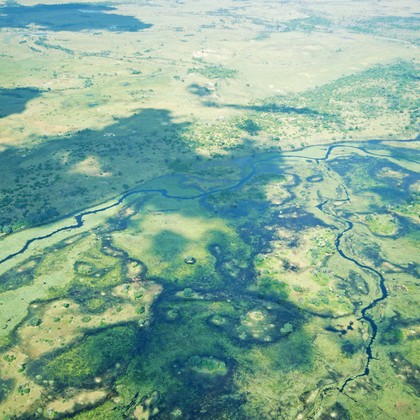
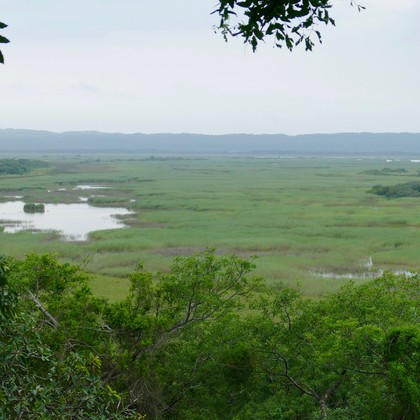
Shallow fresh and brackish water: lakes, dams, pans, floodplains, riverbanks, sewage works, lagoons and estuaries. It forages by wading with the bill half-open, sweeping it through the water to catch small fish, frogs, crustaceans and aquatic insects. Breeds in colonies in trees, reedbeds or on islets, often with herons and ibises.
Where the bird is most at home, classified by the vegetation units of southern Africa.
Range and movements
Across almost the whole region wherever there is shallow water: common in the Okavango Delta, the Makgadikgadi Pans after rain, the floodplains of Zambia and the wetlands of South Africa, and also in Zimbabwe, Mozambique, Malawi, Angola, Eswatini and Lesotho. In Namibia mainly in the north and on the coast at Walvis Bay and Sandwich Harbour. Beyond the region in sub-Saharan Africa and Madagascar.
- Resident
- Summer visitor (c. Oct–Mar)
- Winter visitor (c. Apr–Sep)
- Passage (Mar–Apr, Oct–Nov)
- dark = core range, pale = thinly spread
How and when to look
Best watched while foraging in shallow water, when the bill swings rhythmically from side to side. Sewage works and shallow dams are reliable sites. In flight the outstretched neck and the white wings without black edges (in adults) point to this species.
Conservation status
Not threatened and widespread. It has increased locally with the construction of dams and treatment ponds, but is sensitive to disturbance at breeding colonies and to the loss and pollution of wetlands.
Scientific name
Platalea alba | Scopoli, 1786
Scopoli described the species in 1786 and placed it straight away in the genus where it still stands. The genus Platalea was introduced in 1758 by Linnaeus. Platalea is the Latin word for the spoonbill, going back to Greek platus 'broad, flat', after the bill. alba is Latin for 'white' — for the all-white plumage. The specimen the first description was based on came from Cape of Good Hope (originally given in error as Luzon, Philippines).