All species › Passerines › Wagtails and pipits › African Pied Wagtail
African Pied Wagtail | Motacilla aguimp
Afrikaanse bonte kwikstaart | Lavandera Africana
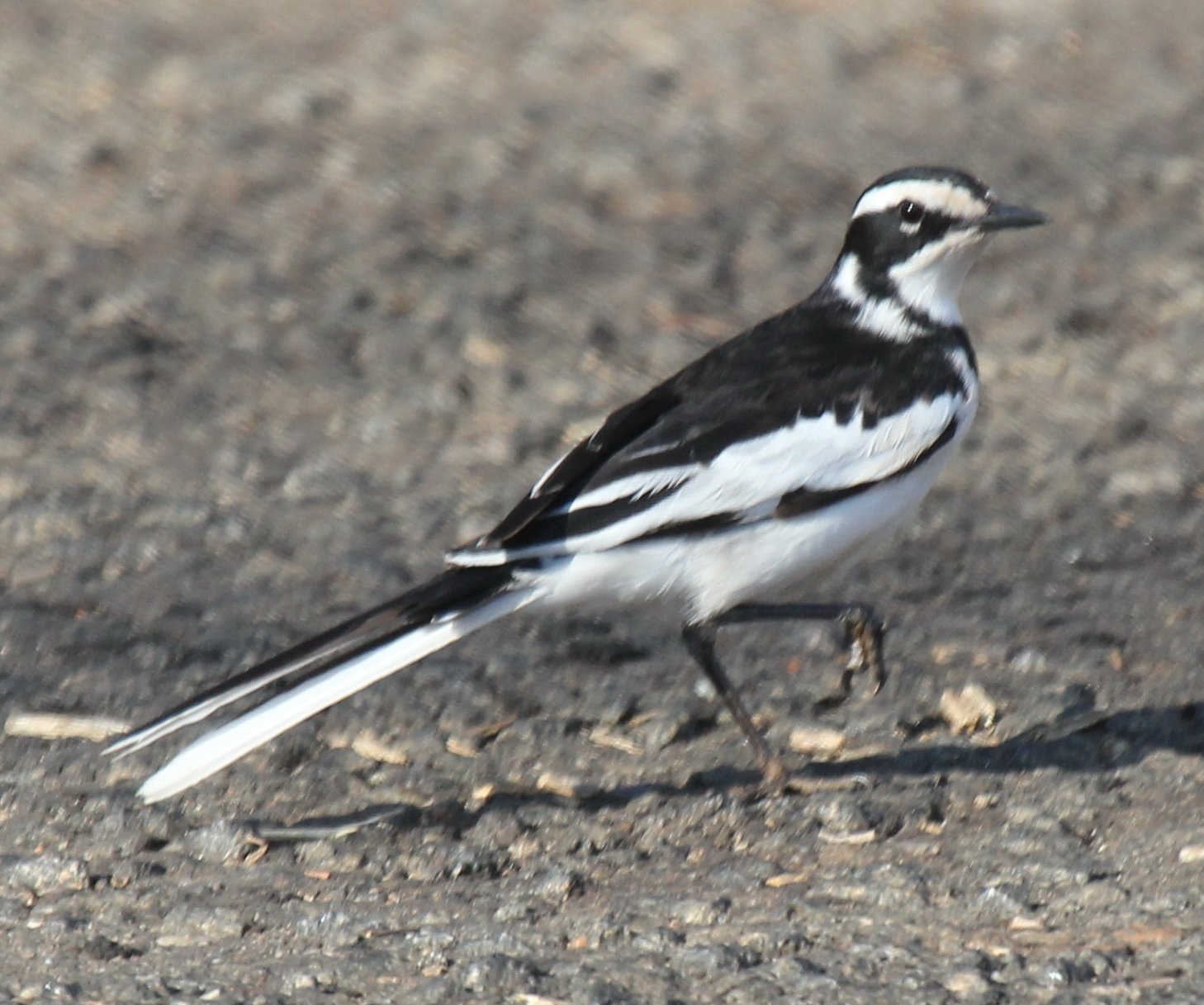
The African Pied Wagtail is the largest wagtail of the region, boldly black and white, and belongs to broad rivers with sandbanks, dams and waterside villages. It is fairly tame and forages in yards, market squares and on river beaches.
Voice
A loud, clear song, a long series of whistled and trilled notes, chee-chee-chweee-chweee, from roofs and rocks, also outside the breeding season. The call is a high chizzik.
Recording: Corné_29 — CC BY-NC-SA 4.0 · converted to mono · xeno-canto
Identification
19 to 21 cm. Head, back and a broad breast band are deep black; a broad white supercilium runs from the bill to well behind the eye, and throat, neck sides and underparts are white. The wing has a large white patch on the coverts that is conspicuous even at rest. The tail is black with white outer feathers. The sexes are nearly alike; the female is slightly greyer on the back. Juveniles are brown-grey instead of black, with the same white wing patch.
Confusion species
Cape Wagtail (Motacilla capensis) is smaller and grey-brown, with a narrow breast band and no white wing patch; check this especially in young pied wagtails. Mountain Wagtail (Motacilla clara) is blue-grey with a thin breast band and much slimmer and longer-tailed. White Wagtail (Motacilla alba), a very rare vagrant, has a grey back, a white forehead and face and less white in the wing.
Habitat
Broad rivers with sandbanks and rocks, lake and dam shores, estuaries, and villages, camps and lodges by the water; locally also in towns. It forages for insects on the ground and along the water's edge. It nests in holes in banks, among driftwood, in walls and under roofs.
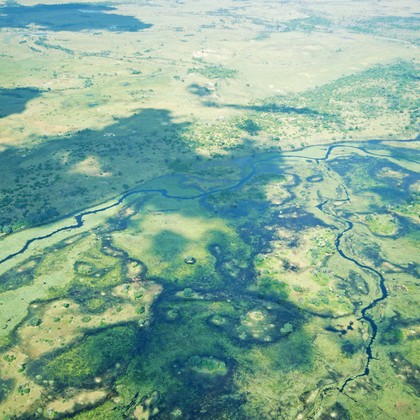
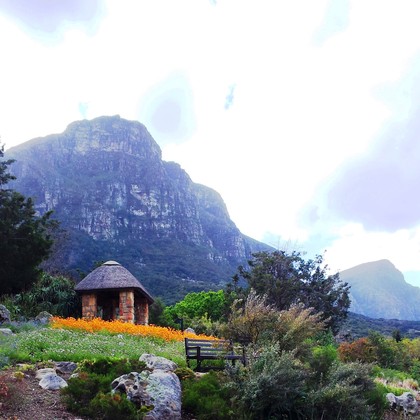
Where the bird is most at home, classified by the vegetation units of southern Africa.
Range and movements
Widespread in the north and east: Angola, Zambia, Malawi, Mozambique, Zimbabwe and northern Botswana and Namibia (Okavango, Chobe, Kunene and the Zambezi Region). In South Africa mainly in the north and east (Limpopo, Mpumalanga and KwaZulu-Natal) and in Eswatini, and westwards along the Orange River; scarce and local in the south, where it is spreading. Absent from the driest parts of the west. Beyond the region across much of sub-Saharan Africa.
- Resident
- Summer visitor (c. Oct–Mar)
- Winter visitor (c. Apr–Sep)
- Passage (Mar–Apr, Oct–Nov)
- dark = core range, pale = thinly spread
How and when to look
Along the Zambezi, Chobe and Okavango it can be found at every lodge and jetty. In young birds look for the white wing patch, which separates them at once from Cape Wagtail. The song is loud and varied and often delivered from a roof.
Conservation status
Not threatened and common, with a large range; it locally benefits from dams and waterside buildings.
Scientific name
Motacilla aguimp | Temminck, 1820
Temminck described the species in 1820 and placed it straight away in the genus where it still stands. The genus Motacilla was introduced in 1758 by Linnaeus. Motacilla was the Roman name for the wagtail; it is really a diminutive of motare 'to move about', but from medieval times -cilla was wrongly taken to mean 'tail'. aguimp is the name the Nama used for this bird according to Levaillant: two syllables each preceded by a click, meaning 'shore runner'. The specimen the first description was based on came from lower Orange River.