All species › Penguins › Penguins › African Penguin
African Penguin | Spheniscus demersus
Brilpinguïn | Pingüino del Cabo
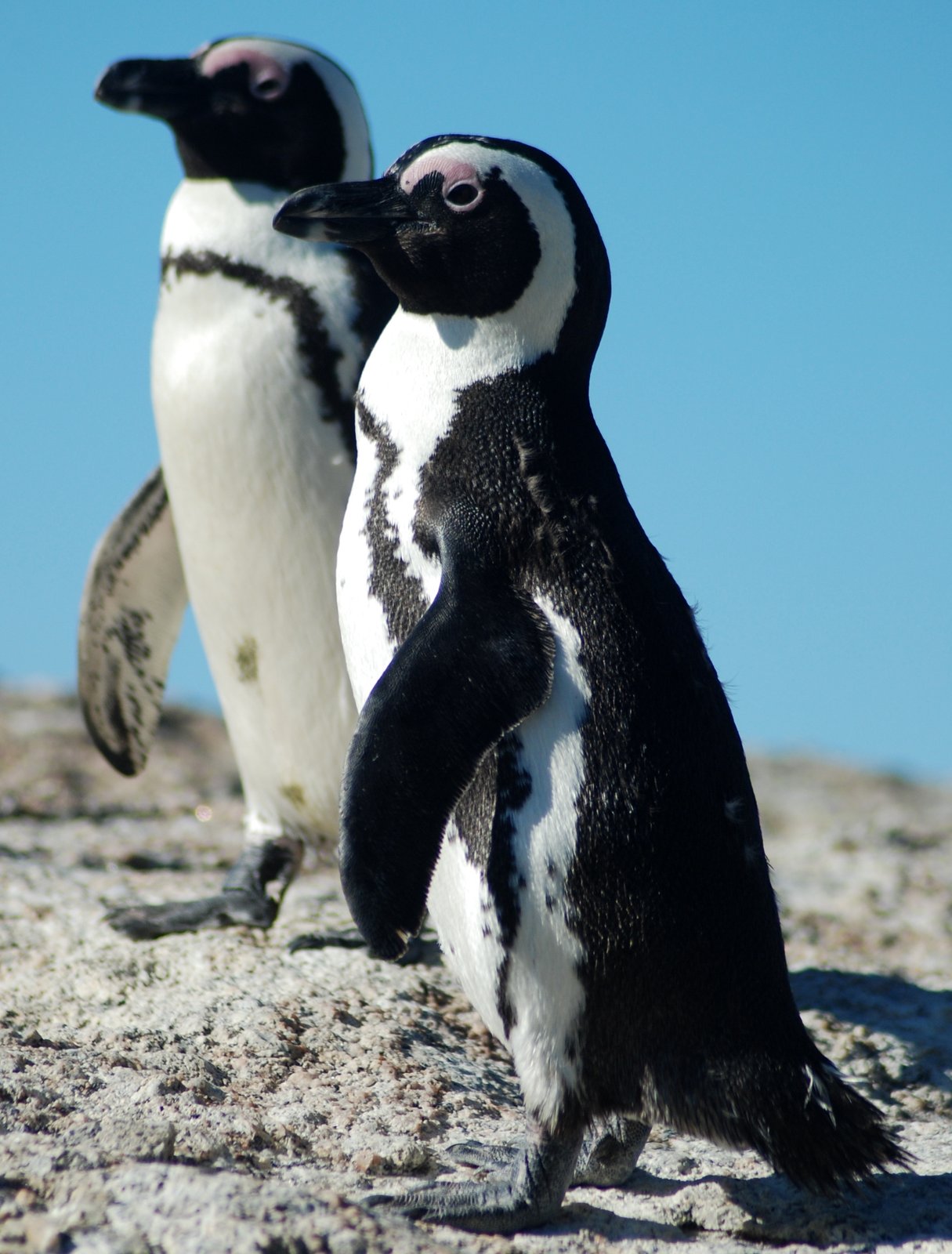
The African Penguin is the only penguin that breeds on the African mainland. It is recognised by the horseshoe-shaped black band across the white breast and the bare pink skin above the eye, and its braying call gave it the old name jackass penguin.
Voice
In the colony a loud donkey-like bray of two or three syllables, aa-aa-aaaah, given with the head thrown back; it carries far and is loudest at night. At sea and at the nest it also gives short barks and soft moaning notes.
Recording: JJSUN — CC BY-NC-SA 4.0 · converted to mono · xeno-canto
Identification
About 60 to 70 cm long, black above and white below. A narrow black band runs across the breast and down the flanks in a horseshoe, and the black face mask is edged by a broad white band from forehead to throat. A bare pink gland patch sits above the eye and flushes redder in heat. The breast carries a scatter of black spots, unique to each bird. Females average smaller with a finer bill. Juveniles are plain blue-grey, without band or face pattern.
Confusion species
No confusion is possible within the region: no other penguin breeds here. Vagrants from the south, such as Magellanic Penguin and the rockhopper penguins, are extremely rare; Magellanic shows two black breast bands and the rockhoppers yellow crest plumes. At sea a swimming penguin can suggest a diving cormorant, but it lies lower and submerges without the visible leap.
Habitat
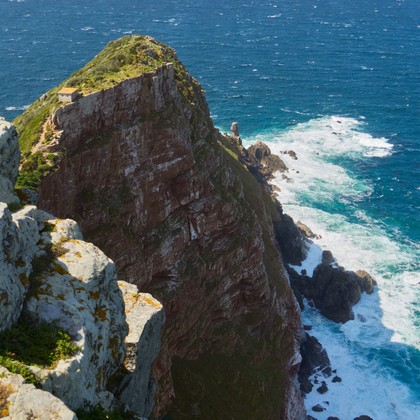
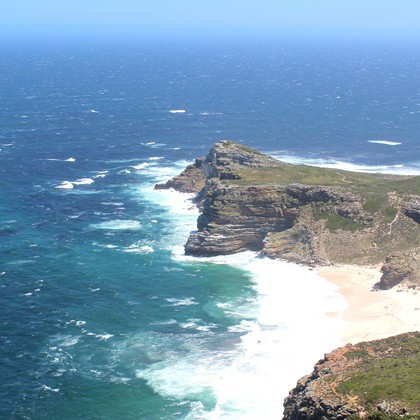
Rocky offshore islands and a few mainland colonies on beach and dune, nesting in burrows under guano, under bushes or in artificial nest boxes. It forages in the cold, productive Benguela Current and in the Agulhas Current, usually within a few tens of kilometres of the colony, on sardine and anchovy.
Where the bird is most at home, classified by the vegetation units of southern Africa.
Range and movements
Confined to the coasts of Namibia and South Africa, from Hollamsbird Island near Walvis Bay to the Eastern Cape around Gqeberha, with the largest colonies on Mercury, Ichaboe and Halifax in Namibia and on Dassen, Robben, Dyer and St Croix in South Africa, plus the mainland colonies at Boulders Beach and Stony Point. Outside the breeding season birds wander north to Angola and east to Mozambique.
- Resident
- Summer visitor (c. Oct–Mar)
- Winter visitor (c. Apr–Sep)
- Passage (Mar–Apr, Oct–Nov)
- dark = core range, pale = thinly spread
How and when to look
The mainland colonies at Simon's Town and Betty's Bay are accessible year-round and give close views from boardwalks. Early morning and late afternoon, as birds move in and out of the water. The moult, during which birds stay ashore for about three weeks without feeding, falls mainly from November to January in South Africa; breeding peaks from March to May.
Conservation status
Critically endangered. The population has fallen by more than 95 per cent in little over a century and now stands at roughly twenty thousand mature birds. Causes include the historical removal of guano and eggs, competition with fisheries for sardine and anchovy, shifts in fish stocks, oil pollution after shipping accidents, predation by Cape fur seals and gulls, and heat in unshaded colonies. Since 2025 permanent no-fishing zones apply around six key breeding sites.
Scientific name
Spheniscus demersus | (Linnaeus, 1758)
Linnaeus described the species in 1758 as Diomedea demersa; because it was later moved to another genus, the author and year stand in brackets. The genus Spheniscus was introduced in 1760 by Brisson. Spheniscus is the diminutive of the Greek sphen, 'wedge' — 'little wedge', for the wedge-shaped, flipper-like wings with which penguins swim. demersus is Latin for 'plunged, submerged', for the species' diving behaviour. The specimen the first description was based on came from Cape of Good Hope.