All species › Pigeons and doves › Pigeons and doves › African Green Pigeon
African Green Pigeon | Treron calvus
Afrikaanse papegaaiduif | Vinago Africano Común
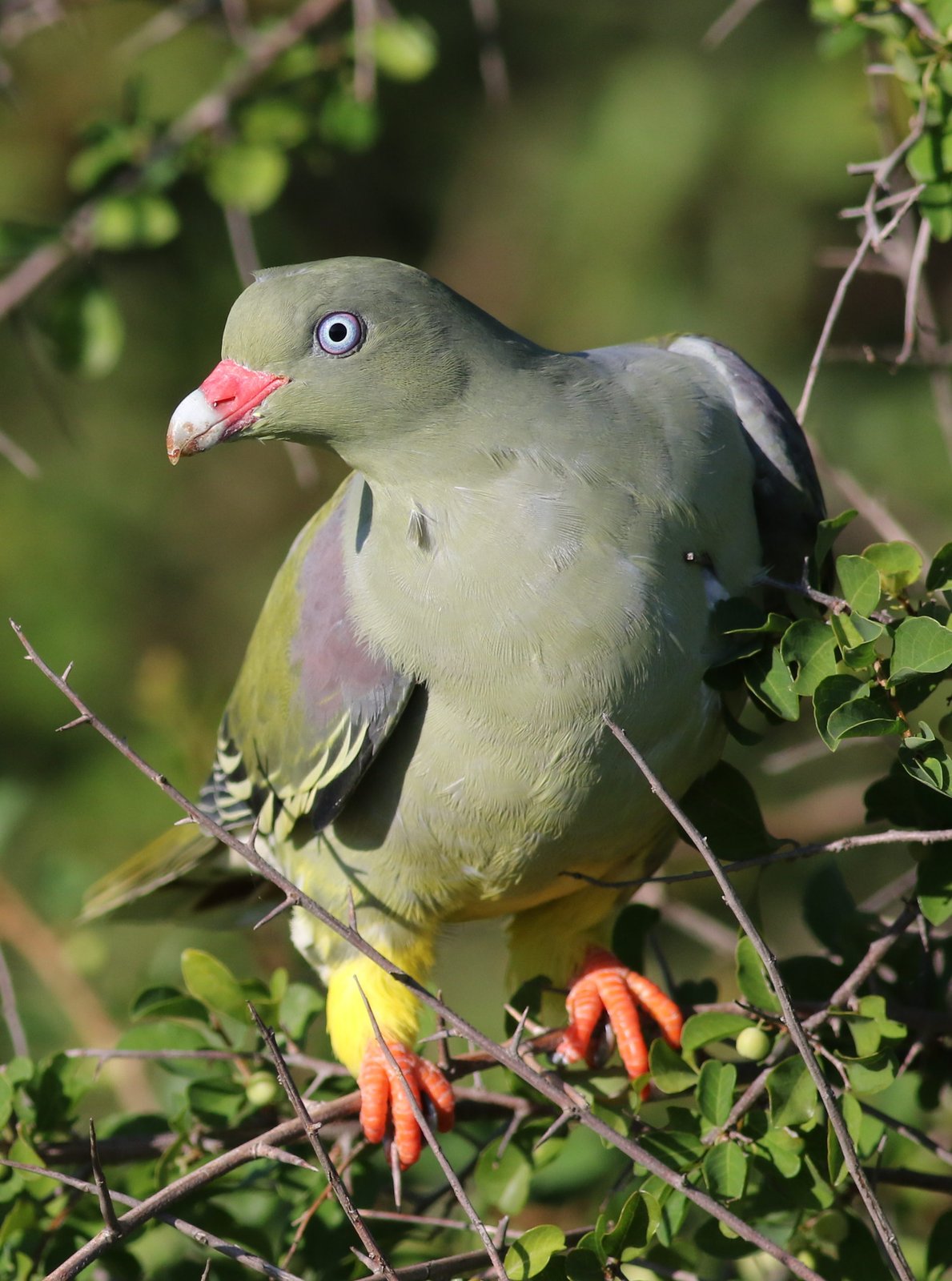
The African Green Pigeon is the only green pigeon in the region, a fruit-eater that clambers like a parrot through the crowns of fig trees. In the foliage it is inconspicuous, despite its bright yellow leggings and red bill base.
Voice
A strange, un-pigeon-like song of whistled and clicking notes followed by husky, grunting sounds, roughly tiew-tiew-kwirr… krrr-krrr-kek; also soft growling and barking sounds from the canopy.
Recording: GABRIEL LEITE — CC BY-NC-SA 4.0 · converted to mono · xeno-canto
Identification
About 30 cm, stocky. Head and neck are grey-green, the underparts yellowish green, mantle and wings olive-green with a vinous to lilac shoulder patch and a narrow yellow edge along the wing coverts. The feathered thighs are bright yellow, the undertail coverts chestnut with pale fringes. The bill is whitish to greyish with a bright red base and cere; the legs are orange-red and the eye pale blue to whitish. The tail is grey with a pale terminal band. The sexes are alike; juveniles lack the shoulder patch.
Confusion species
There is no other green pigeon in the region. In silhouette in a fig tree the species can suggest a parrot, such as Meyer's Parrot (Poicephalus meyeri) or Brown-Headed Parrot (Poicephalus cryptoxanthus), but these have a heavy hooked bill, a short tail and different behaviour. Flight fast and direct, with a pigeon silhouette and whistling wings.
Habitat
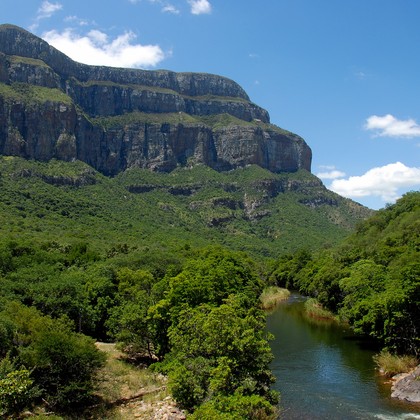
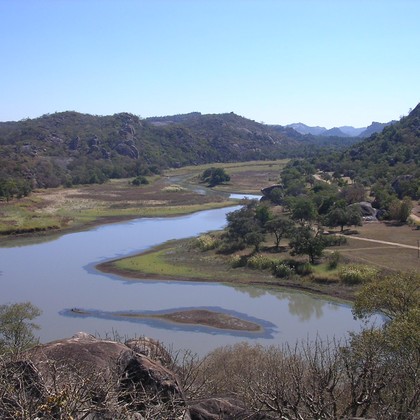
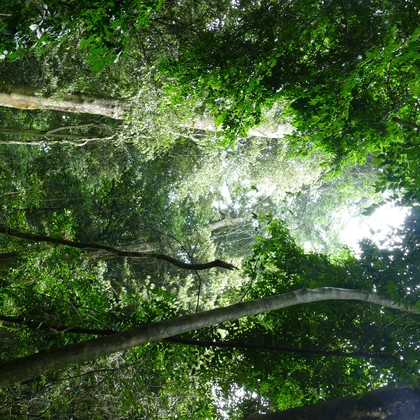
Riverine forest, lowland and coastal forest, woodland with tall trees, and gardens and parks with figs and other fruiting trees. It eats almost exclusively fruit, especially figs, and seldom comes to the ground except to drink. It wanders in flocks in search of ripening fruit trees.
Where the bird is most at home, classified by the vegetation units of southern Africa.
Range and movements
In the northern and eastern parts of the region: Angola, Zambia, Malawi, Mozambique and Zimbabwe, northern and eastern Botswana (Okavango, Chobe), north-eastern Namibia and the Kunene River, Eswatini, and in South Africa from the Eastern Cape through KwaZulu-Natal to Mpumalanga and Limpopo. Absent from the arid west and interior. Beyond the region from Senegal through West and Central Africa to Ethiopia and Kenya.
- Resident
- Summer visitor (c. Oct–Mar)
- Winter visitor (c. Apr–Sep)
- Passage (Mar–Apr, Oct–Nov)
- dark = core range, pale = thinly spread
How and when to look
Find a fruiting fig tree along a river, for example in Kruger along the Sabie or Luvuvhu, or around the Okavango, and wait: flocks come and go and betray themselves by their strange whistles and the patter of falling fruit. All year.
Conservation status
Not threatened and common in suitable habitat. It depends on tall fruiting trees along rivers; clearance of riverine forest and fig trees has a local impact, but the species also uses gardens and exotic fruit trees.
Scientific name
Treron calvus | (Temminck, 1811)
Temminck described the species in 1811 as Columba Calva; because it was later moved to another genus, the author and year stand in brackets. The genus Treron was introduced in 1816 by Vieillot. Treron derives from the Greek trērōn, 'shy, timid', a stock epithet for doves in Homer. calvus is Latin for 'bald'. Temminck himself called the species 'Colombar à front nu', 'bare-fronted green pigeon', after the unfeathered, coloured skin at the base of the bill. The specimen the first description was based on came from Loango, Republic of the Congo.