All species › Birds of prey › Hawks, eagles and kites › African Goshawk
African Goshawk | Aerospiza tachiro
Afrikaanse havik | Azor Tachiro
The African Goshawk is the common goshawk of the forests of eastern and southern Africa, usually hidden in the canopy but heard every morning during its display flight: circling high above the forest with a dry click every few seconds. It hunts birds up to the size of doves, and also rodents, lizards and bats.

Voice
In the display flight, mainly early in the morning, a dry, short click krit or whit, repeated every two to three seconds and kept up for long periods high above the forest. At the nest a fast, loud kek-kek-kek.
No recording with a suitable Creative Commons licence is available for this species yet.
Identification
36–45 cm, wingspan 65–80 cm. A compact, short-winged goshawk with a long tail and yellow legs and eyes. The male is dark slate-grey above, white below with dense rufous barring that may merge into plain rust on the flanks; the grey tail has two or three white spots and dark bands. The female is clearly larger, browner above and more coarsely barred brown below. The cere is grey to greenish-yellow. Juveniles are brown above, white to pale buff below with large dark drops and spots.
Confusion species
Rufous-Breasted Sparrowhawk Accipiter rufiventris has unbarred, plain rufous underparts and lives mainly in montane forest and plantations. Black Sparrowhawk Astur melanoleucus is much larger and black-and-white. Little Sparrowhawk Tachyspiza minulla is much smaller, with a white rump band and two white tail spots. Shikra Tachyspiza badia is paler grey, more finely barred and lives in open woodland. Juveniles resemble juvenile African Cuckoo-Hawk Aviceda cuculoides, which has longer wings, a small crest and shorter legs.
Habitat
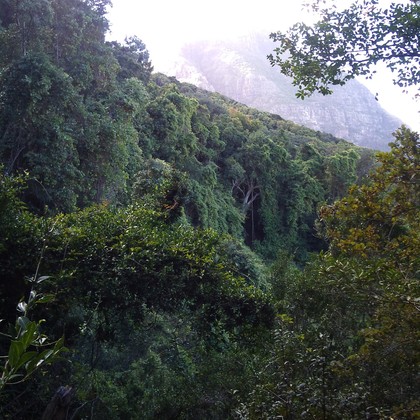
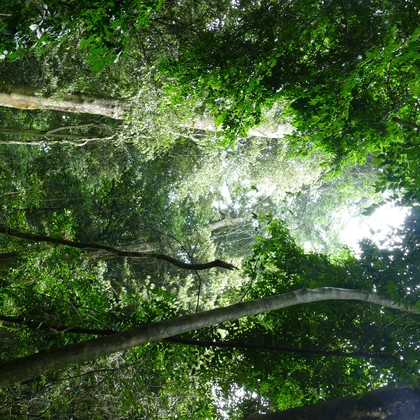
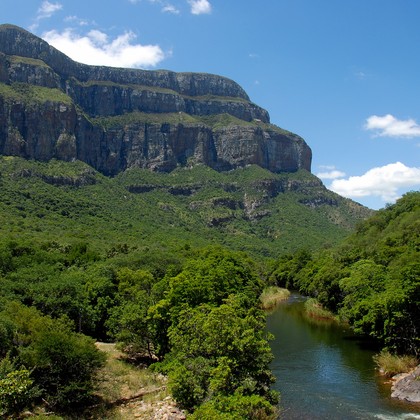
Afromontane forest, coastal and lowland forest, riverine forest and dense wooded ravines, also exotic plantations, large gardens and parks with tall trees in cities such as Durban, Pietermaritzburg and Harare. It hunts from a concealed perch in the shade. The nest is a stick platform high in a tree, often close to the trunk, and is frequently lined with green leaves.
Where the bird is most at home, classified by the vegetation units of southern Africa.
Range and movements
In the east and south of the region: in South Africa from the southern Western Cape along the Garden Route, the Eastern Cape and KwaZulu-Natal to Mpumalanga and Limpopo, then Eswatini, eastern Zimbabwe, Mozambique, Malawi, Zambia, Angola (mainly the western escarpment and the north), and in riverine forest in northern Botswana and the Caprivi Strip. Absent from the arid west and the treeless highveld. Beyond the region it occurs in East Africa to Kenya and southern Somalia; birds of West and Central Africa are sometimes split as a separate species.
- Resident
- Summer visitor (c. Oct–Mar)
- Winter visitor (c. Apr–Sep)
- Passage (Mar–Apr, Oct–Nov)
- dark = core range, pale = thinly spread
How and when to look
Walk a forest edge just after sunrise and listen for the dry clicking high in the sky; the bird itself can then often be seen as a small speck, circling with rapid wingbeats alternating with glides. It is regularly seen in gardens in Durban and in the forests of the Garden Route, sometimes hunting doves at feeding stations.
Conservation status
Not threatened; fairly common in forest and wooded gardens. In South Africa it benefits from plantations and urban greenery, but the clearing of indigenous forest in Mozambique, Malawi and Zambia reduces habitat locally.
Scientific name
Aerospiza tachiro | (Daudin, 1800)
Daudin described the species in 1800 as Falco tachiro; because it was later moved to another genus, the author and year stand in brackets. The genus Aerospiza was introduced in 1922 by Roberts. Aerospiza comes from the Greek aēr, 'air', and spizias, 'hawk'. tachiro is taken from 'le Tachiro', a name by François Levaillant formed from the French tache, 'spot', and rond, 'round' — for the round spots on the underparts. The specimen the first description was based on came from Knysna, Cape Province.