All species › Hoopoes and hornbills › Wood-hoopoes and Scimitarbills
Wood-hoopoes and Scimitarbills | Phoeniculidae
Kakelaars | Abubillas arbóreas
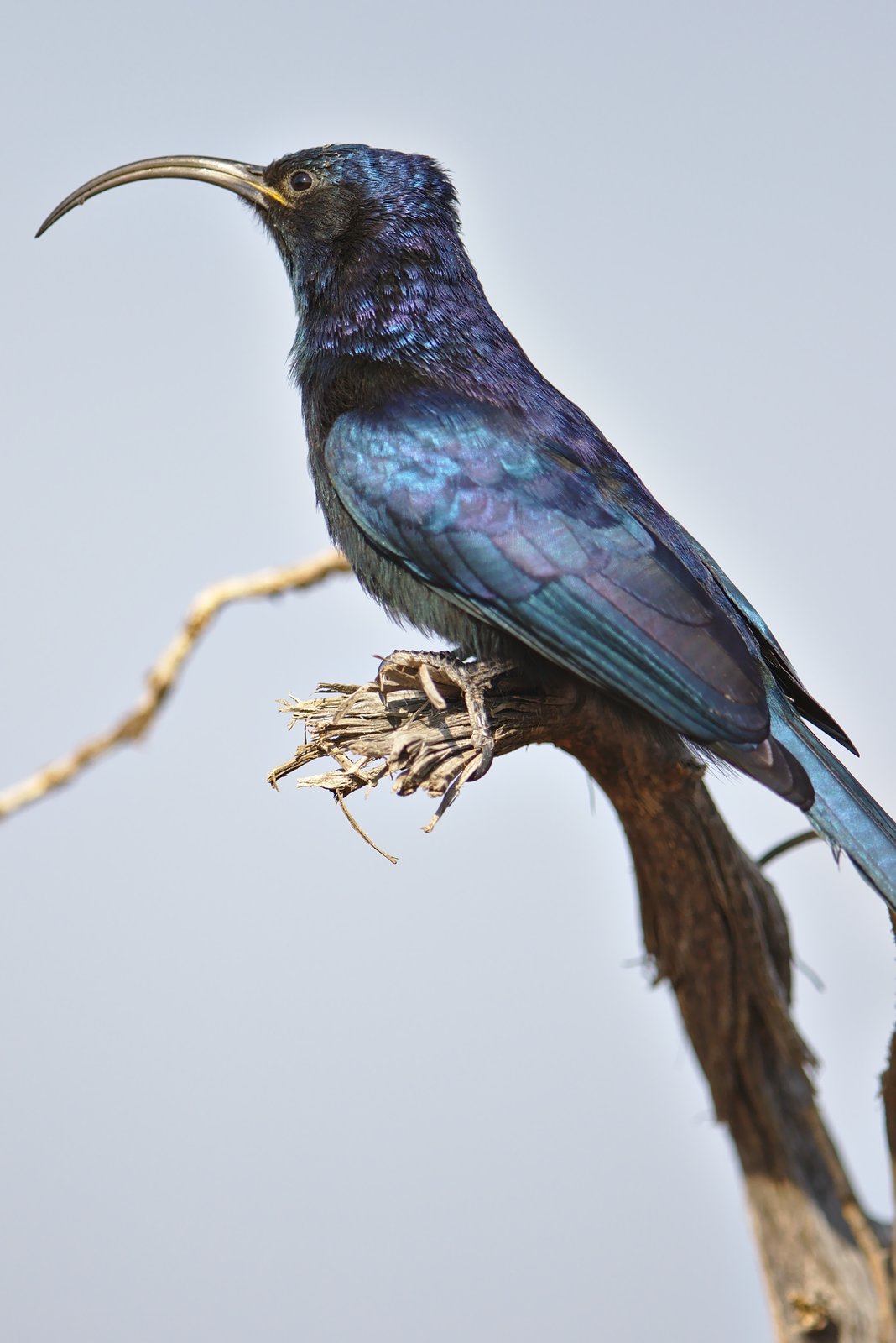
Nine species in two genera make up this exclusively African family, four of which occur in this region. Wood-hoopoes and scimitarbills are slender and long-tailed, with black plumage that shimmers violet, blue or green depending on the light. Their long, graduated tails are often marked with white. The thin bill is moderately decurved in Phoeniculus and sharply sickle-shaped in the scimitarbills (Rhinopomastus). It is a probing tool, worked into bark crevices, under loose bark and into rotten wood for insect larvae, beetles and spiders. The birds hitch and clamber along trunks and branches on strong, curved toes, and often hang upside down. Wood-hoopoes travel through woodland in noisy family parties. The group proclaims its territory with a rising chorus of cackling calls, which is often rocked back and forth on a branch as a display. Scimitarbills are quieter and usually seen alone or in pairs. Nests are in tree cavities, usually old woodpecker or barbet holes. The female incubates two to four eggs alone. In the Green Wood-hoopoe, which is well studied, helpers from earlier broods feed her and the nestlings. Groups roost together in cavities to save heat on cold nights. A pungent secretion from the preen gland, strongest in nestlings, gives the nest a rank smell that is thought to deter predators, hence the local name 'stink bird'.
Native species 4 species
Species that occur here by nature: breeding birds, winter visitors and passage migrants. They are arranged by genus, in the sequence of the list.
Phoeniculus 2 species