All species › Passerines › Chats and flycatchers › White-Crowned Wheatear
White-Crowned Wheatear | Oenanthe leucopyga
Witkruintapuit | Collalba yebélica
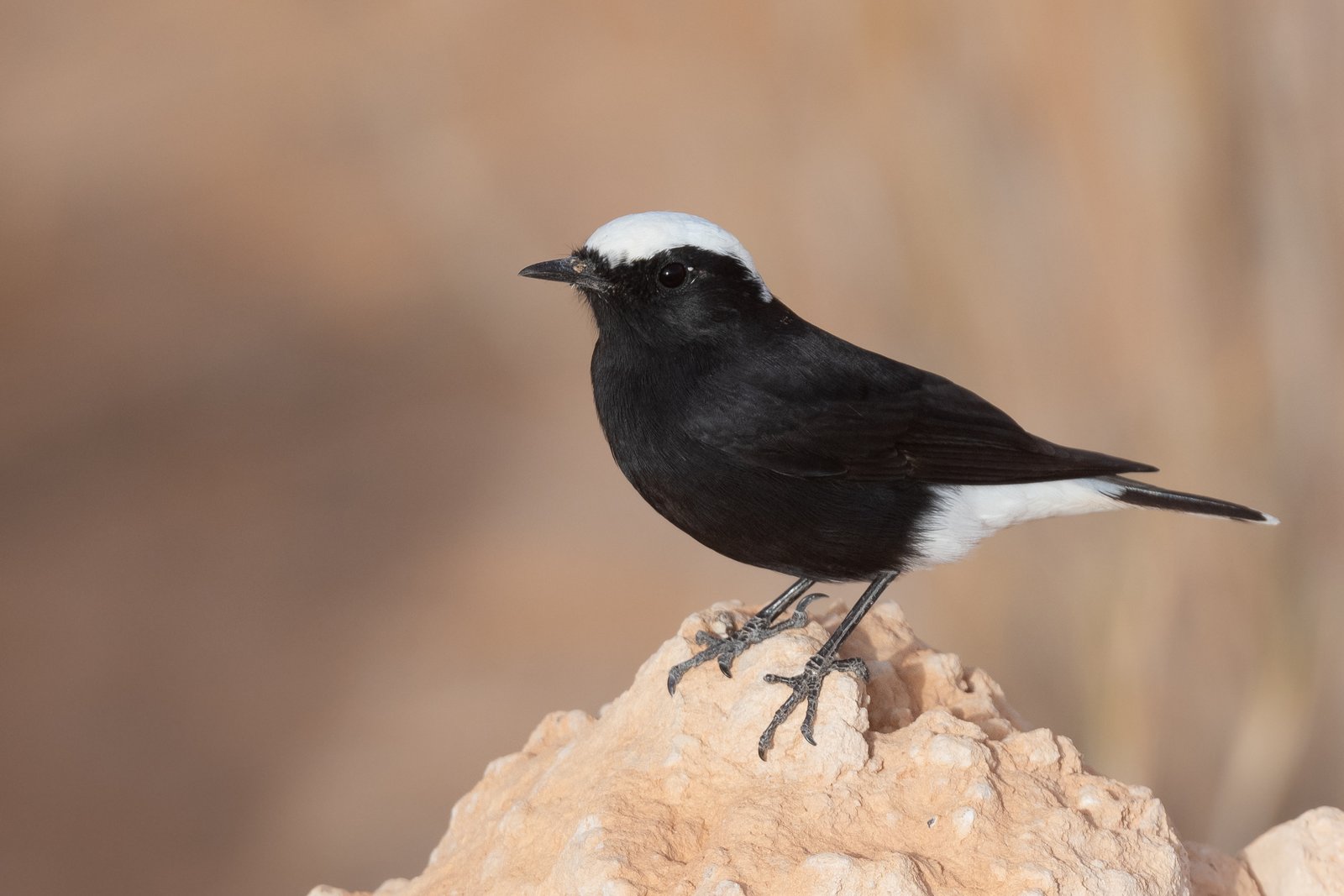
White-crowned Wheatear is the characteristic black wheatear of the Sahara and of the deserts of the Levant and Arabia: large, glossy black with a white crown and an almost wholly white tail. It is confiding, likes oases, villages, forts and camps, and is one of the first birds you see in the desert.
Voice
A loud, rich and varied song of clear whistles, trills and mimicry of other desert birds, heard all year, especially at dawn and dusk and sometimes at night. The call is a clear chee-weet and a short, hard chak.
Recording: David Darrell-Lambert — CC BY-NC-SA 4.0 · converted to mono · xeno-canto
Identification
17–18 cm. Large, slim and long-legged, with a long black bill. Adults are all glossy black with a pure white crown; first-year birds still have a black crown, sometimes with some white. Rump, undertail-coverts and tail white, with black only on the central tail feathers and small black tips to the outer ones: a continuous black terminal band is lacking. Male and female are alike.
Confusion species
Black Wheatear (Oenanthe leucura) of the Maghreb never has a white crown, is bulkier, shorter-billed and always shows a broad black terminal tail band; especially with first-year White-Crowned Wheatears lacking a white crown, the tail is decisive. The male Hooded Wheatear (Oenanthe monacha) has a white hood reaching the mantle and a white belly. Mourning Wheatear (Oenanthe lugens) is smaller and has a white belly; its basalt form is all black but has a broad black terminal band and a black crown. Hume's Wheatear (Oenanthe albonigra) has a white belly and a black crown.
Habitat
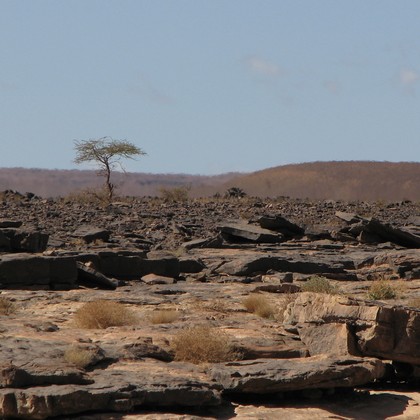
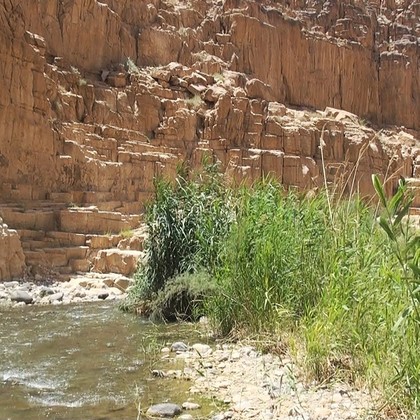
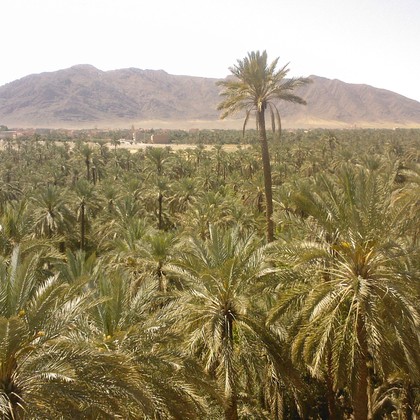
Stony desert and hamada, rocky gorges, wadis and scree in the barest parts of the desert, but also villages, oases, forts, ruins, roadside cafés and camps. Nests in rock crevices, holes in walls and buildings, sometimes in old nests of other birds.
Where the bird is most at home, classified by the habitats of North Africa and the Middle East.
Range and movements
Resident throughout the Sahara within the region: southern and eastern Morocco and Western Sahara, the Algerian Sahara (including Hoggar and Tassili), southern Tunisia, Libya south of the coastal strip and all of Egypt outside the Nile Delta, including Sinai and the deserts along the Nile. Further in Israel (Negev, Arava, Dead Sea), Jordan (mainly the south and east), southern Syria, western Iraq and northern, western and central Saudi Arabia, south to northern Yemen. Rare or a vagrant in Kuwait, the Emirates and Oman. Beyond the region on the Sahelian edges of the Sahara to Sudan and north-east Africa.
- Resident
- Winter visitor (c. Oct–Mar)
- Passage (Mar–Apr, Oct–Nov)
- dark = core range, pale = thinly spread
How and when to look
Almost guaranteed at Merzouga and in the Tafilalt in Morocco, at the oases of the Western Desert in Egypt, at Petra and Wadi Rum in Jordan and around Eilat and the Dead Sea in Israel. It likes to perch on roofs and walls and comes close out of curiosity.
Conservation status
Not globally threatened. Common and widespread; thanks to its liking for buildings and camps it locally even benefits from human presence in the desert.
Scientific name
Oenanthe leucopyga | (Brehm, 1855)
Brehm described the species in 1855 as Vitiflora leucopyga; because it was later moved to another genus, the author and year stand in brackets. The genus Oenanthe was introduced in 1816 by Vieillot. Oenanthe was used by Aristotle for a bird that can no longer be identified; the word comes from the Greek oinos, oinoē 'wine, vine' and anthos 'flower, bloom'. leucopyga is Greek, from leukos 'white' and pugē 'rump'. The specimen the first description was based on came from Korosko, Egypt.