All species › Passerines › Leaf warblers › Western Bonelli's Warbler
Western Bonelli's Warbler | Phylloscopus bonelli
Bergfluiter | Mosquitero papialbo
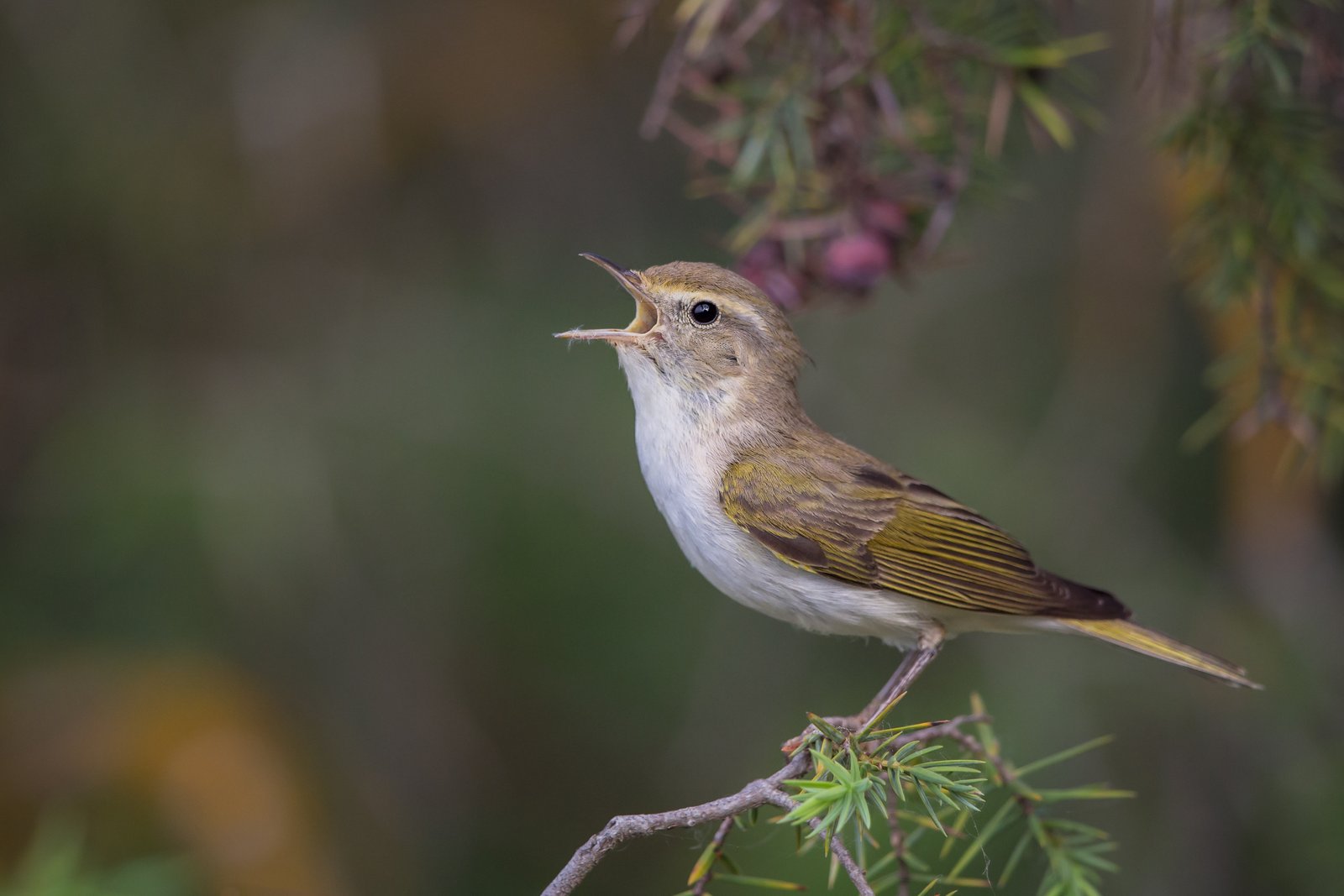
The Western Bonelli's Warbler is a pale, low-contrast leaf warbler of open broadleaved and coniferous woodland on mountain slopes. In this region it is the western of the two Bonelli's warblers: it breeds in the forests of the Atlas and the Rif and migrates across the western Sahara to the Sahel; east of Tunisia it is replaced by the Eastern Bonelli's Warbler.
Voice
The song is a short, dry rattle on one pitch, srrrrrrr, at close range a series of separate ticks, repeated every few seconds. The call is decisive against Eastern Bonelli's: a soft, disyllabic, rising hoo-eet, not the short chip of that species.
Recording: Tony Rinaud — CC BY-NC-SA 4.0 · converted to mono · xeno-canto
Identification
10.5–11.5 cm. Grey-green to grey-brown above and silky white below, with no yellow on throat or breast. Three coloured accents make the species: a bright yellow rump (often only visible in flight or when stretching), a yellow-green panel on the folded wing and yellow-green edges to the tail. The face is plain and open, with a faint short supercilium, a large dark eye and hardly any eye-stripe. Lower mandible pale orange, legs brown. Sexes alike.
Confusion species
Eastern Bonelli's Warbler (Phylloscopus orientalis) is almost identical, on average greyer with less green in wing and rump; only the call is decisive. Wood Warbler (Phylloscopus sibilatrix) is larger with a bright yellow throat and breast. Willow Warbler (Phylloscopus trochilus) and Common Chiffchaff (Phylloscopus collybita) lack the yellow rump and wing panel and are more yellowish or brownish below. Western Olivaceous Warbler (Iduna opaca) is larger, with a long bill and uniform brown-grey upperparts.
Habitat
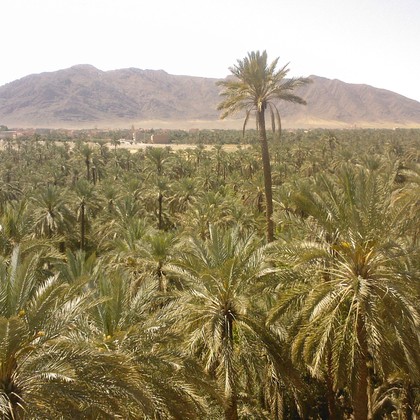
Breeds in open, dry woodland on slopes with plenty of light and a herb layer: holm oak, cork oak and cedar forest, pine forest and woodland with Atlas juniper, in the Atlas up to over 2000 m. On passage in oases, gardens, acacia scrub and wooded wadis.
Where the bird is most at home, classified by the habitats of North Africa and the Middle East.

Range and movements
Breeds in Morocco in the Rif, the Middle and High Atlas and the cork-oak forests of the Atlantic lowlands, in northern Algeria (Tell Atlas, Aurès) and in north-western Tunisia (Kroumirie). On passage throughout Morocco, including Western Sahara, and through the oases of the Algerian Sahara; scarce in Libya and a rarity further east, where Eastern Bonelli's Warbler migrates instead. Winters in the Sahel from Senegal to Chad. Beyond the region it breeds in south-western and central Europe, from Iberia and France to the Alps and Italy.
- Summer visitor (c. Apr–Sep)
- Winter visitor (c. Oct–Mar)
- Passage (Mar–Apr, Oct–Nov)
- dark = core range, pale = thinly spread
How and when to look
In May and June listen in the cedar and oak forests of the Middle Atlas, for example around Ifrane and Azrou, for the dry rattle; the bird itself usually stays high in the canopy. On spring passage it is common in April in the oases of the Moroccan desert edge.
Conservation status
Not globally threatened. In North Africa vulnerable to the decline of the Atlas forests through logging, overgrazing and drought; the cedar forests of the Middle Atlas have suffered severe dieback since the 1990s.
Scientific name
Phylloscopus bonelli | (Vieillot, 1819)
Vieillot described the species in 1819 as Sylvia Bonelli; because it was later moved to another genus, the author and year stand in brackets. The genus Phylloscopus was introduced in 1826 by Boie. Phylloscopus is Greek, from phullon 'leaf' and skopos 'seeker', from skopeō 'to watch': the bird that searches the foliage. bonelli honours the Italian zoologist Franco Andrea Bonelli (1784–1830), who curated the natural history collections at the University of Turin. The specimen the first description was based on came from Piedmont.