All species › Passerines › Indigobirds and whydahs › Village Indigobird
Village Indigobird | Vidua chalybeata
Staalvink | Viuda senegalesa
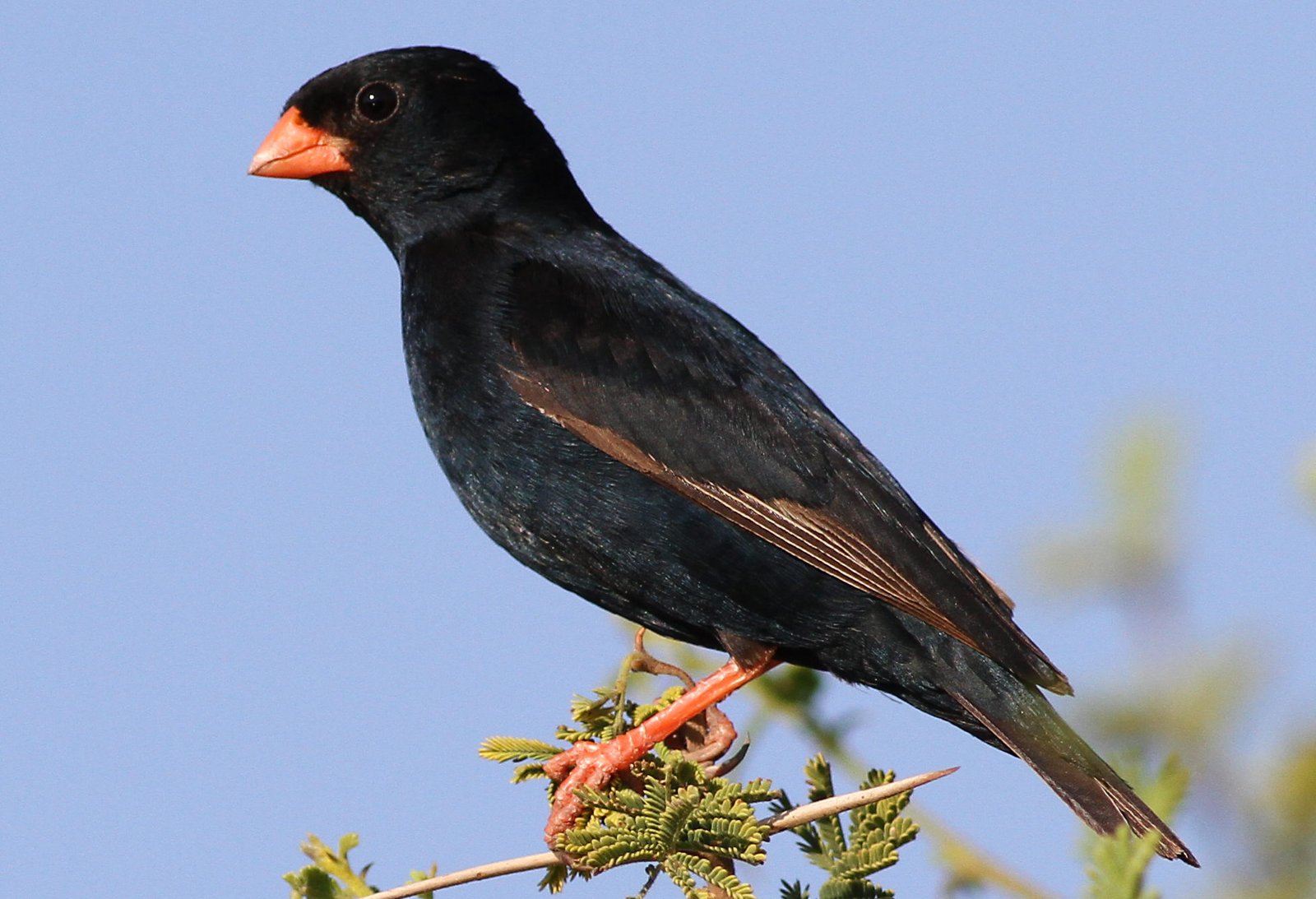
The Village Indigobird is a small, glossy black finch of the African savanna that lays its eggs as a brood parasite in the nests of Red-billed Firefinch. In the region it is known only from a few recent records in the south of the Algerian Sahara.
Voice
From a fixed song post the male gives a fast, scratchy and squeaky twittering, interspersed with imitations of Red-billed Firefinch such as a descending weet-weet and a soft chrr-chrr. The call is a dry chip.
Recording: Julien Birard — CC BY-NC-SA 4.0 · converted to mono · xeno-canto
Identification
11–12 cm, small and stocky with a short tail. The breeding male is wholly black with a blue to blue-green gloss and blackish-brown wings. The bill is red to orange-red in birds from West Africa and white in those from the eastern Sahel; the legs are orange-red to pink. The female is warm brown with dark streaks on the back and pale buff underparts, with a pale crown stripe, dark lateral crown stripes and a pale supercilium; her bill is pale horn. The non-breeding male resembles the female. Juveniles are plain brown.
Confusion species
No other indigobird occurs in the region; the African relatives can only be separated with certainty on leg and bill colour, gloss and the mimicked host call. Females resemble those of Pin-Tailed Whydah (Vidua macroura), which has a pink to red bill and a more boldly striped head. Red-billed Firefinch (Lagonosticta senegala), the host, is red with small white spots on the flanks.
Habitat
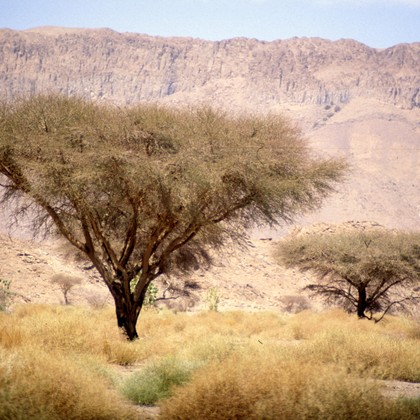
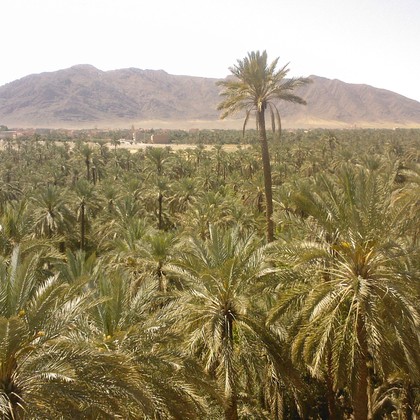
Dry acacia savanna, villages, gardens and field edges with bare ground for foraging; in the Sahara only in oases and vegetated wadis. Builds no nest of its own: the female lays her eggs in nests of Red-billed Firefinch, where the young are raised together with those of the host. Feeds mainly on small grass seeds picked from the ground.
Where the bird is most at home, classified by the habitats of North Africa and the Middle East.
Range and movements
Algeria: recorded in 2021 and 2022 in the Tamanrasset area and south towards In Guezzam, the first records for the country; the observers considered escape from captivity likely, although the Sahel is close by. Qatar: one bird in 2022, surely an escaped cage bird. No certain records elsewhere in the region. Beyond, widespread in the savanna of sub-Saharan Africa, from Senegal and Mauritania east to Sudan and Ethiopia and south to southern Africa.
How and when to look
A glossy black finch with a red or white bill at an oasis in southern Algeria deserves a photograph and, if possible, a sound recording of the song: the mimicked call of the host confirms the species. Report such a sighting to the national rarities committee.
Conservation status
Not globally threatened. In the region a very rare vagrant with only recent records in southern Algeria and Qatar; escape from captivity is likely in both cases.
Scientific name
Vidua chalybeata | (Müller, 1776)
Müller described the species in 1776 as Fringilla chalybeata; because it was later moved to another genus, the author and year stand in brackets. The genus Vidua was introduced in 1816 by Cuvier, GLCFD. Vidua is the Latin word for 'widow'. chalybeata is Latin for 'steel-coloured', from chalybs, 'steel' — for the male's blue-black gloss. The specimen the first description was based on came from Senegal (substituted; originally Brazil in error).