All species › Passerines › Larks › Thick-Billed Lark
Thick-Billed Lark | Ramphocoris clotbey
Diksnavelleeuwerik | Calandria picogorda
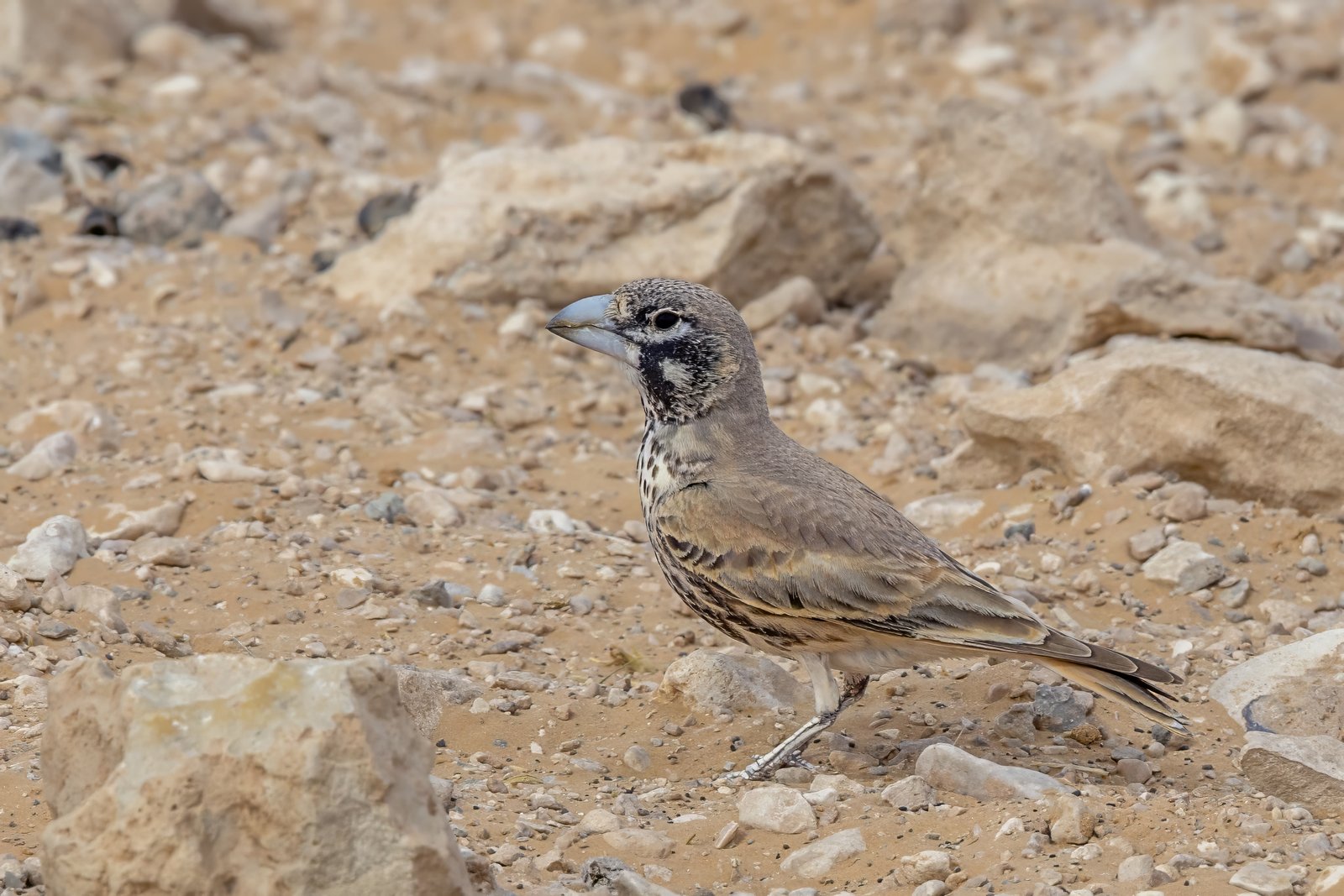
The Thick-billed Lark is a compact, big-headed lark with a huge pale bill that would suit a grosbeak better than a lark. It lives on the bare, stony plains of the northern Sahara and the Syrian-Arabian desert and wanders after rain to places that briefly turn green. Birders travel to Morocco or the Negev specially to see it.
Voice
The song is short and unobtrusive: a series of soft, rather scratchy notes with clear whistles in between, tseet-tseet-trrrlee, from the ground, a stone or in a short song flight. The call is a soft choo-eet or a dry prrt, often in flight.
Recording: Stanislas Wroza — CC BY-NC-SA 4.0 · converted to mono · xeno-canto
Identification
17–18 cm, heavily built with a short tail and a very thick, deep, horn-coloured bill. The male has a largely black head with a white cheek patch and white throat, a grey-brown back, and white underparts with large black spots on breast and flanks. The female is duller, with a brown rather than black head and fewer spots. In flight a broad white trailing edge to the secondaries, black underwings and a black tail with white corners stand out. Juveniles are plain sandy brown without head markings, but already have the thick bill.
Confusion species
The bill makes confusion unlikely. Calandra Lark (Melanocorypha calandra) is also heavy, with black neck patches and a white trailing edge to the wing, but has a less extreme bill, no black head and lives on farmland and grass steppe. Females and juveniles can briefly recall Desert Lark (Ammomanes deserti), but the thick bill and white trailing edge settle it.
Habitat
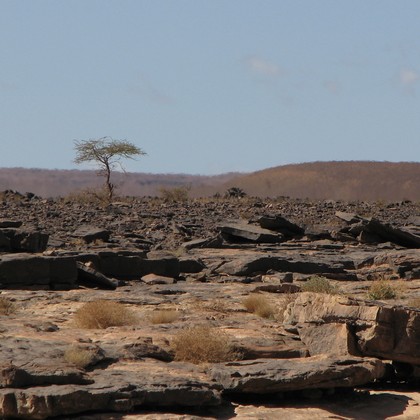
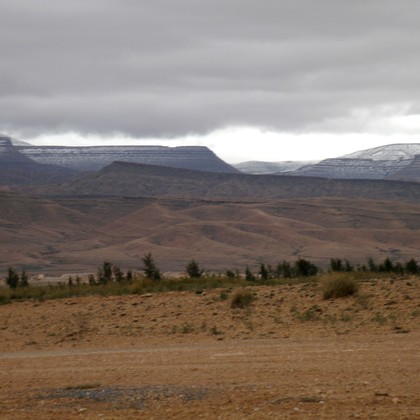
Stony and pebbly desert plains (hamada) with sparse, low vegetation, often on somewhat raised plateaus and in the transition to semi-desert and alfa steppe. After rain it appears where green growth emerges, including fallow ground and field edges. It eats seeds, green shoots and, in the breeding season, insects.
Where the bird is most at home, classified by the habitats of North Africa and the Middle East.
Range and movements
In North Africa it breeds in eastern and south-eastern Morocco (around Boumalne, Errachidia, Merzouga and Tagdilt), the northern Algerian Sahara and southern Tunisia, with scattered records in north-west Libya and Western Sahara. Very scarce in Egypt. In the Middle East it occupies the northern Arabian desert: northern Saudi Arabia, eastern Jordan, the Syrian desert and western Iraq, with wandering birds reaching Kuwait mainly in winter; in Israel it is an irregular breeder in the Negev and on the plateau around Mitzpe Ramon. Not found outside the region.
- Resident
- Winter visitor (c. Oct–Mar)
- Passage (Mar–Apr, Oct–Nov)
- dark = core range, pale = thinly spread
How and when to look
The Tagdilt plateau near Boumalne-Dadès in Morocco is the classic site: drive the tracks slowly in the early morning in March–April and search among the short-toed larks for a heavy, dark-headed bird. Look especially after a wet winter; in dry years the species may have gone and turned up elsewhere.
Conservation status
Not threatened. Numbers fluctuate strongly with rainfall and the species is poorly known in many countries. Overgrazing and conversion of steppe to farmland may press locally, but most of its habitat is uninhabited.
Scientific name
Ramphocoris clotbey | (Bonaparte, 1850)
Bonaparte described the species in 1850 as Melanocorypha clot-bey; because it was later moved to another genus, the author and year stand in brackets. The genus Ramphocoris was introduced in 1850 by Bonaparte. Ramphocoris is Greek, from rhamphos 'bill'; the second element is linked to korudos 'lark', after this lark's heavy bill. clotbey honours the French physician Antoine Barthélemy Clot (1793–1868), who organised medicine in Egypt and was granted the title of bey there in 1832. The specimen the first description was based on came from the Egyptian desert.