All species › Passerines › Chats and flycatchers › Taiga Flycatcher
Taiga Flycatcher | Ficedula albicilla
Taigavliegenvanger | Papamoscas de la taiga
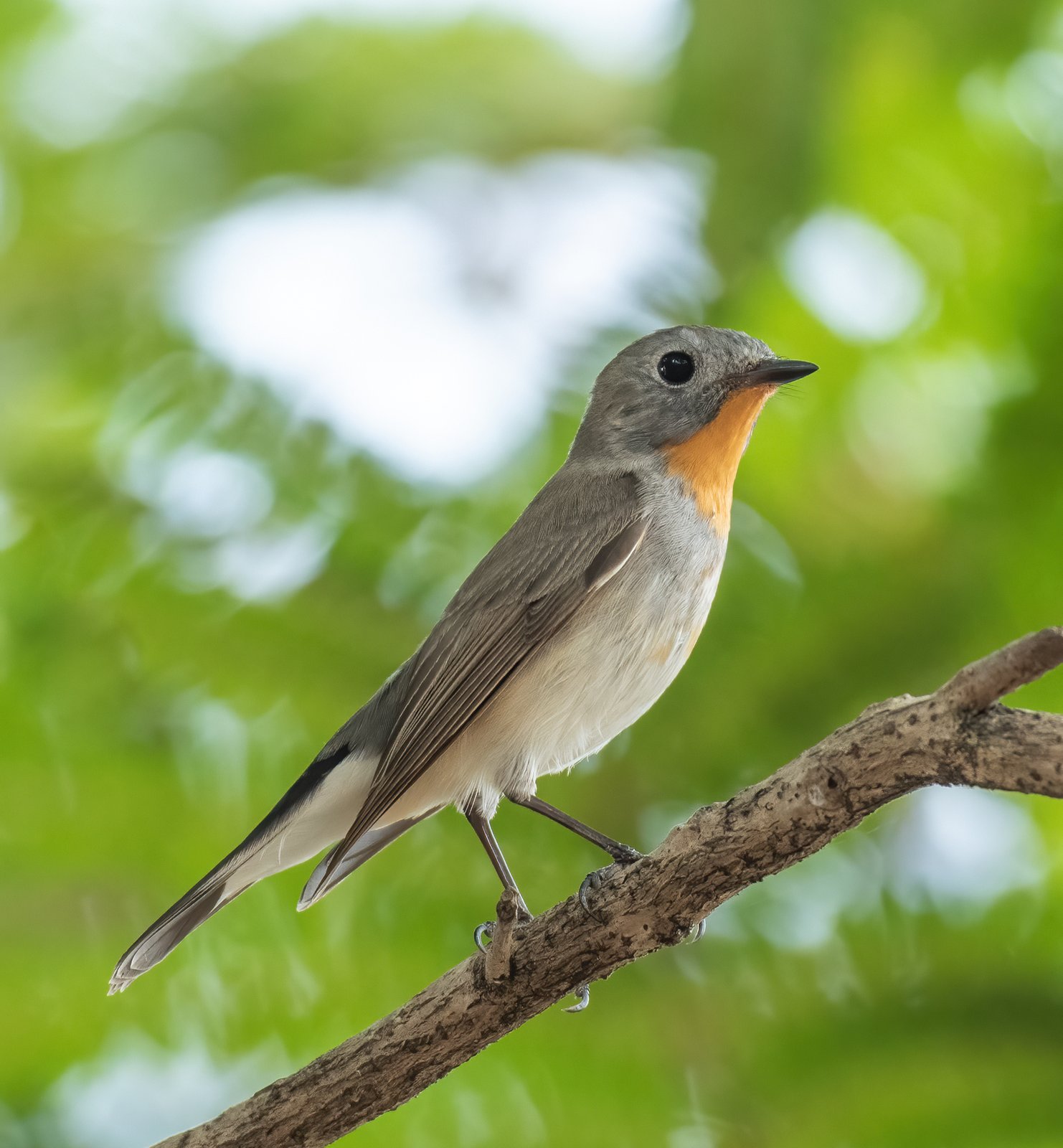
The Taiga Flycatcher is the eastern counterpart of Red-breasted Flycatcher: it breeds in the Siberian taiga and winters in South and Southeast Asia. In the region it is a vagrant recorded almost only in eastern Arabia, mainly as a wintering bird in the parks of the UAE.
Voice
The call is a dry, cricket-like rattling trrrr, harder and flatter than that of Red-breasted Flycatcher, and a short, sharp tchek. Wintering birds are often silent.
Recording: Richard E. Webster — CC BY-NC-SA 4.0 · converted to mono · xeno-canto
Identification
11–12 cm. Shape and behaviour as Red-breasted Flycatcher: small and round, with a large head, a large eye in a narrow pale eye-ring and a constantly cocked tail with large white patches at the base. Note three details: the uppertail coverts are jet black, as black as the tail; the bill is all dark; and the breast and flanks are a cooler grey, without a warm buff wash. The breeding male has a small, bright orange throat patch, sharply defined and bordered by grey on the breast; in winter most birds have an off-white throat. Females and first-winters are grey-brown above and greyish-white below.
Confusion species
Red-breasted Flycatcher (Ficedula parva), a regular winter visitor in the east of the region, is the only real confusion species. It has uppertail coverts browner than the tail, a pale base to the lower mandible and a warmer, buff-tinged breast; the male has a larger, duller orange throat that extends onto the upper breast. The call also helps: the rattle of Red-breasted Flycatcher is warmer and less dry. An identification is best based on photographs of the rump and bill and recordings of the call.
Habitat
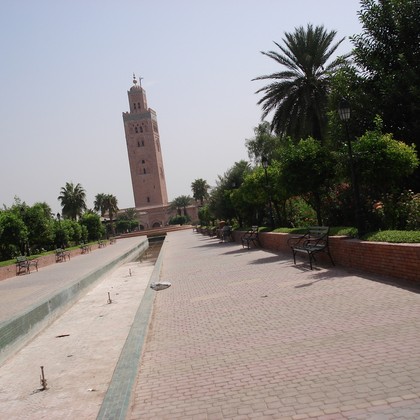
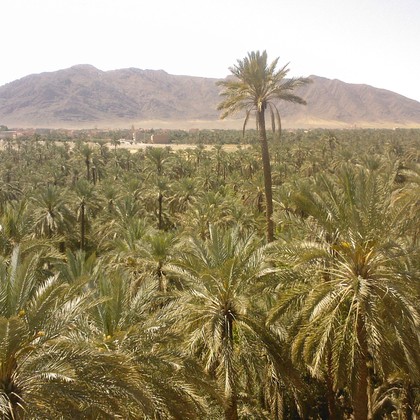
In winter in parks, gardens and copses with tall trees and dense shrubs, often near water and green lawns; in Oman also in oases. Behaves like Red-breasted Flycatcher, low in the foliage, with short sallies after flying insects.
Where the bird is most at home, classified by the habitats of North Africa and the Middle East.
Range and movements
In the UAE a rare winter visitor with several records, birds often staying for weeks or months in the same park. In Kuwait at least two records (the second in December 2013) and a few records in Oman. There are no confirmed records from the rest of the region; a bird in Saudi Arabia, Qatar, Bahrain or Israel is to be expected. Beyond the region it breeds from the Urals across the Siberian taiga to the Russian Far East and northeastern China, and winters from northern India and Nepal to Southeast Asia and southern China.
How and when to look
In winter check every Red-breasted Flycatcher in the parks of Dubai and Abu Dhabi: photograph the rump and the underside of the bill and record the call. Report any sighting to the national rarities committee.
Conservation status
Not globally threatened. As a vagrant it raises no conservation issue in the region. It was long treated as a subspecies of Red-breasted Flycatcher; because of the similarity, records in the region may be under-reported.
Scientific name
Ficedula albicilla | (Pallas, 1811)
Pallas described the species in 1811 as Muscicapa Albicilla; because it was later moved to another genus, the author and year stand in brackets. The genus Ficedula was introduced in 1760 by Brisson. Ficedula is Latin for a small fig-eating bird, from ficus 'fig'; it was believed to turn into the blackcap in winter. albicilla means 'white-tailed', from Latin albus 'white' and cilla 'tail', for the white tail base. The specimen the first description was based on came from Dauria, Siberia.