All species › Waders, gulls and terns › Sandpipers and snipes › Spotted Redshank
Spotted Redshank | Tringa erythropus
Zwarte ruiter | Archibebe oscuro
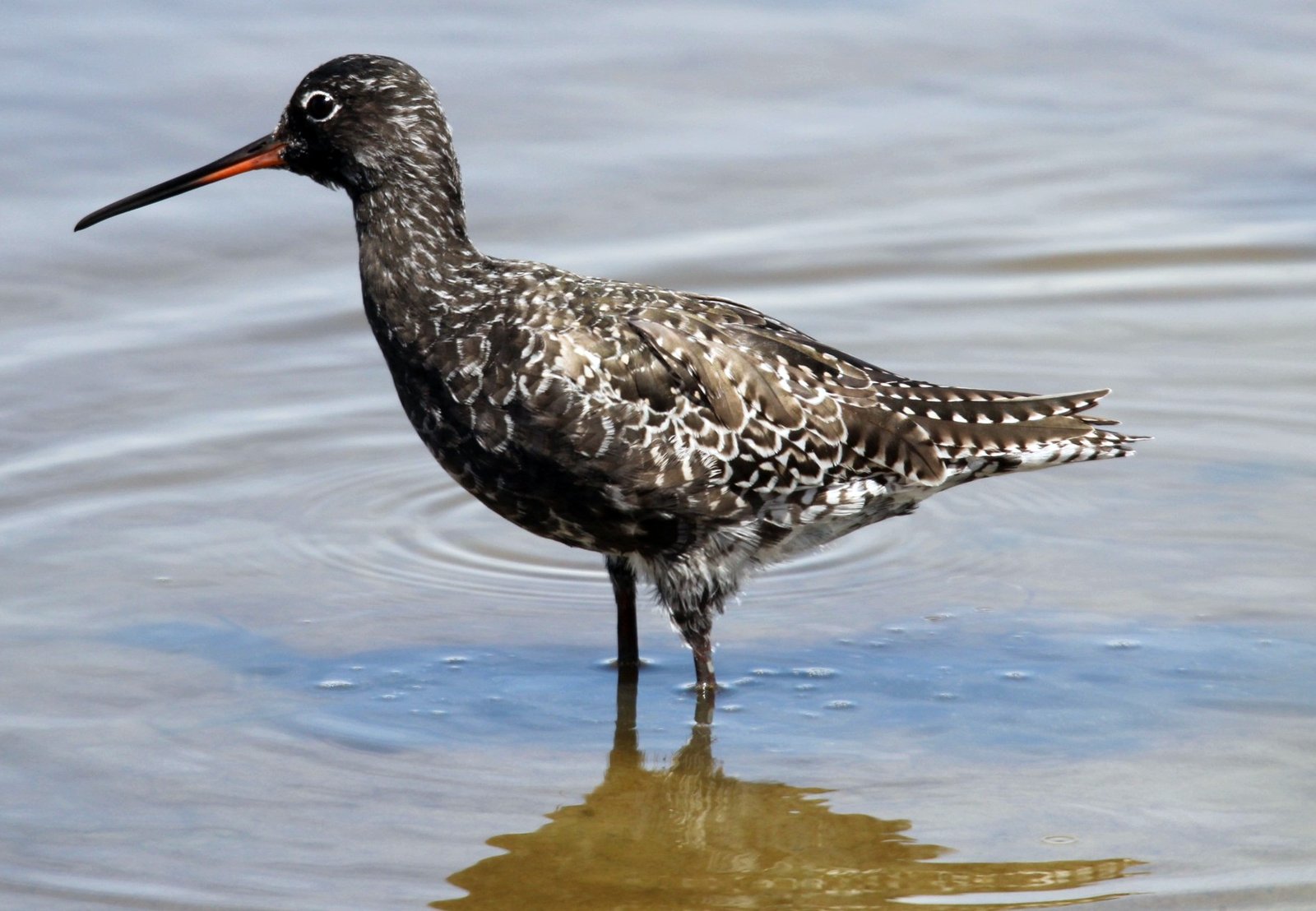
A long, slender Tringa that is almost entirely sooty-black in spring and strikingly pale grey in winter. In the region it is a passage migrant and winter visitor of marshes, fish ponds and lagoons, most numerous in the north and in the Levant and Mesopotamia, and scarce in Arabia.
Voice
A clear, sharp disyllabic chew-it, stressed on the second, rising note; often given on take-off and high in the air, and the best clue to a bird flying over. When alarmed a short chik.
Recording: Xavier Riera — CC BY-NC-SA 4.0 · converted to mono · xeno-canto
Identification
Large and slender, with a long, thin, straight bill with a fine downward hook at the tip and red at the base of the lower mandible, and long red legs. In winter plumage pale grey above with fine white spots and white below, with a dark loral stripe and an obvious white stripe from the bill to above the eye. In breeding plumage (April – June) sooty black with white spots on the back and dark red legs; moulting birds look blotchy. Juveniles are brownish-grey and finely barred on the flanks. In flight a white oval patch on the back, a plain dark wing and toes projecting well beyond the tail.
Confusion species
Common Redshank (Tringa totanus) is smaller and more compact, with a shorter bill with more red and, in flight, a broad white trailing edge to the wing that Spotted Redshank lacks; in winter plumage Common Redshank is browner. Common Greenshank (Tringa nebularia) has greenish legs and a slightly upturned bill. Ruff (Calidris pugnax) can have red legs but has a short bill.
Habitat
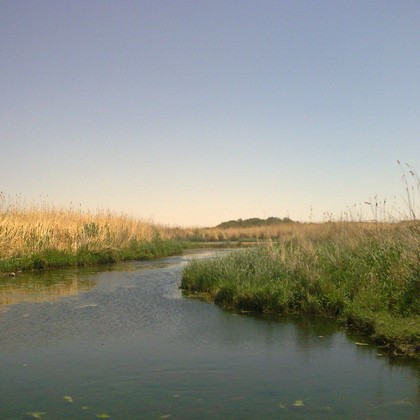
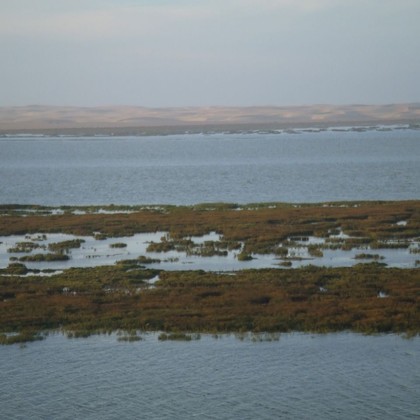
Shallow fresh and brackish water with a soft bottom: marshes, fish ponds, sewage ponds, flooded fields, lagoons and salt pans. It often wades deeper than other Tringa species, up to the belly, and sometimes swims; it also feeds in small groups that drive fish together.
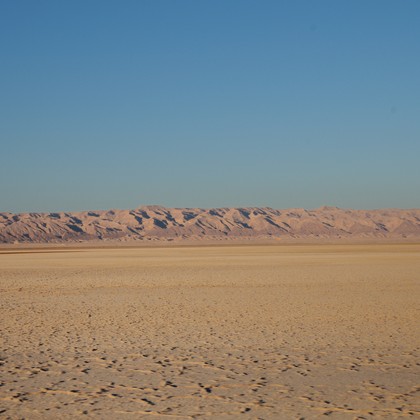
Where the bird is most at home, classified by the habitats of North Africa and the Middle East.
Range and movements
In the Maghreb a passage migrant and winter visitor in small numbers on the wetlands of Morocco, Algeria and Tunisia, such as Merja Zerga, the El Kala lagoons and Ichkeul; scarce on the Libyan coast. Egypt: on passage and in winter in the Nile Delta and on the delta lakes, also along the Nile. In the east fairly common in Israel (fish ponds of the Hula and Beit She'an valleys and the coast), in Jordan, Lebanon and Syria, and in the Mesopotamian marshes of Iraq. Scarce in Arabia: in the Emirates an uncommon and very localised passage migrant and winter visitor, recorded in all months except June; also scarce in Kuwait, Bahrain, Qatar, Saudi Arabia and Oman, and rare in Yemen. Breeds on the tundra and forest tundra from Lapland to eastern Siberia; also winters around the Mediterranean, in the Sahel and East Africa and in South and South-East Asia.
- Resident
- Summer visitor (c. Apr–Sep)
- Winter visitor (c. Oct–Mar)
- Passage (Mar–Apr, Oct–Nov)
- dark = core range, pale = thinly spread
How and when to look
The fish ponds of the Hula and Beit She'an valleys in Israel are good sites in winter and on passage, often with small groups wading together. In April and early May birds in almost entirely black breeding plumage can be seen there. In the Gulf states search mainly at sewage ponds and lagoons, but expect only a few birds.
Conservation status
Not globally threatened (LC). In Europe the breeding population in Fennoscandia has declined, possibly because of changes on the breeding grounds and along the flyway. In the region it depends on marshes and fish ponds; drainage of wetlands and the loss of the Mesopotamian marshes reduced the supply of suitable staging sites, though the partly restored marshes in Iraq offer room again.
Scientific name
Tringa erythropus | (Pallas, 1764)
Pallas described the species in 1764 as Scolopax erythropus; because it was later moved to another genus, the author and year stand in brackets. The genus Tringa was introduced in 1758 by Linnaeus. Tringa is the Neo-Latin name Aldrovandi gave to the green sandpiper, after Ancient Greek trungas, a thrush-sized, white-rumped, tail-bobbing wading bird mentioned by Aristotle. erythropus is Greek, from eruthros 'red' and pous 'foot', after the red legs. The specimen the first description was based on came from Holland.