All species › Passerines › Starlings › Spotless Starling
Spotless Starling | Sturnus unicolor
Zwarte spreeuw | Estornino negro
The Spotless Starling is the resident counterpart of the Common Starling in the western Mediterranean. In this region it breeds only in the Maghreb, where it is one of the commonest songbirds of villages, towns, olive groves and farmland; in winter it mixes there with large flocks of Common Starlings from Europe.
Voice
Like Common Starling, but louder and with more clear, drawn-out whistles, such as a rising and falling tsseeeoo and a sharp wee-oo, interspersed with clicking and rattling sounds and mimicry. The call is a short, sharp tchair; flocks give a grating shreeh.
Recording: João Ferreira Tomás — CC BY-NC-SA 4.0 · shortened to the first 60 s, mono · xeno-canto
Identification
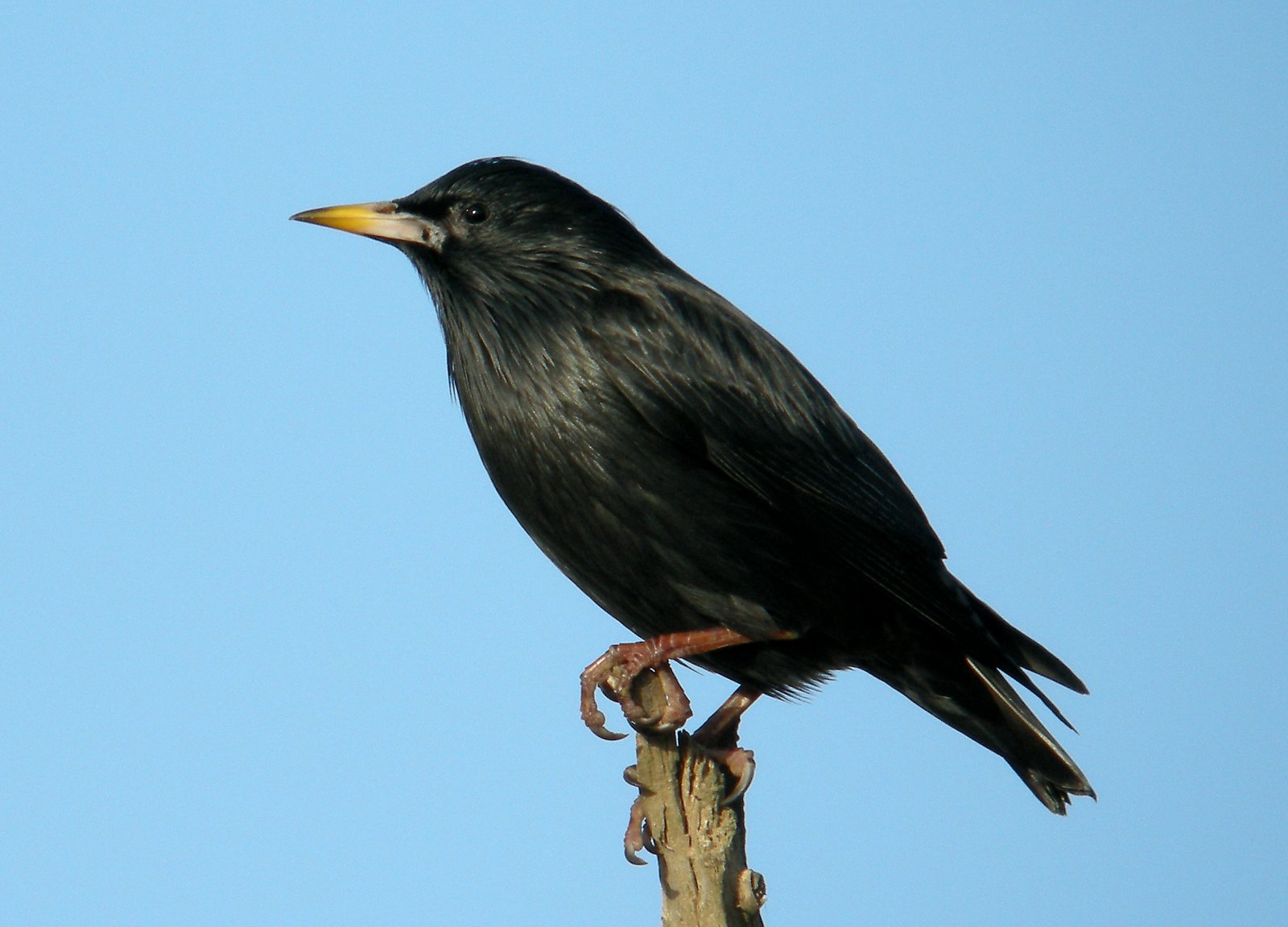
21–23 cm. In the breeding season uniformly black with a purplish, not green, gloss, with no or at most a few tiny pale spots; the throat and breast feathers are long and narrow and form a shaggy beard that is fluffed out when singing. Bill yellow, with a blue-grey base in the male and a pink base in the female; legs pink. In fresh plumage after the autumn moult with fine, sparse pale spots that wear off by spring, much finer than in Common Starling; the bill is then dark. Juveniles are uniform dark grey-brown, darker than young Common Starlings. In flight triangular wings and a short tail, like Common Starling.
Confusion species
Common Starling (Sturnus vulgaris), an abundant winter visitor to the Maghreb, is heavily spotted white and buff in winter plumage, has a green and purple gloss, short throat feathers and buff-fringed wing feathers; even in the breeding season it keeps brown fringes on the wings. Juveniles are tricky: the young Spotless Starling is darker and more uniform, with a darker throat. Common Blackbird (Turdus merula) has a longer tail, an orange bill and hops rather than walks.
Habitat
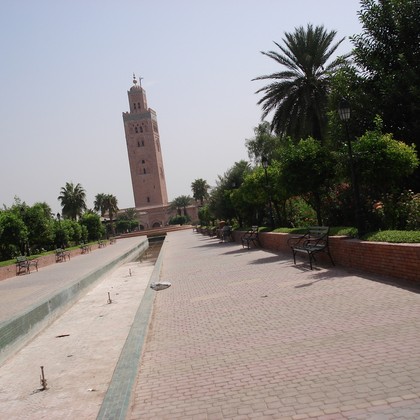
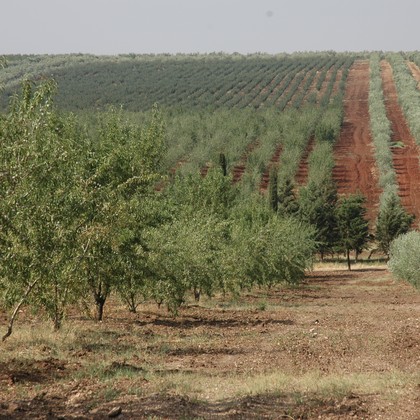
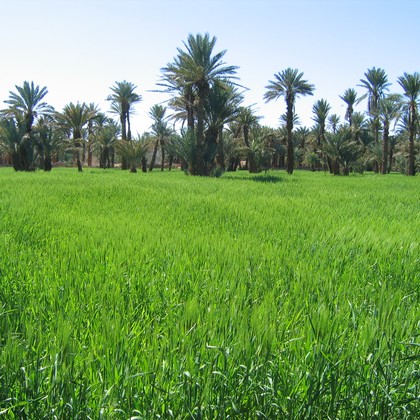
Open country with trees and buildings: villages, towns, farms, olive groves and orchards, fields and pastures, open oak and cork-oak woodland, cliffs and old walls. Nests in holes in buildings, walls, trees and rocks, often in loose colonies. Forages on foot for insects and also eats many olives, figs, grapes and other fruit.
Where the bird is most at home, classified by the habitats of North Africa and the Middle East.
Range and movements
Resident in north-west Africa: in Morocco common in the north, the Atlantic lowlands and the valleys of the Rif and the Middle and High Atlas, south to about the Souss; in northern Algeria in the Tell and the coastal belt; in northern and central Tunisia. Absent from the Sahara; in Libya at most a vagrant. Beyond the region in the Iberian Peninsula, southern France, Corsica, Sardinia and Sicily.
- Resident
- Summer visitor (c. Apr–Sep)
- Winter visitor (c. Oct–Mar)
- Passage (Mar–Apr, Oct–Nov)
- dark = core range, pale = thinly spread
How and when to look
In any town or village in northern Morocco, for example on the rooftops and aerials of Rabat, Fes or Chefchaouen, where males sing in spring with fluffed-out throat feathers and flapping wings. In winter it pays to scan flocks of Common Starlings in olive groves for birds with an almost unspotted black plumage.
Conservation status
Not globally threatened. Common and probably stable; in North Africa locally controlled as a pest of olives and fruit.
Scientific name
Sturnus unicolor | Temminck, 1820
Temminck described the species in 1820 and placed it straight away in the genus where it still stands. The genus Sturnus was introduced in 1758 by Linnaeus. Sturnus is the Latin word for 'starling'. unicolor is Latin for 'of one colour', from unus 'one' and color 'colour', after the unspotted plumage. The specimen the first description was based on came from Sardinia.