All species › Passerines › Thrushes › Song Thrush
Song Thrush | Turdus philomelos
Zanglijster | Zorzal común
The Song Thrush is the common wintering thrush of the region: from October to March it inhabits olive groves, orchards, parks and oases from Morocco to the Persian Gulf. It does not breed here; the birds come from Europe, Turkey and western Russia.
Voice
The winter call is a short, sharp tsip, often in flight and at night from migrating birds; when alarmed a ticking chik-chik. The song, sometimes heard as early as February or March before departure, consists of loud, clear motifs each repeated two to four times.
Recording: Paolo Zucca — CC BY-NC-SA 4.0 · converted to mono · xeno-canto
Identification
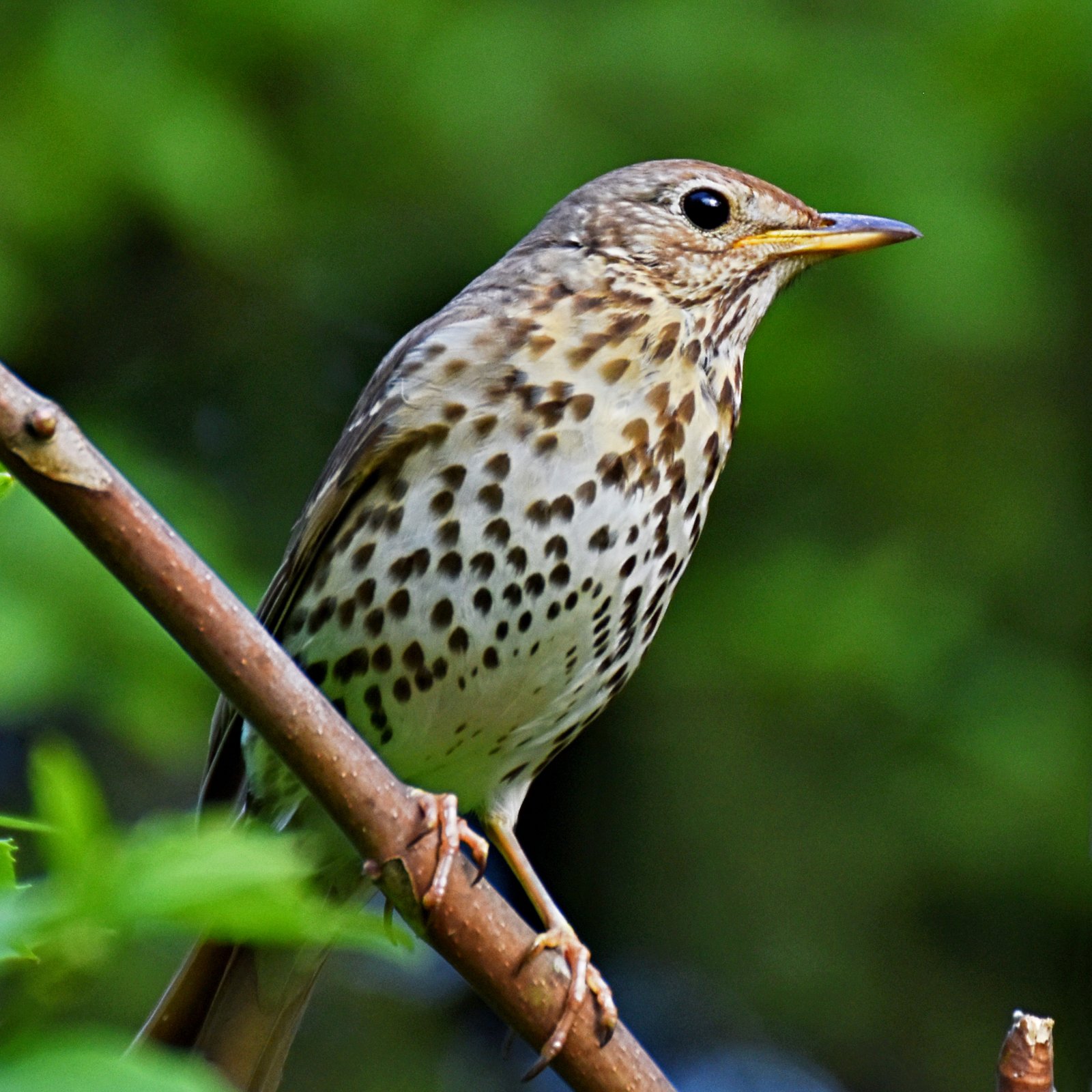
20–23 cm. A medium-sized, compact thrush with a fairly short tail. Upperparts warm olive-brown and unmarked; wing coverts with small pale tips. Underparts white, washed warm yellowish to buff on the breast and flanks, with small dark arrow- or drop-shaped spots in neat rows; the belly is white and less spotted. The head is rather plain with a pale eye-ring and a faint malar stripe. In flight a warm orange-buff underwing. Sexes alike.
Confusion species
Mistle Thrush (Turdus viscivorus) is much larger and greyer, with large round spots, a white underwing and white tail corners. Redwing (Turdus iliacus) has a broad white supercilium, a dark cheek and rusty-red flanks and underwing. Yemen Thrush (Turdus menachensis), in the mountains of south-west Arabia, has streaks instead of spots, a dull unspotted belly and an orange-yellow bill.
Habitat
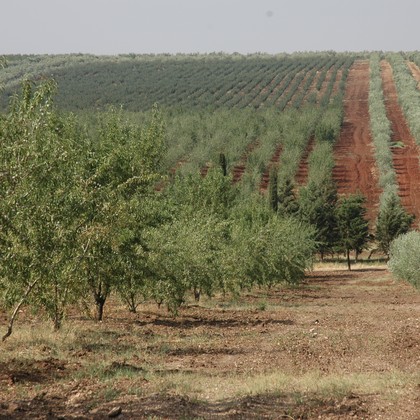
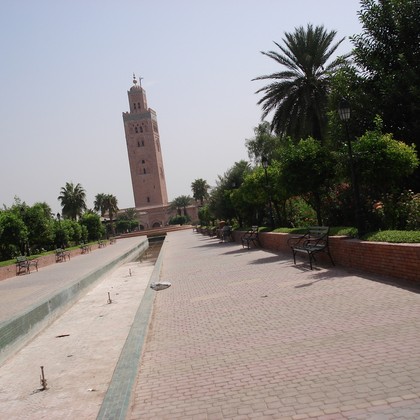
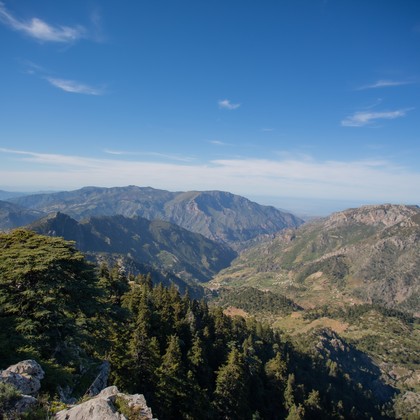
In winter olive groves, orchards, vineyards, maquis, parks and gardens, scrub along wadis, irrigated farmland and oases with date palms; also city parks in the Gulf states. Forages on the ground for worms, snails and insects, and eats many berries and olives. On passage any area with trees or bushes.
Where the bird is most at home, classified by the habitats of North Africa and the Middle East.
Range and movements
Common winter visitor to northern Morocco, Algeria and Tunisia, coastal Libya, northern Egypt (Nile Delta, Sinai), Israel, Lebanon, Syria, Jordan and Iraq. On the Arabian Peninsula a common winter visitor to Kuwait, northern and eastern Saudi Arabia, Bahrain and Qatar, less common in the Emirates and Oman and rare in Yemen. In the Sahara only on passage in oases. Breeds from Europe to central Siberia and northern Iran.
- Resident
- Summer visitor (c. Apr–Sep)
- Winter visitor (c. Oct–Mar)
- Passage (Mar–Apr, Oct–Nov)
- dark = core range, pale = thinly spread
How and when to look
In winter in an olive grove or park in the Maghreb or the Levant: look for a thrush that runs, stops and cocks its head to listen for worms. Snail shells on a stone (an 'anvil') betray its presence.
Conservation status
Not globally threatened. In the region it is trapped and shot on a large scale, in the Maghreb and the Levant with nets and limesticks; this hunting mainly affects the wintering birds.
Scientific name
Turdus philomelos | Brehm, 1831
Brehm described the species in 1831 and placed it straight away in the genus where it still stands. The genus Turdus was introduced in 1758 by Linnaeus. Turdus is the ordinary Latin word for 'thrush'. philomelos refers to Philomela of Greek myth, who was turned into a singing bird; her name is formed from philos 'loving' and melos 'song'. The specimen the first description was based on came from central Germany.