All species › Waders, gulls and terns › Sandpipers and snipes › Ruff
Ruff | Calidris pugnax
Kemphaan | Combatiente
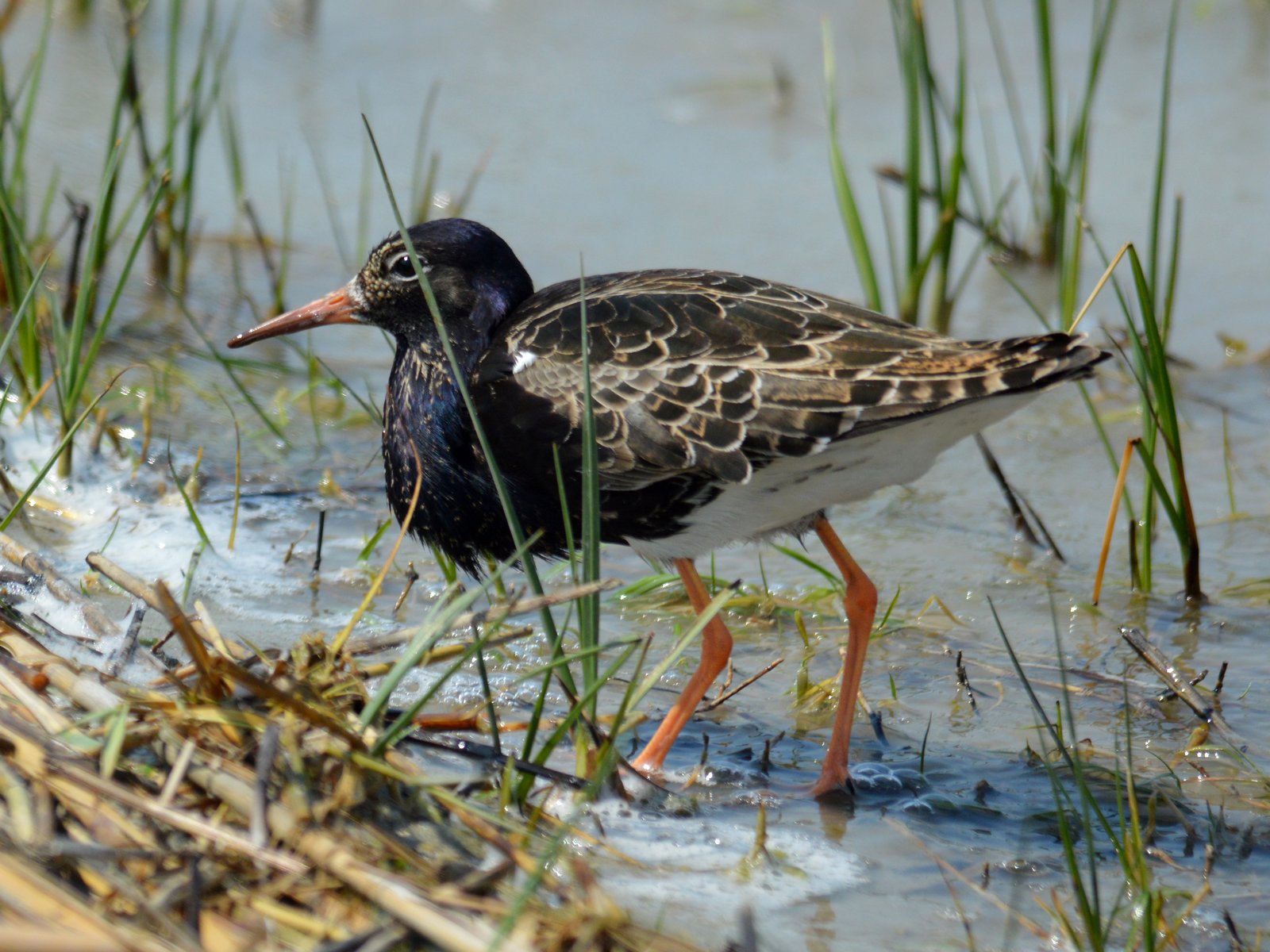
A wader with a striking difference between the sexes: males are much larger than females and in spring sport ruffs and ear tufts in varying colours. In the region it is one of the most numerous passage migrants, crossing the Sahara and the Arabian deserts in flocks in March and April and then turning up at every pool, sewage pond and irrigated field.
Voice
Almost silent on passage and in winter; sometimes a soft, low kuk or gruu when flushed.
Recording: Stanislas Wroza — CC BY-NC-SA 4.0 · converted to mono · xeno-canto
Identification
Medium-sized, with a small head on a fairly long neck, a short, slightly decurved bill and fairly long legs that may be orange, yellow or greenish. Males are much larger than females. Outside the breeding season both sexes are grey-brown with dark centres and pale fringes to the feathers, giving scaly upperparts; often a pale area around the bill base. In spring males acquire a ruff and ear tufts in black, white, rufous or barred; on passage through the region these are usually only half developed. Juveniles are warm buff with neatly scaled upperparts. In flight a narrow white wingbar and two large white oval patches on either side of the dark rump.
Confusion species
A juvenile female sometimes recalls a Common Redshank (Tringa totanus) or a Wood Sandpiper (Tringa glareola), but Ruff has a shorter bill, a smaller head, scaly rather than spotted upperparts and, in flight, the white oval rump patches. Pectoral Sandpiper (Calidris melanotos), a vagrant from North America and Siberia, has a sharply demarcated streaked breast and an all-dark centre to the rump. Buff-breasted Sandpiper (Calidris subruficollis), also a vagrant, is smaller, plain buff below and lacks white rump patches.
Habitat
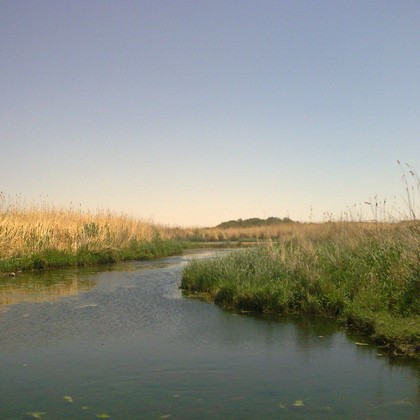
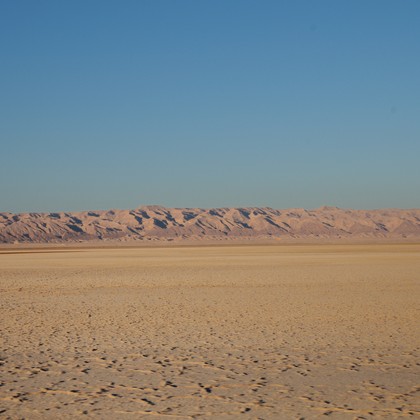
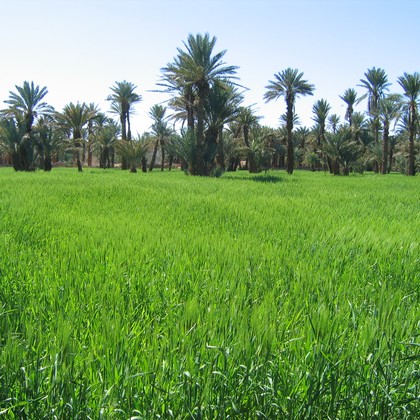
Shallow fresh and brackish water with muddy edges: flooded fields and irrigation plots, marshes, sewage pools, reservoirs, rice fields and the margins of salt lakes; also damp grassland and pivot fields in the desert. Visits open tidal flats less than most sandpipers.
Where the bird is most at home, classified by the habitats of North Africa and the Middle East.
Range and movements
A passage migrant throughout the region, from the Moroccan coast and the Saharan oases to the Gulf: in spring large numbers cross North Africa, the Nile Valley, Sinai, Israel (Jordan Valley, Eilat) and Jordan, and autumn passage runs broadly across the Arabian Peninsula, Iraq and the Levant. It winters in Morocco (mainly the Atlantic lowlands and Merja Zerga), northern Algeria, Tunisia, the Egyptian Nile Delta and Valley, Iraq (the Mesopotamian marshes), and patchily in Saudi Arabia, the Gulf states, Oman and Yemen, where irrigated farmland and sewage ponds in the desert attract many birds. Beyond the region it breeds from north-west Europe to eastern Siberia and winters mainly in the Sahel, East and southern Africa and South Asia.
- Resident
- Summer visitor (c. Apr–Sep)
- Winter visitor (c. Oct–Mar)
- Passage (Mar–Apr, Oct–Nov)
- dark = core range, pale = thinly spread
How and when to look
In March and April the fields and fishponds of the Jordan and Bet She'an valleys and the sewage ponds around Eilat are good places to see flocks fresh from Africa, with males whose ruffs are starting to grow. In the Gulf states flocks winter on pivot fields and lawns, for example around Al Wathba and in the Al Ain area.
Conservation status
Not globally threatened, but breeding populations in western Europe have collapsed through agricultural intensification, and the core of the flyway is shifting eastwards. In the region it is threatened by the drying out of wetlands, hunting of migrants and poisoning on farmland; at the same time irrigation schemes and sewage pools in the desert offer new stopover sites.
Scientific name
Calidris pugnax | (Linnaeus, 1758)
Linnaeus described the species in 1758 as Tringa Pugnax; because it was later moved to another genus, the author and year stand in brackets. The genus Calidris was introduced in 1804 by Merrem. Calidris goes back to Ancient Greek kalidris or skalidris, a name Aristotle used for an unidentified grey waterside bird. pugnax is Latin for 'combative', after the males' sparring at their display grounds. The specimen the first description was based on came from Sweden.