All species › Waders, gulls and terns › Gulls and terns › Ring-Billed Gull
Ring-Billed Gull | Larus delawarensis
Ringsnavelmeeuw | Gaviota de Delaware
A medium-sized North American gull that crosses the Atlantic to Europe and north-west Africa. In the region it is almost confined to Morocco, where it has been seen often enough since 1982 that a winter search through the gull flocks of the Atlantic coast has a fair chance of success.
Voice
Seldom heard in winter; a high, slightly hoarse kyow and a short kek-kek, higher and shriller than European Herring Gull.
Recording: Tom Cooney — CC BY-NC-SA 4.0 · converted to mono · xeno-canto
Identification
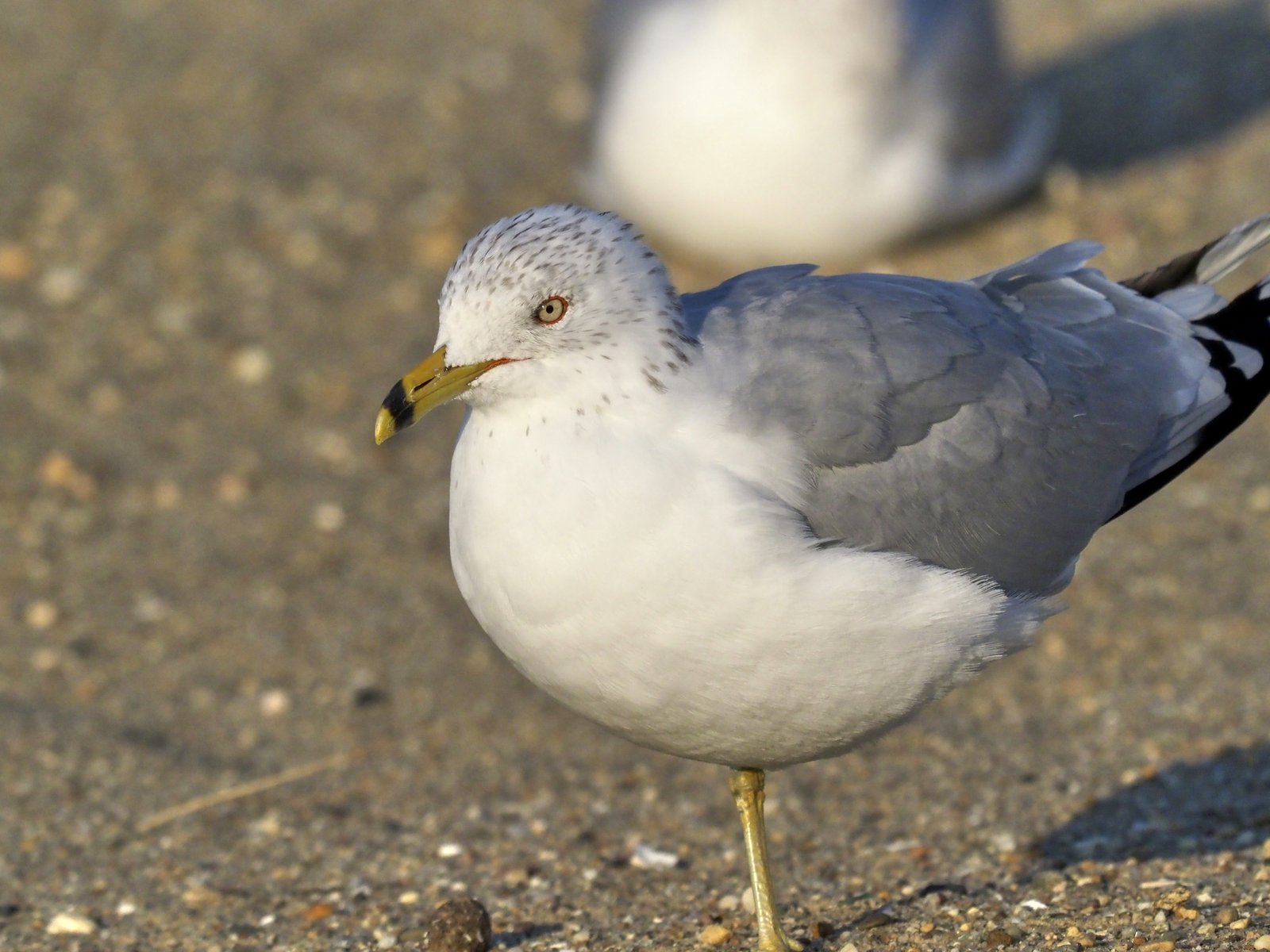
Slightly larger and bulkier than Common Gull, with a pale grey mantle that is paler than in that species. Adults have a yellow eye, yellow legs and a yellow bill with a sharp, complete black ring just behind the tip; in winter the head is finely brown-spotted. The wingtip is black with small white mirrors. Second-year birds already have a grey mantle but still brownish wing coverts, a pink bill with a black tip, a narrow, untidy black tail band and often a pale eye; first-years are grey-brown and scaly with a white tail base and an irregular dark band.
Confusion species
Common Gull (Larus canus) is the trickiest confusion: smaller and rounder-headed, with a darker grey mantle, a dark eye, a slimmer bill without a sharp ring and larger white mirrors in the wingtip. Yellow-legged Gull (Larus michahellis) and European Herring Gull (Larus argentatus) are much larger, with a red gonys spot; young birds of those species have a darker, more coarsely marked plumage. An adult Audouin's Gull (Ichthyaetus audouinii) also shows a dark band on the bill, but the bill is deep red with a black band and the legs are grey-green.
Habitat
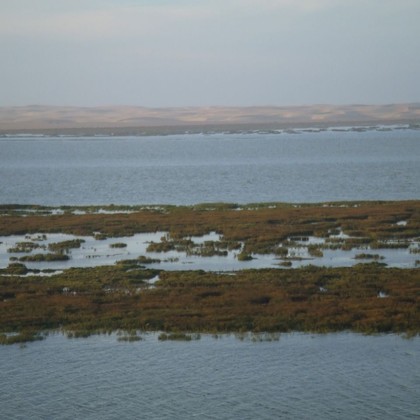
In the region on beaches, estuaries, lagoons, harbours and fish-processing sites, usually among other gulls; sometimes on freshwater pools near the coast. In North America it breeds on islands in inland lakes and winters on coasts, rivers and in car parks.
Where the bird is most at home, classified by the habitats of North Africa and the Middle East.

Range and movements
In Morocco it was first recorded in 1982, and by about 2011 some forty records had been documented, almost all in winter on the Atlantic coast from Rabat southwards, including near Agadir and at Plage Blanche, with a few on the Mediterranean coast (including near Melilla). Elsewhere in the region there are at most isolated records. Beyond the region it breeds in Canada and the northern United States and winters south to Mexico and the Caribbean; birds stray annually to western Europe, the Azores and the Canary Islands, and sporadically to West Africa.
- Resident
- Winter visitor (c. Oct–Mar)
- dark = core range, pale = thinly spread
How and when to look
Between November and March, search the large gull flocks at river mouths and fishing harbours on Morocco's Atlantic coast, such as around Agadir, for a Common Gull-sized bird with a paler mantle, a pale eye and a heavy bill with a sharp black ring. Birds often stay for weeks at the same site.
Conservation status
Not globally threatened and greatly increased in North America. In the region a rare winter visitor, recorded in Morocco almost every winter.
Scientific name
Larus delawarensis | Ord, 1815
Ord described the species in 1815 and placed it straight away in the genus where it still stands. The genus Larus was introduced in 1758 by Linnaeus. Larus is Latin, from Ancient Greek laros, and appears to have referred to a gull or another large seabird. delawarensis refers to the Delaware River in eastern North America. The specimen the first description was based on came from the Delaware River near Philadelphia.