All species › Passerines › Bulbuls › Red-Vented Bulbul
Red-Vented Bulbul | Pycnonotus cafer
Roodbuikbuulbuul | Bulbul cafre
The Red-vented Bulbul is a South Asian garden bird that did not reach this region on its own: escaped and released cage birds have become established in the cities on the Persian Gulf since the 1980s and 1990s. There it is now a familiar sight in parks, hotel grounds and villa districts, often alongside the native White-eared Bulbul.
Voice
Cheerful and noisy. The song is a short, jaunty whistled phrase, roughly be-quick-quick-wee or pee-pee-pa-wa, often given as a duet. The call is a sharp peep or pik, in alarm a rapidly repeated, shrill pik-pik-pik.
Recording: David Darrell-Lambert — CC BY-NC-SA 4.0 · converted to mono · xeno-canto
Identification
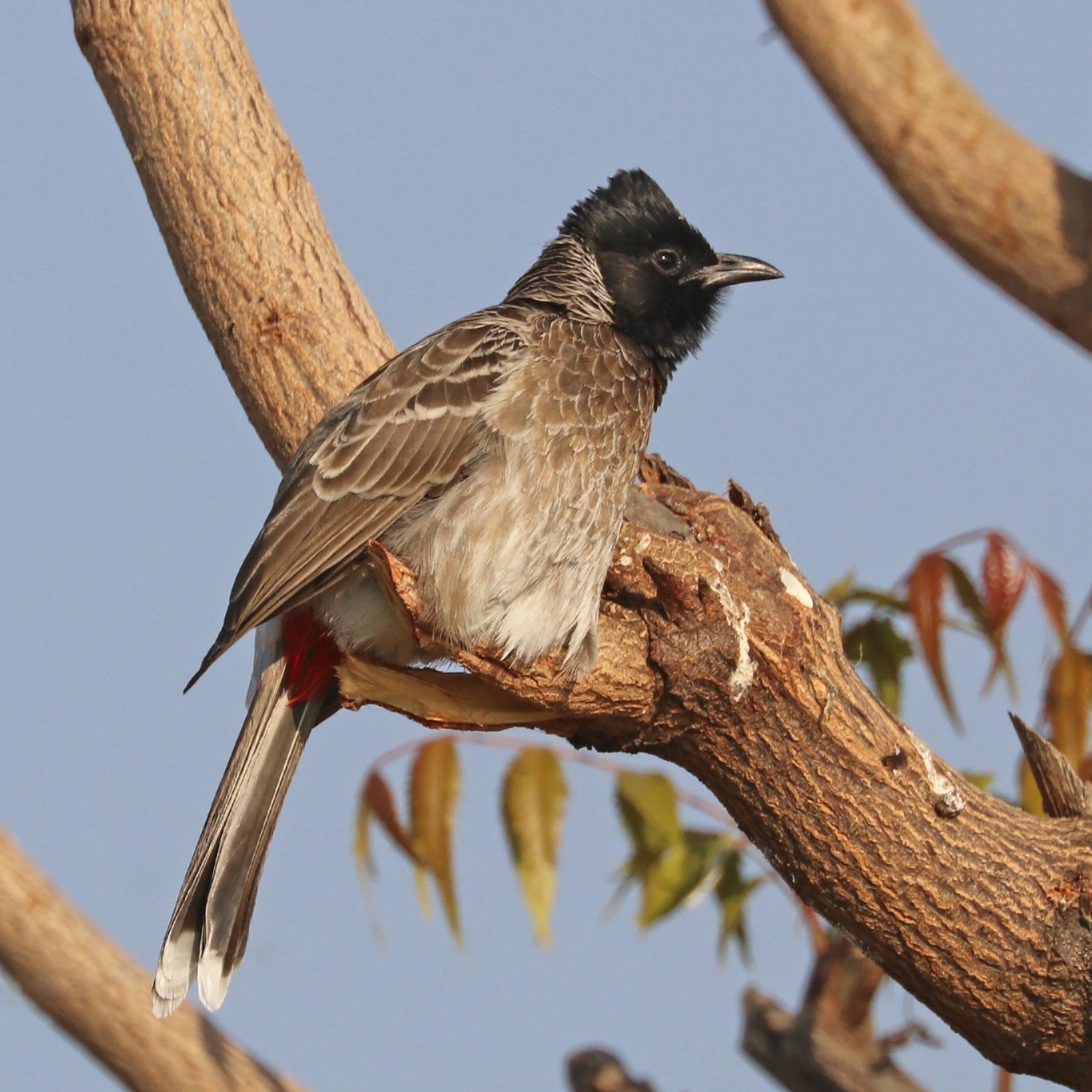
19–21 cm. A dark, slender bulbul with a short, pointed black crest. Head and throat are glossy black, without a white cheek patch or eye-ring; the black bib merges into a dark brown breast. Mantle, breast and flanks are dark greyish-brown with pale feather fringes, giving a distinctly scaly look at close range. The rump is off-white and conspicuous in flight, and the undertail coverts are bright crimson. The tail is blackish-brown with a white terminal band. The sexes are alike; juveniles are duller and browner on the head, with a paler, more orange-pink vent.
Confusion species
White-eared Bulbul (Pycnonotus leucotis) has a large white cheek patch, pale unscaled underparts, yellow undertail coverts and no white rump. Hybrids between the two are regular in the Gulf states: they show a small or faint white cheek patch, orange undertail coverts and a dark mottled breast, and cannot be safely assigned. White-spectacled Bulbul (Pycnonotus xanthopygos) has a white eye-ring and yellow under the tail. Red-whiskered Bulbul (Pycnonotus jocosus), occasionally seen elsewhere in the region as an escaped cage bird, has a tall black crest, a red patch behind the eye, white cheeks and white underparts.
Habitat
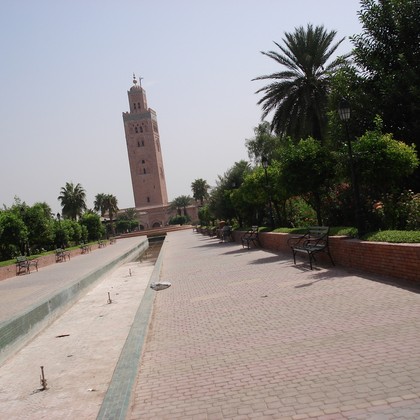
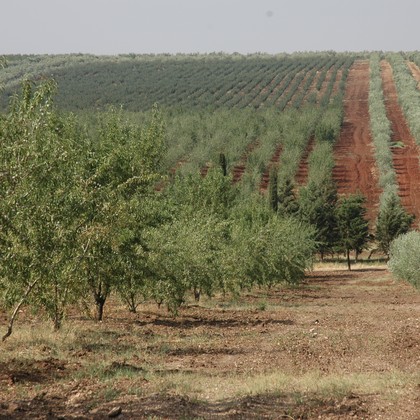
In the region almost exclusively in built-up areas: city parks, villa gardens, hotel grounds, golf courses, roadside plantings and irrigated orchards and date gardens on the edge of towns. It hardly occurs away from irrigated greenery. Eats fruit, berries, flowers and nectar, supplemented with insects. The nest is a small cup of twigs and grass in a shrub or low tree.
Where the bird is most at home, classified by the habitats of North Africa and the Middle East.
Range and movements
Established as an introduced species in Kuwait, Bahrain, Qatar (scarce, in parks and gardens), the United Arab Emirates (since the early 1990s, now in almost all cities), northern Oman (mainly around Muscat and on the Batinah coast) and eastern Saudi Arabia (Eastern Province), with local populations elsewhere, including around Riyadh. Isolated records elsewhere in the region relate to escaped cage birds. The natural range lies outside the region: from Pakistan through India, Sri Lanka and Nepal to Myanmar and south-west China. Also introduced elsewhere, including Hawaii, Fiji, Samoa and Tonga.
- Resident
- Summer visitor (c. Apr–Sep)
- Winter visitor (c. Oct–Mar)
- Passage (Mar–Apr, Oct–Nov)
- dark = core range, pale = thinly spread
How and when to look
In the Emirates and Bahrain an early morning in a city park is enough: the birds sit high in flowering trees and show the white rump and red vent as they fly off. In Qatar, Bahrain and the Emirates also look out for hybrids with White-eared Bulbul; note the colour of the undertail and the size of the cheek patch.
Conservation status
Not globally threatened and very common in its own range. The species does not occur naturally in the region; it was brought in as a cage bird and has become established through escaped and released birds in the urban green areas of the Gulf states. Elsewhere, especially on Pacific islands, it is regarded as a harmful invasive species. In the region the main concern is hybridisation with the native White-eared Bulbul.
Scientific name
Pycnonotus cafer | (Linnaeus, 1766)
Linnaeus described the species in 1766 as [Turdus] cafer; because it was later moved to another genus, the author and year stand in brackets. The genus Pycnonotus was introduced in 1826 by Boie. Pycnonotus is Greek, from puknos 'thick, compact' and -nōtos '-backed', from nōton 'back', after the dense plumage of the back. cafer refers to the Cape region (Kaffraria) of South Africa, an error, as the species does not occur there. The specimen the first description was based on came from Sri Lanka.