All species › Passerines › Chats and flycatchers › Pied Bush Chat
Pied Bush Chat | Saxicola caprata
Zwarte roodborsttapuit | Tarabilla pía
The Pied Bush Chat is an Asian relative of the European Stonechat, ranging from Iran and Central Asia to the Philippines and New Guinea. The nearest breeders, of the form rossorum, are in eastern Iran and Afghanistan and winter in Pakistan and India. In the region it is a rare vagrant, recorded mainly in the east and along the Red Sea.
Voice
The call is a dry chek-chek and a whistled chew. The song is a short, cheerful and fast phrase of whistles, chip-chepee-chewee, often given from a tall stem.
Recording: Dipendra Maharshi — CC BY-NC-SA 4.0 · converted to mono · xeno-canto
Identification
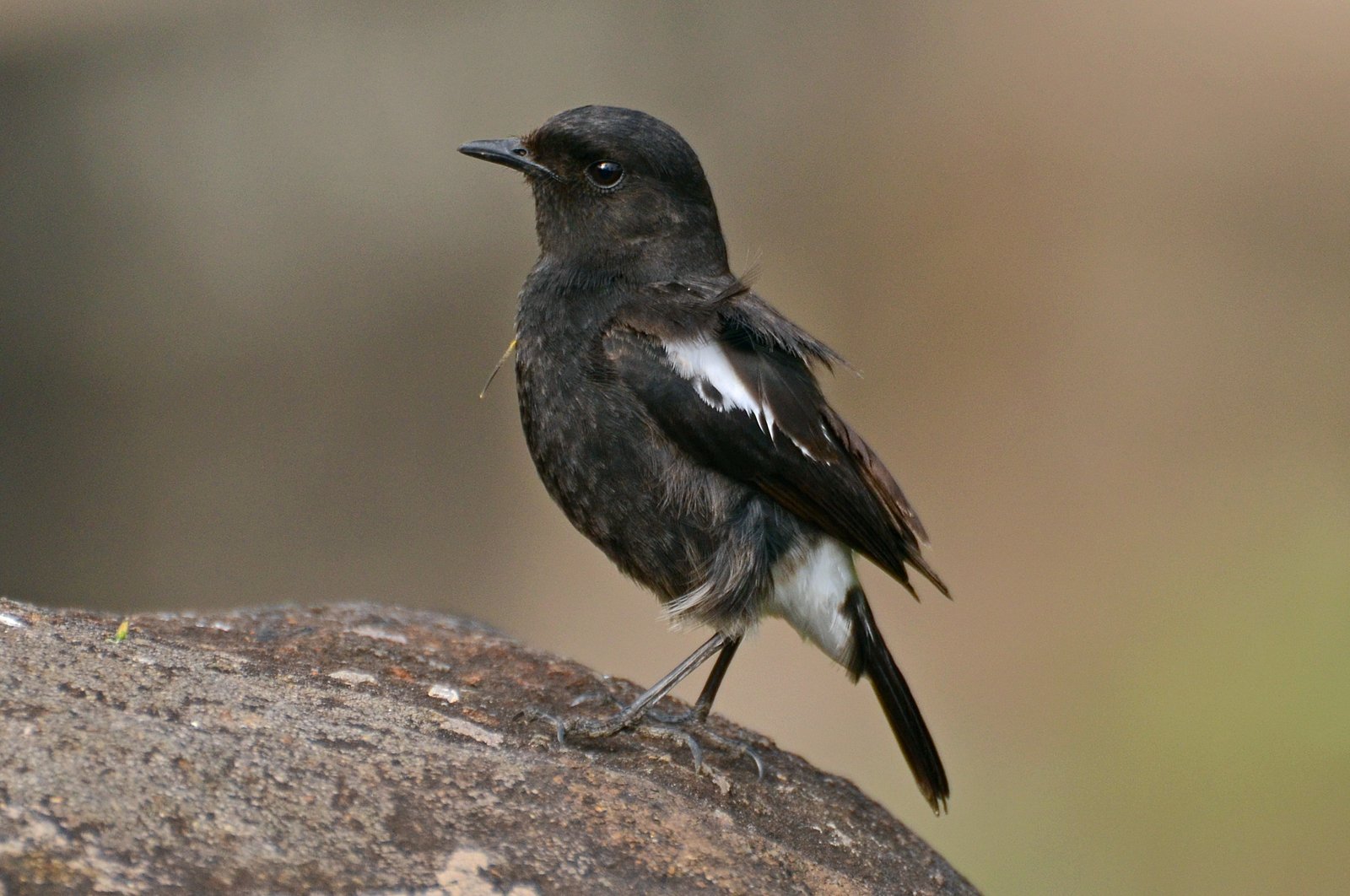
13–14 cm. A compact, upright bush chat. The male is entirely glossy black with a white wing-bar on the inner coverts, a white rump and white undertail-coverts; in flight the white in wing and rump stands out. In fresh autumn plumage brown fringes give the black a scaly, sooty wash. The female is plain dark greyish-brown, faintly streaked above, with a rufous rump and warm-toned belly; she lacks a clear supercilium and a white wing patch. Juveniles are spotted brown.
Confusion species
With his all-black head, back and breast the male cannot be confused with European Stonechat (Saxicola rubicola) or Siberian Stonechat (Saxicola maurus), which have an orange breast and white neck patch. Black wheatears such as Mourning Wheatear (Oenanthe lugens) and White-crowned Wheatear (Oenanthe leucopyga) are larger and longer-legged, show much white in the tail and perch on the ground or rocks rather than on stems. The female resembles a female Siberian Stonechat but is darker and plainer, without a pale supercilium or white neck patch.
Habitat
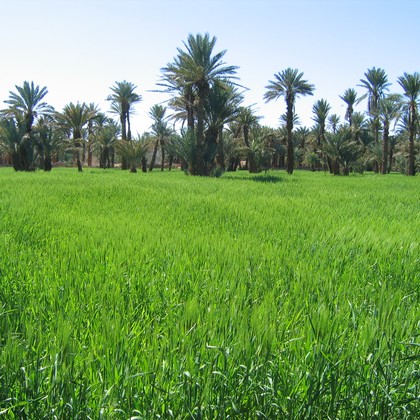
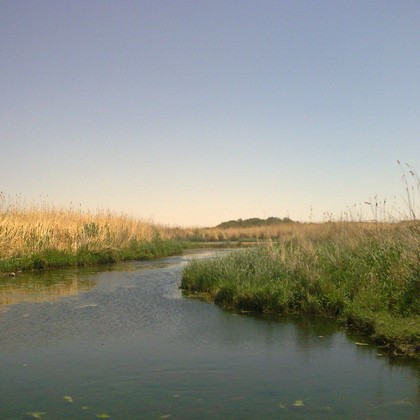
Outside the region open country with bushes, tall grass and reed fringes, field edges and irrigated land. In the region vagrants have mainly been found in damp, vegetated places: reed fringes, fields, parks and coastal oases.
Where the bird is most at home, classified by the habitats of North Africa and the Middle East.
Range and movements
A vagrant in the region. Israel had six records up to 2006; Egypt's first was in October 2006 at El Gouna on the Red Sea. In Kuwait it has been seen a few times (the second in May 2018), and there are a few records from the Emirates, Oman and Saudi Arabia. Its status in Iraq, close to the breeding range in Iran, is unclear. Beyond the region the species breeds from eastern Iran, Turkmenistan and Afghanistan through Pakistan and India to South-East Asia, the Philippines and New Guinea.
How and when to look
In spring in Kuwait, eastern Saudi Arabia and the Emirates, check any all-dark stonechat in reed fringes and fields. A photograph is wanted: national rarities committees will want to assess such a record.
Conservation status
Not globally threatened and a common bird in South Asia. In the region known only as a rare vagrant.
Scientific name
Saxicola caprata | (Linnaeus, 1766)
Linnaeus described the species in 1766 as Motacilla Caprata; because it was later moved to another genus, the author and year stand in brackets. The genus Saxicola was introduced in 1802 by Bechstein. Saxicola is Latin, from saxum 'stone, rock' and -cola 'dweller', from colere 'to inhabit': 'rock dweller', after the open stony ground these birds keep to. caprata is of uncertain origin; it may be Late Latin for 'of a goat', from caper 'he-goat', but what that would refer to is unclear. The specimen the first description was based on came from Luzon, Philippines.