All species › Birds of prey › Hawks, eagles and kites › Pallas's Fish Eagle
Pallas's Fish Eagle | Haliaeetus leucoryphus
Pallas' zeearend | Pigargo de Pallas
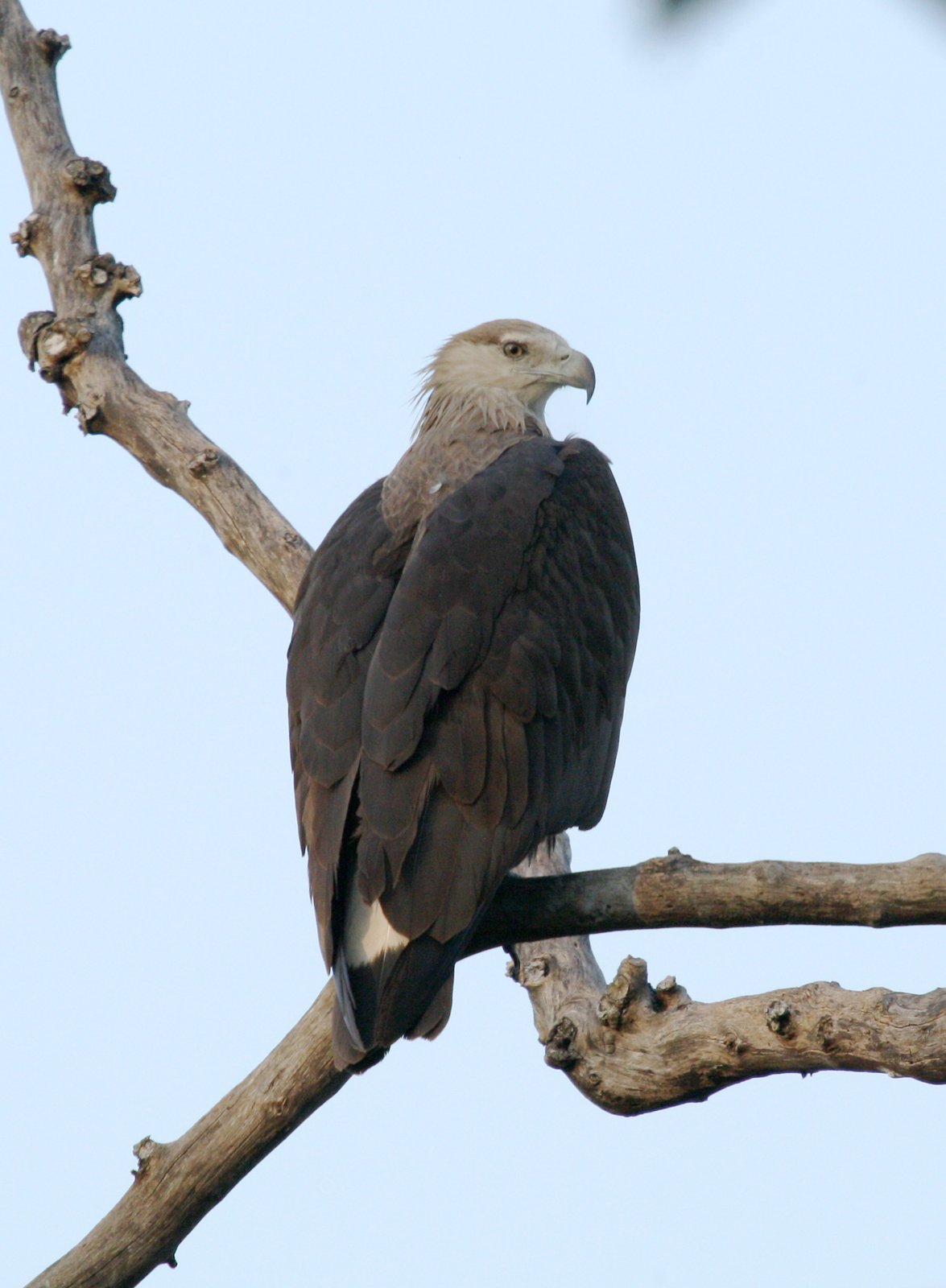
Pallas's Fish Eagle is a large, dark sea eagle of the lakes and rivers of Central and South Asia, with a pale head and a black tail with a broad white band. It is globally threatened. In the region it is a vagrant: the westernmost winterers once reached the marshes of Mesopotamia and the shores of the Persian Gulf.
Voice
Usually silent in winter. On the breeding grounds a loud, barking, far-carrying kok-kok-kok, often in duet.
Recording: Lars Lachmann — CC BY-NC-SA 4.0 · converted to mono · xeno-canto
Identification
72–85 cm, wingspan 180–215 cm. The adult has a pale sandy head and neck with a whitish throat, a dark brown body and dark wings. The decisive feature is the tail: black with a broad white central band. The bill is dark grey, less massive than in White-tailed Eagle. In flight long, fairly narrow, plank-like wings and a longer, rounded tail than in White-tailed Eagle. The juvenile is dark cool brown without a tail band, with a pale band across the underwing coverts and pale inner primaries, and a dark mask behind the eye; adult plumage is reached in about four years.
Confusion species
White-tailed Eagle (Haliaeetus albicilla) is larger, with a massive yellow bill, broader wings and a short, wedge-shaped tail that is all white in adults; the young White-tailed Eagle lacks the pale underwing band. A young Pallas's Fish Eagle may resemble a young Steppe Eagle (Aquila nipalensis) with its white wing band, but that has a shorter neck, smaller head and a rounded, barred tail. Osprey (Pandion haliaetus) is much smaller and white below.
Habitat
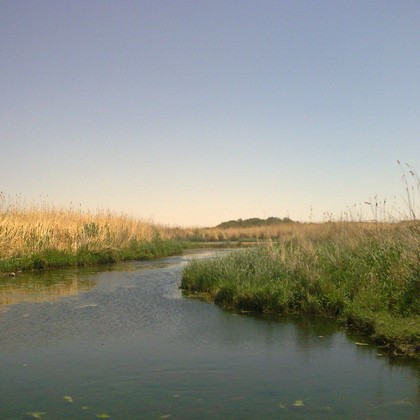
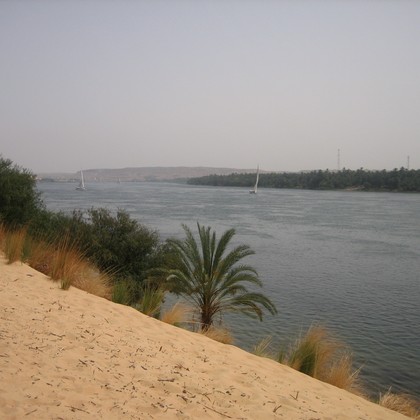
Large lakes, marshes and slow rivers in open country, with tall trees or reedbeds for roosting. Feeds mainly on fish, also waterbirds and carrion. In the region to be expected in the reed marshes and lakes of Mesopotamia and at fish farms and lagoons along the Persian Gulf.
Where the bird is most at home, classified by the habitats of North Africa and the Middle East.
Range and movements
According to the older literature a rare winter visitor to the marshes of southern Iraq; recent records in the region are extremely scarce and the species is now regarded as a vagrant to Iraq and the Persian Gulf. Not reliably recorded elsewhere in the region. Beyond it breeds from Kazakhstan and Mongolia to northern India, Bangladesh and Myanmar, and winters in South Asia, the westernmost birds reaching Iran.
How and when to look
A large, dark sea eagle with a black-and-white tail in the marshes of southern Iraq or on the Gulf coast is worth a photograph and a report; young birds are easily mistaken for a White-tailed Eagle or a Steppe Eagle.
Conservation status
Endangered: the world population numbers fewer than 2,500 adults and is declining through the drainage and pollution of lakes and marshes, nest disturbance and poisoning. The destruction of the Mesopotamian marshes in the 1990s made the region almost unsuitable for the species; with their partial recovery since then, new records cannot be ruled out.
Scientific name
Haliaeetus leucoryphus | (Pallas, 1771)
Pallas described the species in 1771 as Aquila leucorypha; because it was later moved to another genus, the author and year stand in brackets. The genus Haliaeetus was introduced in 1809 by De Savigny. Haliaeetus is Greek in origin, from hals 'sea' and aetos 'eagle': sea eagle. leucoryphus is Greek for 'white-headed', from leukos 'white' and koruphē 'crown, head'. The specimen the first description was based on came from the lower Ural River, Kazakhstan.