All species › Nightjars › Nightjars › Nubian Nightjar
Nubian Nightjar | Caprimulgus nubicus
Nubische nachtzwaluw | Chotacabras nubio
A small, warmly coloured nightjar of the African thorn savanna, which in the region occurs only in the deep rift of the Dead Sea and the Arava, in the Tihama of south-west Arabia and on Socotra. In Israel and Jordan it is one of the rarest breeding birds.
Voice
Not a churr but a repeated, soft and full two-note kow-wow ... kow-wow, with short pauses, from the ground or a tamarisk; it carries only a few hundred metres. When flushed a soft kwik.
Recording: Paul Coiffard — CC BY-NC-SA 4.0 · converted to mono · xeno-canto
Identification
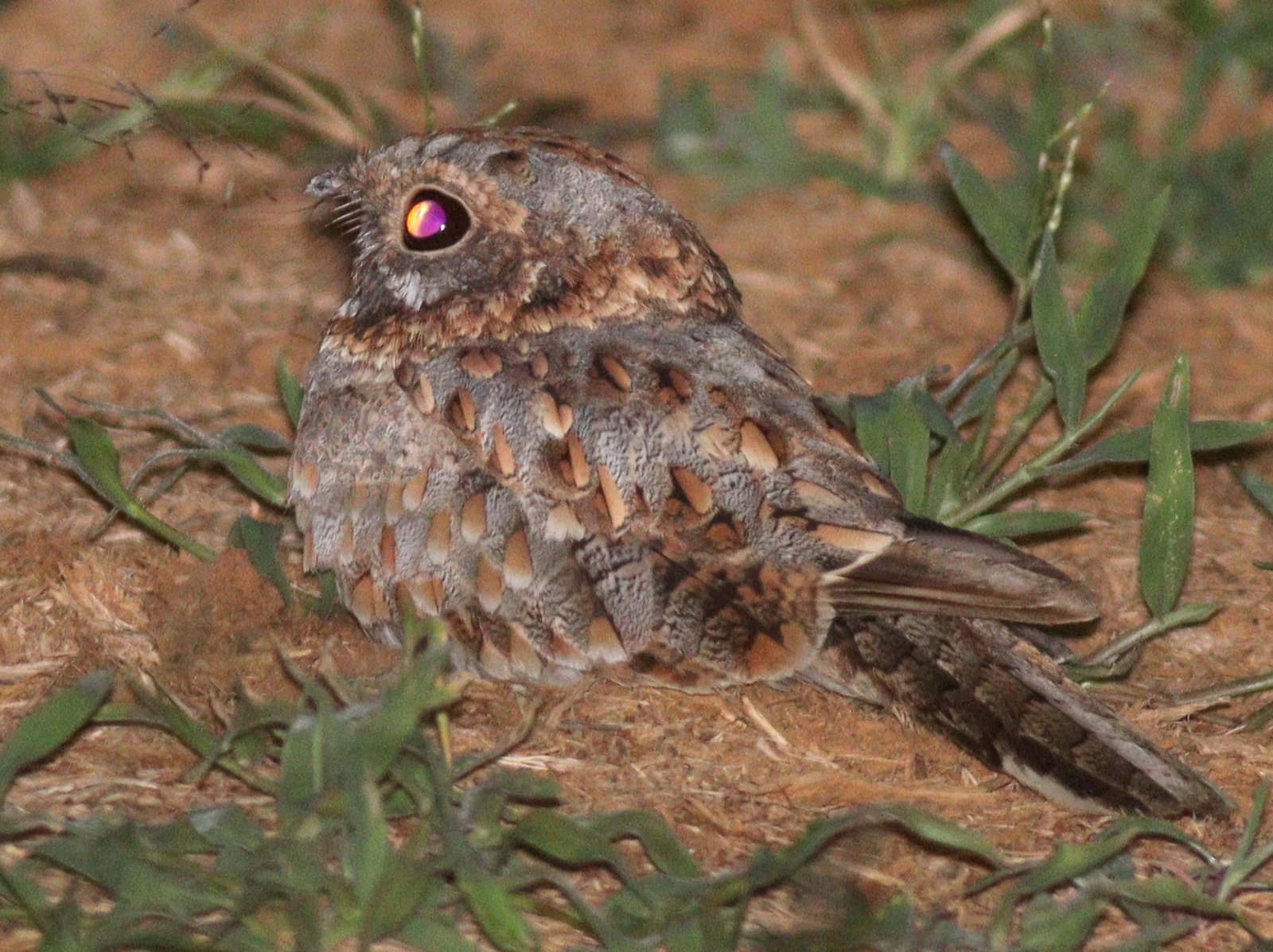
Small and compact, with a fairly short tail, blunt wings and a round head. Grey with much rufous, a warm rusty nape band and large yellow to cream drop-shaped spots on scapulars and wing-coverts. In flight the large white primary patches and white tail corners stand out in both sexes, though slightly smaller in the female. Flight short, low and fluttering.
Confusion species
Eurasian Nightjar (Caprimulgus europaeus) is larger and longer-tailed, without a rusty nape band, and only the male has white in wing and tail. Egyptian Nightjar (Caprimulgus aegyptius) is larger and uniformly sandy with little white. In south-west Arabia, Plain Nightjar (Caprimulgus inornatus) is plainer brown, without a rusty nape band or large drop-shaped spots.
Habitat
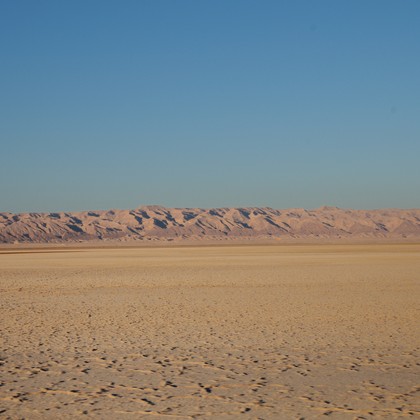
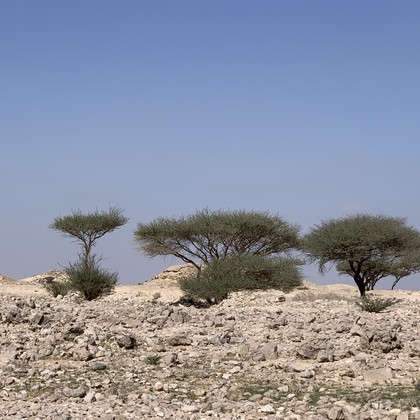
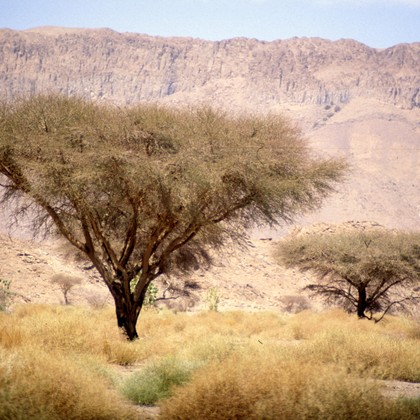
Salt marshes with scattered tamarisks, bare salt and clay flats, sandy places with sparse vegetation and acacia scrub in the hot lowlands. Rests by day in the shade of a bush, often on dry bare ground, and hunts at night low over open terrain.
Where the bird is most at home, classified by the habitats of North Africa and the Middle East.
Range and movements
In Israel an estimated 75–100 pairs breed, most of them in the Sodom basin at the southern end of the Dead Sea, further in the northern and southern Arava and at the north end of the Dead Sea; until the early 1980s it occurred north to Bet She'an. On the Jordanian side it breeds in the Ghor south of the Dead Sea (including at Fifa and Ghor Safi). In south-west Arabia it is resident in the Tihama of Saudi Arabia (Jizan) and Yemen, and Socotra has its own subspecies jonesi. There are a few reports from south-east Egypt and Oman. Beyond the region it occurs from Sudan and Eritrea to Somalia and northern Kenya.
- Summer visitor (c. Apr–Sep)
- Passage (Mar–Apr, Oct–Nov)
- dark = core range, pale = thinly spread
How and when to look
On a calm evening in March or April, drive along the edges of the salt marshes at Neot HaKikar and in the Sodom basin and listen for the soft kow-wow; birds often sit on the road. Drive slowly: traffic is one of the main causes of death here.
Conservation status
Not globally threatened, but vulnerable in Israel: after a steep decline in the 1980s the population recovered to several dozen pairs. Threats are the conversion of salt marshes to farmland, insecticides, road deaths and disturbance by off-road vehicles. Little is known about the Arabian populations.
Scientific name
Caprimulgus nubicus | Lichtenstein, 1823
Lichtenstein described the species in 1823 and placed it straight away in the genus where it still stands. The genus Caprimulgus was introduced in 1758 by Linnaeus. Caprimulgus is Latin, from capra 'nanny goat' and mulgere 'to milk', after the old belief that nightjars suckled goats at night. nubicus means 'of Nubia', the region along the Nile in present-day southern Egypt and northern Sudan. The specimen the first description was based on came from Nubia.