All species › Passerines › Sylvia warblers › Marmora's Warbler
Marmora's Warbler | Curruca sarda
Sardijnse grasmus | Curruca sarda
Marmora's Warbler is a small, uniformly slate-grey warbler of the maquis of Corsica and Sardinia. Part of the population crosses the Mediterranean in winter to the eastern Maghreb, and a small outpost breeds on the Tunisian islet of Zembra. Anyone looking for it in the region should therefore mainly search the coastal scrub of Tunisia in winter.
Voice
On Zembra and in spring a fast, scratchy chatter of one to two seconds, fuller and lower than Dartford Warbler's and with short rattles in it. In winter mainly the call: a hard, dry chek, often in accelerating series, and a rattling cherr-r-r when agitated.
Recording: Benjamin Drillat — CC BY-NC-SA 4.0 · shortened to the first 60 s, mono · xeno-canto
Identification
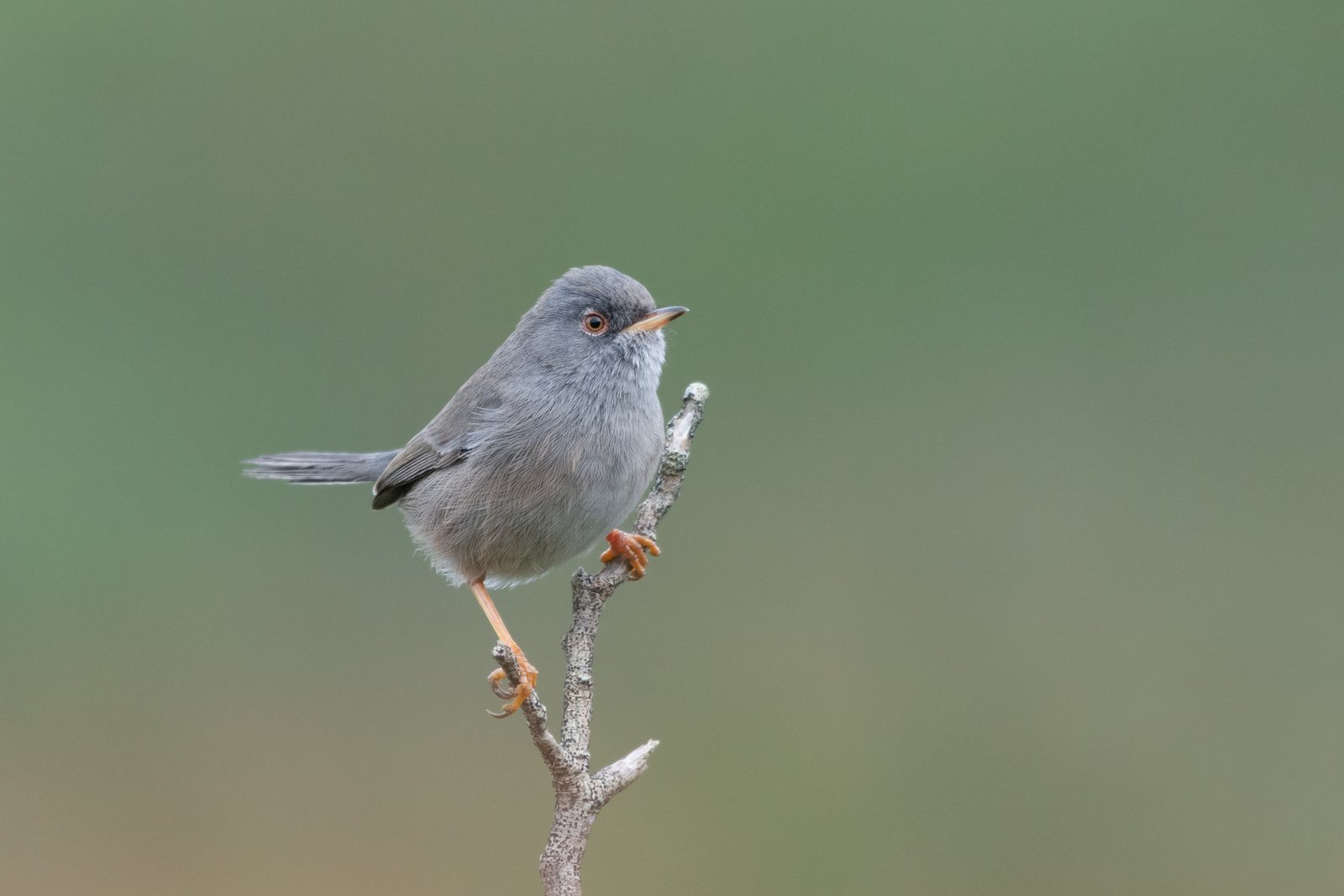
12–13 cm. Small and long-tailed, uniformly dark slate-grey from head to belly, without red, pink or brown in the plumage. The eye-ring is orange-red, the iris reddish brown, the legs orange and the bill dark with an orange base. The long, graduated tail is blackish with narrow pale edges. The female is slightly duller and browner grey, but remains uniform; juveniles are drab brown with a dull eye. Raises the crown feathers when excited.
Confusion species
Dartford Warbler (Curruca undata), in winter in the same Tunisian scrub, has wine-red underparts with white speckles on the throat; females and young are harder, but always show a brownish-pink tinge below. Balearic Warbler (Curruca balearica) has a pale belly and has not been recorded in the region. Sardinian Warbler (Curruca melanocephala) is bulkier, with a black hood above a sharply bordered white throat. Western Subalpine Warbler (Curruca iberiae) has an orange throat with a white moustache.
Habitat
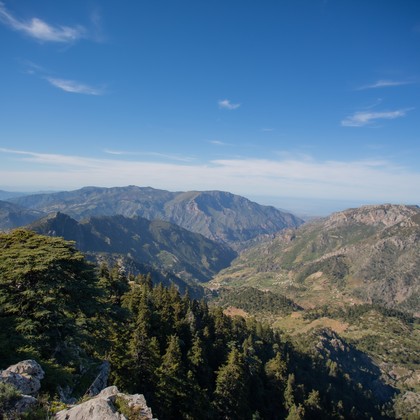
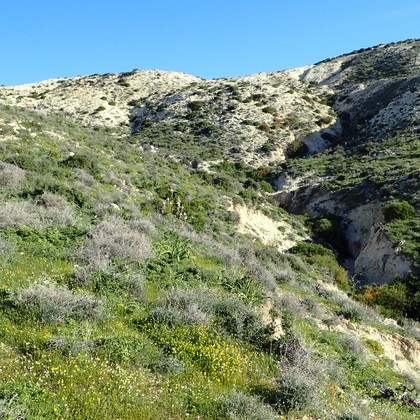
Low, dense scrub: maquis and garrigue with cistus, lentisk, rosemary and juniper on coastal hills and islands. In winter also in low open garrigue on the coastal plain and on the edges of saltbush and olive groves.
Where the bird is most at home, classified by the habitats of North Africa and the Middle East.
Range and movements
In the region mainly a winter visitor: in Tunisia (the coastal hills of Cap Bon, the Sahel of Sousse and Sfax and into the south-east), in eastern Algeria and in Tripolitania in north-west Libya; rare elsewhere in the Maghreb. A small breeding population on Zembra island in the Gulf of Tunis. Otherwise the species breeds on Corsica, Sardinia, the Tuscan islands and Pantelleria; outside those islands and the North African wintering area it is rare.
- Resident
- Summer visitor (c. Apr–Sep)
- Winter visitor (c. Oct–Mar)
- Passage (Mar–Apr, Oct–Nov)
- dark = core range, pale = thinly spread
How and when to look
In winter search the low garrigue of Cap Bon or the coastal hills around Hammamet and Monastir, and listen for the hard chek series. Check every dark, long-tailed warbler that lacks wine-red underparts.
Conservation status
Not globally threatened. Its entire world range is small and confined to a few islands, making it sensitive to maquis fires. The North African wintering range is poorly known; its status in Algeria and Libya is uncertain.
Scientific name
Curruca sarda | (Temminck, 1820) (GBIF: Sylvia sarda)
Temminck described the species in 1820 as Sylvia sarda; because it was later moved to another genus, the author and year stand in brackets. The genus Curruca was introduced in 1802 by Bechstein. Curruca is Latin, the name of an unidentified small bird mentioned by the Roman poet Juvenal. sarda is the Latin feminine form for 'Sardinian', after Sardinia. The specimen the first description was based on came from Sardinia.