All species › Waders, gulls and terns › Plovers and lapwings › Kentish Plover
Kentish Plover | Anarhynchus alexandrinus
Strandplevier | Chorlitejo patinegro
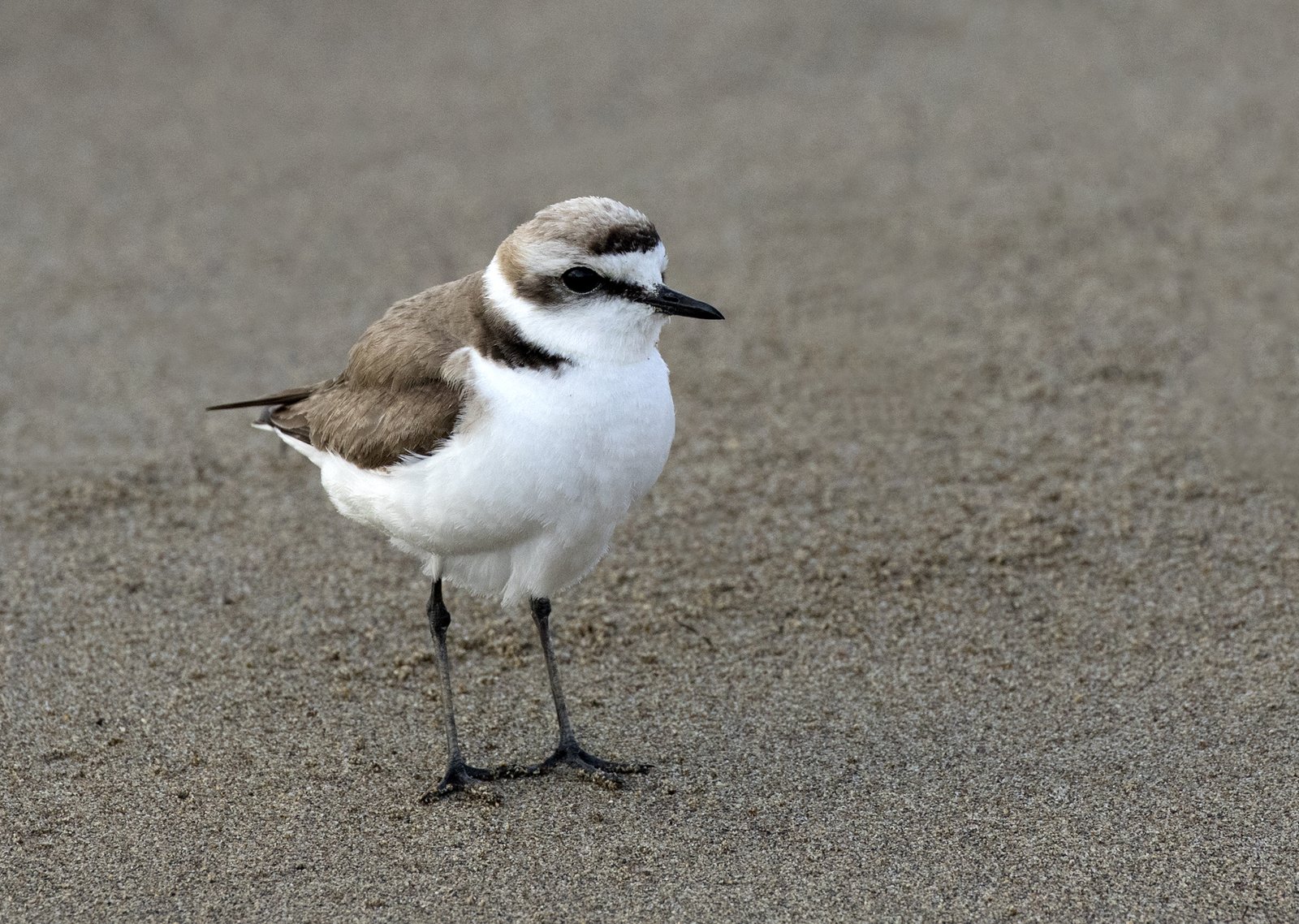
A small, pale plover that would rather run than fly across bare sandy flats. In the region it is the commonest breeding coastal plover: it occurs on almost every beach, salt pan and sebkha from Morocco's Atlantic coast to the Persian Gulf, and also breeds far inland on chotts and salt flats.
Voice
A soft, short pit or prrit and a slightly questioning too-it, much less clear than the whistle of Common Ringed Plover. In display the male gives a rattling, purring chirr-chirr-chirr, often in a butterfly flight low over the breeding site.
Recording: David Darrell-Lambert — CC BY-NC-SA 4.0 · converted to mono · xeno-canto
Identification
Small, sandy-brown and white, with a relatively large head, a fine all-black bill and dark grey to blackish, fairly long legs. The breast band is always broken: two separate dark patches at the breast sides, never a complete ring. The breeding male has a warm rufous crown, a black forehead bar and a black eye-stripe; females and winter birds are dull sandy-brown, with brown breast patches. In flight shows a clear white wing-bar and white tail sides. Runs in short, fast dashes, then stops dead.
Confusion species
Common Ringed Plover (Charadrius hiaticula) and Little Ringed Plover (Thinornis dubius) have a complete black breast band; Common Ringed also has orange legs and an orange bill base, Little Ringed a yellow eye-ring and no wing-bar. Siberian Sand Plover (Anarhynchus mongolus) and Greater Sand-Plover (Anarhynchus leschenaultii) are also pale with breast patches in winter, but larger, with a heavier bill and a broader, often complete grey-brown breast band; Greater Sand-Plover also has long, pale legs. A juvenile can recall a Sanderling (Calidris alba), but has the typical plover head with a short bill and large eyes.
Habitat
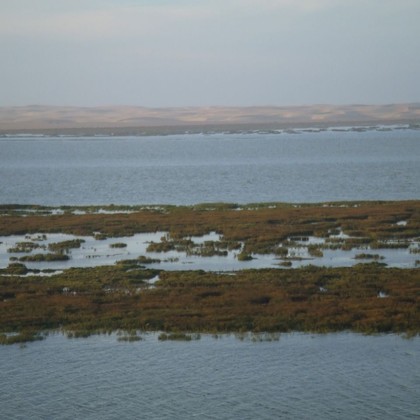
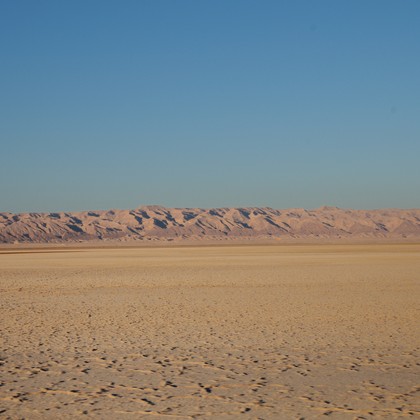
Bare, flat sand and mud flats with hardly any vegetation: beaches above the tideline, shell banks, coastal sebkhas, the bunds of salt pans, drying shores of lagoons and the edges of salt lakes and chotts inland. Also on reclaimed land, around fish farms and on the bare edges of sewage works in the Gulf states. Outside the breeding season on mudflats and in lagoons, often in loose flocks.
Where the bird is most at home, classified by the habitats of North Africa and the Middle East.
Range and movements
Breeds along almost the entire coast of the region: Morocco's Atlantic coast and Western Sahara south to Dakhla, the Mediterranean coast from Morocco to Israel and Lebanon, the Nile Delta and the Egyptian lakes, both coasts of the Red Sea (Sinai, Egypt, Saudi Arabia, Yemen), the coasts of Oman and Socotra, and the whole Persian Gulf from the Emirates, Qatar and Bahrain to Kuwait and southern Iraq. Inland it breeds on the chotts and sebkhas of Algeria and Tunisia, on salt flats in Libya and the Egyptian oases, around the Dead Sea and in Syria and Iraq. More numerous in winter, especially in the Gulf, on the Egyptian lakes, in the Tunisian salt pans and along Morocco's Atlantic coast. Beyond the region it breeds from western Europe and north-west Africa to Central Asia and China, and winters south to the Sahel, East Africa and South Asia.
- Resident
- Summer visitor (c. Apr–Sep)
- Winter visitor (c. Oct–Mar)
- Passage (Mar–Apr, Oct–Nov)
- dark = core range, pale = thinly spread
How and when to look
Easiest to see on the salt pans at Eilat, the Tunisian salt pans at Sfax and the lagoons of Khor Kalba and Ras al-Khor in the Emirates, where it feeds at close range. In spring, set the telescope on a bare sandy flat near a lagoon and wait: the birds only catch the eye when they start running.
Conservation status
Not globally threatened, but the world population is declining. In the region it suffers from coastal development and tourist beaches, infilling of sebkhas and lagoons, disturbance by vehicles and predation by dogs, cats and crows. Salt pans and protected lagoons are important breeding sites; in the Gulf it also breeds on reclaimed land, which disappears again once building starts.
Scientific name
Anarhynchus alexandrinus | (Linnaeus, 1758) (GBIF: Charadrius alexandrinus)
Linnaeus described the species in 1758 as Charadrius alexandrinus; because it was later moved to another genus, the author and year stand in brackets. The genus Anarhynchus was introduced in 1832 by Quoy & Gaimard. Anarhynchus is Greek, from ana- 'backward' and rhunkhos 'bill', after the sideways-bent bill of the wrybill, the type species of the genus. alexandrinus is Latin for 'of Alexandria', the Egyptian port the first described specimen came from. The specimen the first description was based on came from Egypt.