All species › Waders, gulls and terns › Gulls and terns › Kelp Gull
Kelp Gull | Larus dominicanus
Kelpmeeuw | Gaviota dominicana
A large, black-mantled gull of the southern hemisphere, which reaches the edge of the region through a small breeding population established in Mauritania and Senegal in recent decades. On the Atlantic coast of southern Morocco and Western Sahara it is now seen almost annually, often among Lesser Black-Backed Gulls.
Voice
A deep, hoarse kyaa and a laughing call series, lower than Lesser Black-backed Gull; little heard outside the breeding season.
Recording: African Bioacoustics Community — CC BY-NC-SA 4.0 · converted to mono · xeno-canto
Identification
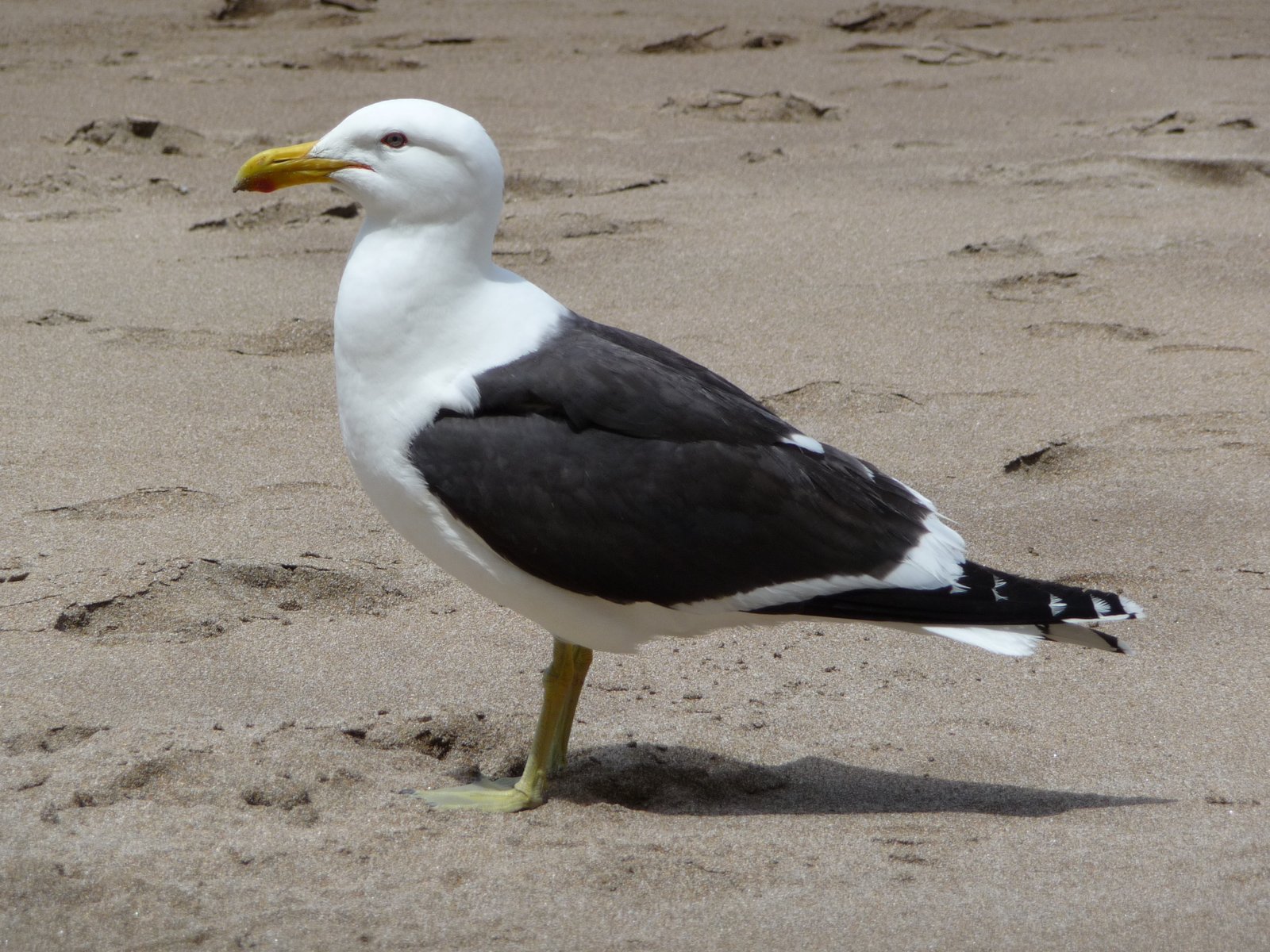
Large and heavily built, with a slate-grey to almost black mantle and wings, a heavy yellow bill with a red gonys spot and olive-green to greenish-yellow legs. West African birds (form vetula) usually have a dark eye. The wingtip is black with only one small white mirror on p10; the white trailing edge to the wing is broad. In flight it looks broad-winged and heavy. Young birds are dark grey-brown with a black bill; they acquire the black mantle gradually and are adult only after four years.
Confusion species
Great Black-backed Gull (Larus marinus) is even larger, with pink legs, a pale eye and much more white in the wingtip; at Khnifiss the two species occur together. Lesser Black-backed Gull (Larus fuscus), especially the dark form intermedius, is smaller and slimmer, with bright yellow legs, a pale eye, a slimmer bill and longer wingtips. Young Kelp Gulls are hard to separate from young Lesser and Great Black-Backed Gulls; the heavy bill and the legs help.
Habitat
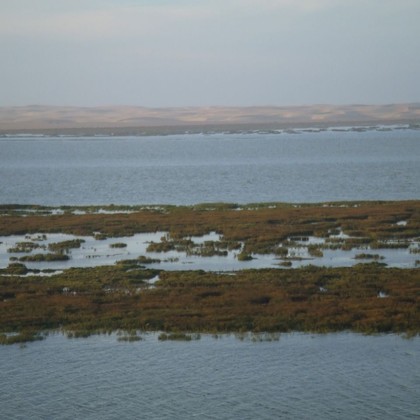
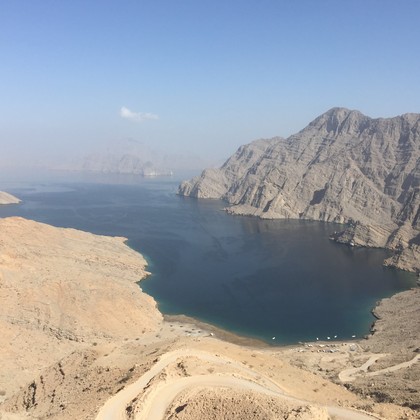
Sandy beaches, rocky shores, lagoons and estuaries, and above all fishing harbours and fish factories on the desert coast, where it roosts with other gulls and scavenges fish waste.
Where the bird is most at home, classified by the habitats of North Africa and the Middle East.
Range and movements
In the region known only from the Atlantic coast of southern Morocco and Western Sahara: most records come from Khnifiss lagoon, Akhfenir, Mhiriz and Dakhla, with odd birds further north to near Agadir. A few birds occur each year, sometimes up to four together; breeding has not been established in the region (breeding birds previously reported at Khnifiss proved to be Great Black-Backed Gulls). It is not known from the rest of the region. Beyond the region it breeds on the coasts of South America, southern Africa, Australia, New Zealand and subantarctic islands, and for some decades in small numbers in Mauritania and Senegal; wanderers reach the Canary Islands and exceptionally Europe.
- Resident
- Winter visitor (c. Oct–Mar)
- Passage (Mar–Apr, Oct–Nov)
- dark = core range, pale = thinly spread
How and when to look
The fishing harbours and fish factories between Tarfaya, Akhfenir and Dakhla, with their large flocks of Lesser Black-Backed Gulls, are the best places; between November and April look for a bird that is heavier and darker than the rest, with greenish legs.
Conservation status
Not globally threatened and numerous over much of its range. In the region a scarce non-breeding visitor, whose number of records seems to be increasing with the growth of the West African population.
Scientific name
Larus dominicanus | Lichtenstein, 1823
Lichtenstein described the species in 1823 and placed it straight away in the genus where it still stands. The genus Larus was introduced in 1758 by Linnaeus. Larus is Latin, from Ancient Greek laros, and appears to have referred to a gull or another large seabird. dominicanus refers to the Dominican friars, whose black-and-white habit recalls this gull's black back and white head and underparts. The specimen the first description was based on came from coast of Brazil.