All species › Cuckoos › Cuckoos › Jacobin Cuckoo
Jacobin Cuckoo | Clamator jacobinus
Jacobijnkoekoek | Críalo blanquinegro
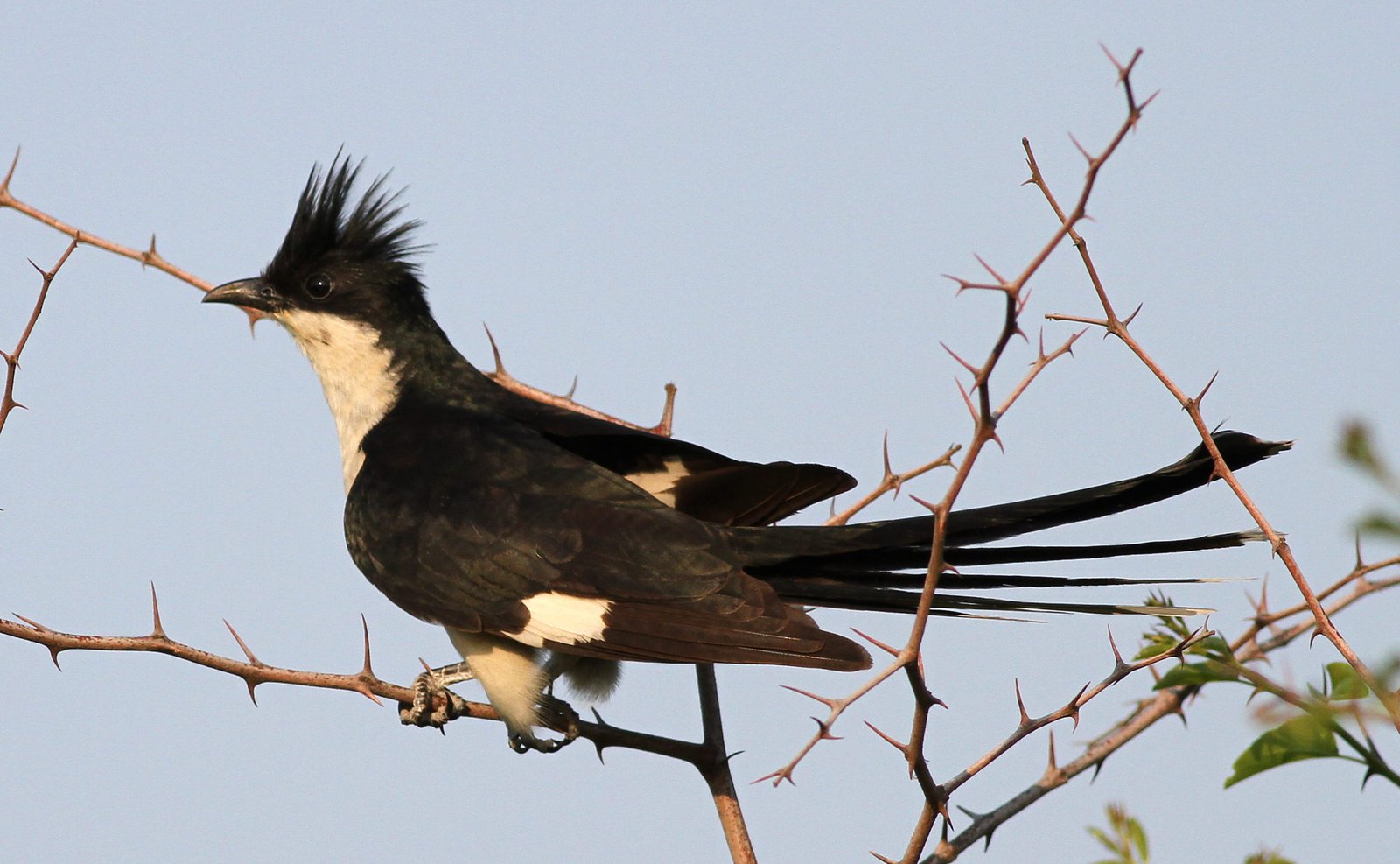
A black-and-white cuckoo with a pointed black crest and a long tail, which in the region occurs mainly in summer in south-west Arabia and Oman. It arrives with the monsoon and lays its eggs in the nests of bulbuls and babblers; outside that area it is a scarce migrant or vagrant.
Voice
A loud, clear, metallic piew-piu or kli-kli-klieuw, repeated several times, and a fast, shrill pee-pee-pee-pee during chases. Calls mainly in the first weeks after arrival, often in flight and from a high treetop.
Recording: Uku Paal — CC BY-NC-SA 4.0 · converted to mono · xeno-canto
Identification
Long, graduated tail and a pointed crest. The pale morph, by far the commonest in Arabia, is glossy black above with a narrow white patch at the base of the primaries and white tips to the tail feathers; underparts white to pale greyish, without streaks. The dark morph is all black apart from the white wing patch. Bill black. Juveniles are duller brownish-black above, with a short crest and buff-tinged underparts. Flight fast and direct, the white wing patch conspicuous.
Confusion species
Great Spotted Cuckoo (Clamator glandarius) is larger, with a grey crest, a white-spotted back and creamy-yellow breast. Levaillant's Cuckoo (Clamator levaillantii), an African species not recorded in the region, is larger with a black-streaked throat. A dark Jacobin Cuckoo may resemble a Black Drongo (Dicrurus macrocercus), but has a crest, a white wing patch and a rounded, not forked, tail.
Habitat
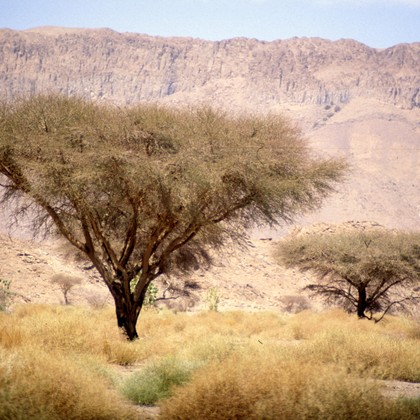
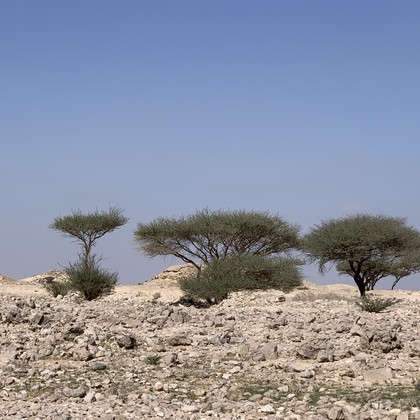
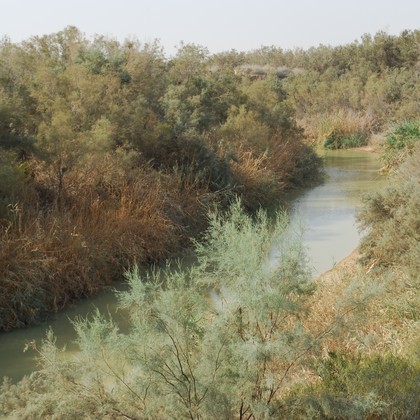
Acacia savanna and thorn scrub, wadis with riverine trees and figs, terraces and field edges with hedges in the mountains, and gardens; in Dhofar the monsoon woodland and green slopes above the coastal plain. On passage also in parks, palm groves and coastal vegetation. Eats hairy caterpillars and other insects, high in tree crowns or low in bushes.
Where the bird is most at home, classified by the habitats of North Africa and the Middle East.
Range and movements
Summer visitor and breeder in Yemen, mainly in the Tihama and the western mountains, and in south-west Saudi Arabia (Asir, Tihama); in Oman a summer visitor to Dhofar and scarce on passage in the north. Hosts are mainly White-spectacled Bulbul (Pycnonotus xanthopygos) and Arabian Babbler (Argya squamiceps). A scarce to rare migrant in the United Arab Emirates and elsewhere on the Arabian Peninsula; a vagrant to Israel, Jordan and Egypt. Beyond the region in sub-Saharan Africa and from Iran and South Asia to Myanmar; Indian birds migrate to East Africa, partly across Arabia.
- Resident
- Summer visitor (c. Apr–Sep)
- Winter visitor (c. Oct–Mar)
- Passage (Mar–Apr, Oct–Nov)
- dark = core range, pale = thinly spread
How and when to look
The best chance is from May to August in the vegetated wadis of the Tihama and south-west Saudi Arabia, or during the monsoon in Dhofar, when birds chase each other calling loudly. On autumn passage it pays to check coastal parks and gardens in Oman.
Conservation status
Not globally threatened. Widespread in the region, but its status in Yemen is poorly known; loss of riverine woodland and scrub through cutting and overgrazing may play a role locally.
Scientific name
Clamator jacobinus | (Boddaert, 1783)
Boddaert described the species in 1783 as Cuculus Jacobinus; because it was later moved to another genus, the author and year stand in brackets. The genus Clamator was introduced in 1829 by Kaup. Clamator is Latin for 'shouter', from clamare 'to shout'. jacobinus refers to the Jacobins, the French Dominican friars, whose black-and-white habit resembles the black-and-white plumage. The specimen the first description was based on came from Coromandel Coast, India.