All species › Passerines › Chats and flycatchers › Hooded Wheatear
Hooded Wheatear | Oenanthe monacha
Monnikstapuit | Collalba monje
The Hooded Wheatear is the largest and longest-tailed wheatear of the region, a resident of bare rocky desert, gorges and wadis from Egypt's Eastern Desert to Oman. It is scarce and thinly spread, often in the hottest and most barren spots, and catches many insects in flight like a flycatcher.
Voice
Rather silent. The call is a soft, dry chak or a whistled vit. The song is a varied, scratchy phrase of whistles and mimicry of other birds, not loud and not often heard.
Recording: Khalifa Al Dhaheri — CC BY-NC-SA 4.0 · shortened to the first 60 s, mono · xeno-canto
Identification
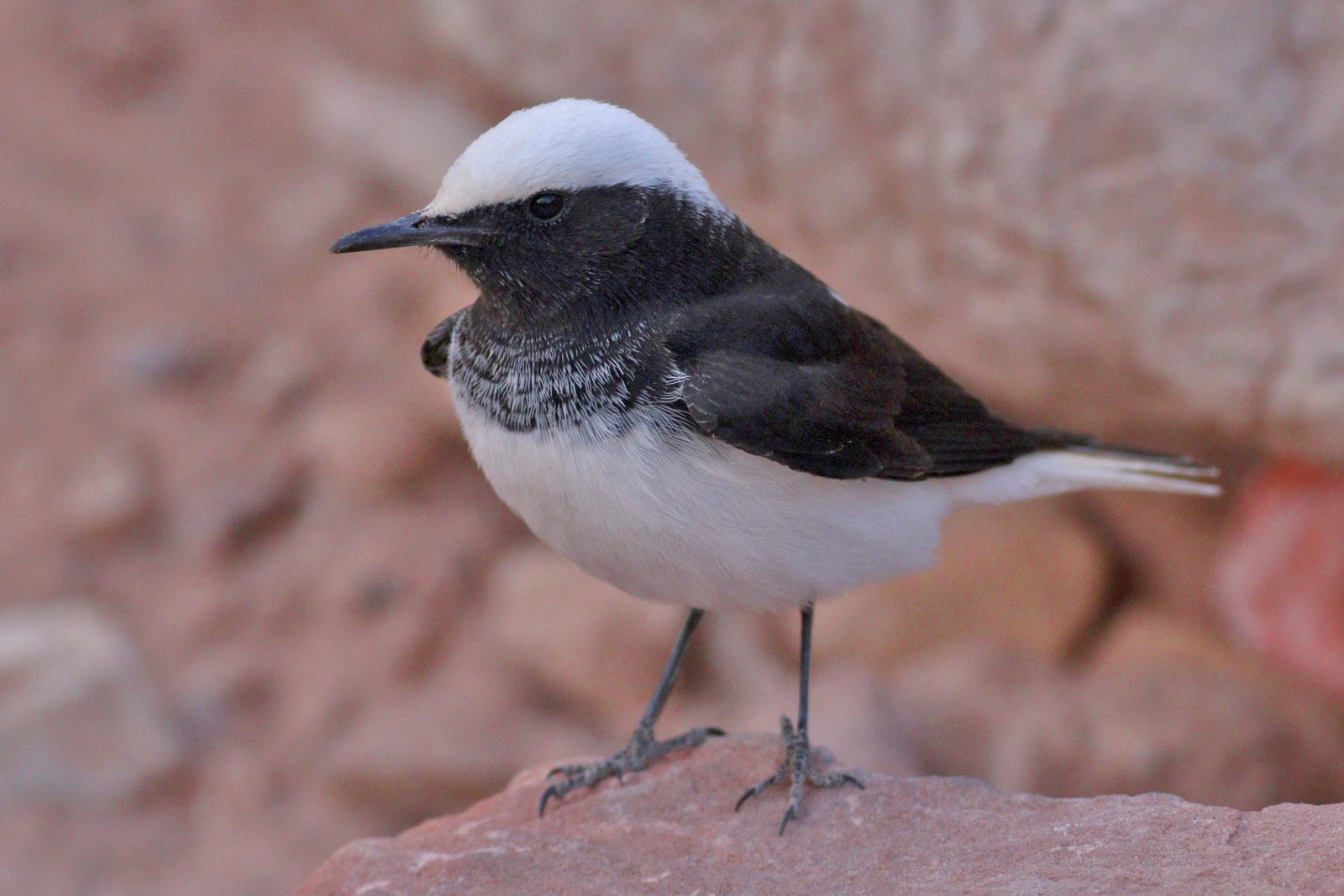
16–17.5 cm. Elongated, with a long tail and a strikingly long, slender bill. The male has a white crown and nape forming a hood that extends onto the mantle, and a black face, throat, breast, back and wings; belly, rump and undertail-coverts are white. The tail is white with black central feathers and no, or a very narrow, black terminal band. The female is plain sandy brown with a pale orange-buff rump and tail, only the central feathers and a faint terminal band being dark. In flight the female's rufous tail stands out.
Confusion species
Mourning Wheatear (Oenanthe lugens) is smaller and shorter-tailed, with a white crown not reaching the mantle, a black T-shaped tail pattern and warm buff undertail-coverts; the black throat does not extend onto the breast. White-crowned Wheatear (Oenanthe leucopyga) is all black apart from a white crown and white rump and tail. Pied Wheatear (Oenanthe pleschanka) has a dark back but is smaller and has a black terminal tail band. With her rufous tail the female resembles a female Red-tailed Wheatear (Oenanthe chrysopygia), but is larger, slimmer, paler and longer-billed.
Habitat
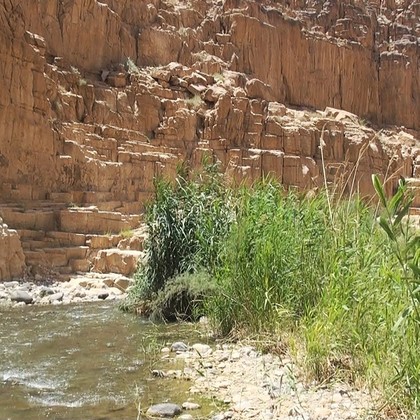
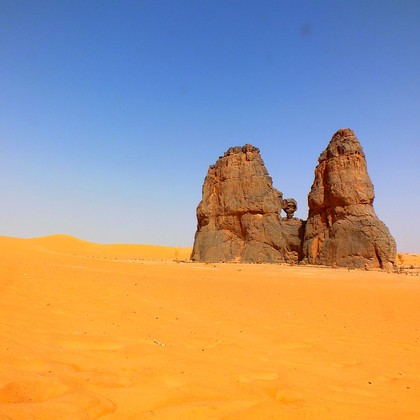
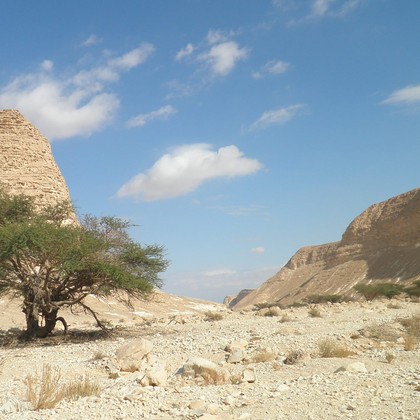
The barest rocky desert: steep gorges, cliffs and scree slopes, dry wadis with little or no vegetation, often in hot lowlands and up to about 1,500 m. Nests in rock crevices. Often catches insects in agile aerial sallies from a boulder.
Where the bird is most at home, classified by the habitats of North Africa and the Middle East.
Range and movements
In eastern Egypt: the Eastern Desert and Red Sea mountains, and in Sinai. Further in southern Israel (the mountains around Eilat and the edge of the Dead Sea), in southern Jordan (including Wadi Rum, Petra and the Dead Sea rift) and scattered across the rocky interior of Saudi Arabia, Yemen and Oman. In the Emirates it breeds scarcely in the Hajar mountains; it formerly bred more widely in the Emirates and Oman. In Iraq and Kuwait it is rare or a vagrant. Beyond the region the species occurs in the Red Sea Hills of Sudan, southern Iran, Afghanistan and Pakistan.
- Resident
- Winter visitor (c. Oct–Mar)
- Passage (Mar–Apr, Oct–Nov)
- dark = core range, pale = thinly spread
How and when to look
In Israel it is one of the target birds of the mountains around Eilat, for example Amram's canyon and the Shehoret canyon, and of the Dead Sea rift at Ein Gedi; in Jordan look for it in Wadi Rum. Be out early in the morning: in the midday heat it retreats into the shade of rocks.
Conservation status
Not globally threatened, but generally scarce and thinly spread in the region, at low densities. It has declined in the Hajar mountains of the Emirates and Oman; the causes are unclear, though disturbance and drought probably play a part.
Scientific name
Oenanthe monacha | (Temminck, 1825)
Temminck described the species in 1825 as Saxicola monacha; because it was later moved to another genus, the author and year stand in brackets. The genus Oenanthe was introduced in 1816 by Vieillot. Oenanthe was used by Aristotle for a bird that can no longer be identified; the word comes from the Greek oinos, oinoē 'wine, vine' and anthos 'flower, bloom'. monacha goes back to Late Latin monachus 'monk', after the black hood of the male. The specimen the first description was based on came from Luxor, Egypt.