All species › Passerines › Larks › Greater Short-Toed Lark
Greater Short-Toed Lark | Calandrella brachydactyla
Kortteenleeuwerik | Terrera común
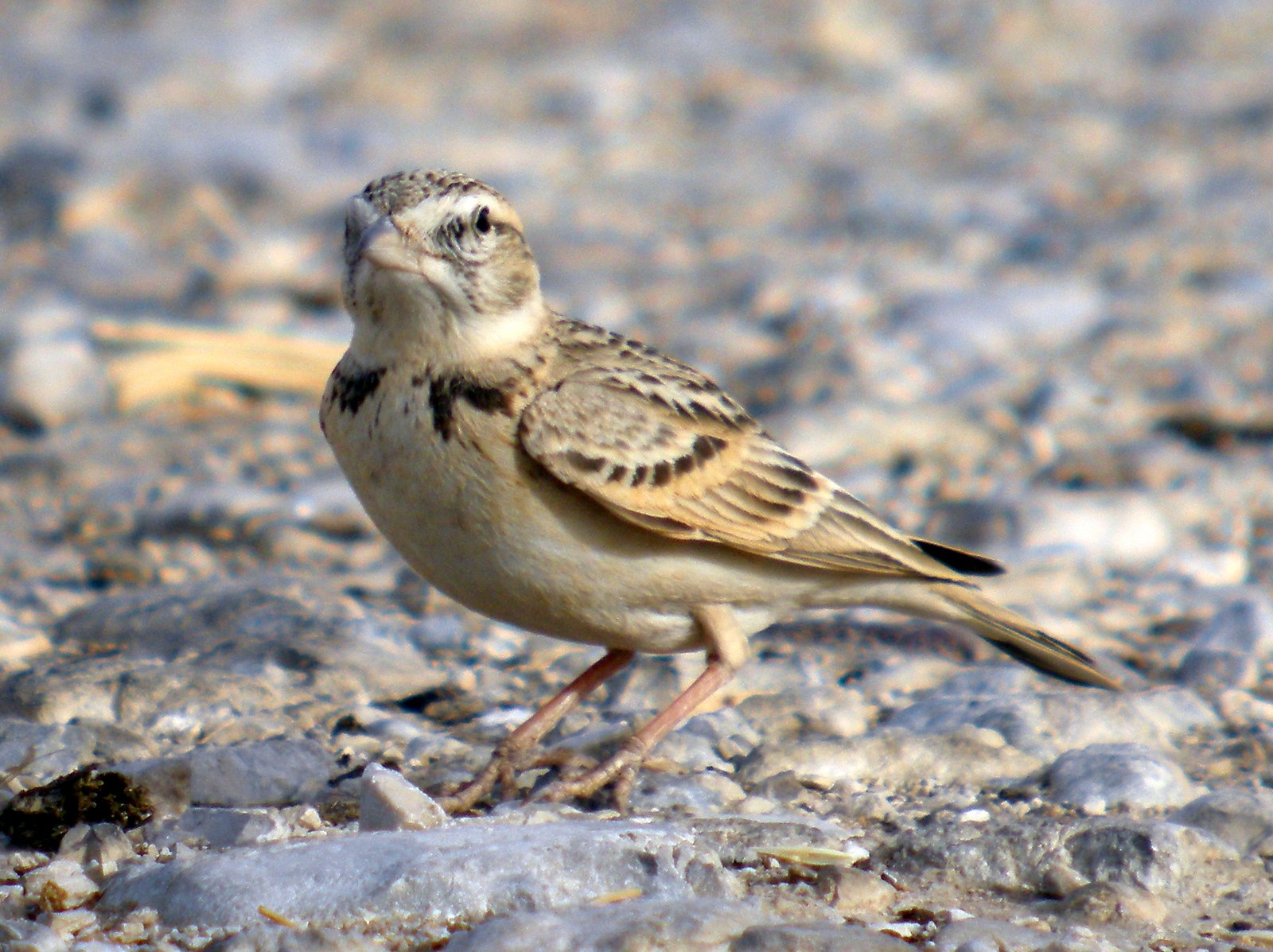
Greater Short-toed Lark is a small, pale lark of dry, open plains. In the north of the region it is a common breeder of steppe and fields, and in spring and autumn huge numbers pass across the Sahara, Sinai and the Arabian Peninsula. Flocks of hundreds of birds swarming low over a plain are then a common sight.
Voice
The call is a dry, short drrit or chirrp, often in series from migrating flocks. The song is a short, repeated twittering phrase, chee-chee-chirrup, delivered in an undulating song flight in which the bird rises with each phrase.
Recording: Meena Haribal — CC BY-NC-SA 4.0 · converted to mono · xeno-canto
Identification
13–14 cm, slim and pale sandy, with a short, thick, pointed conical bill. The underparts are white and unstreaked, with a small dark patch on the side of the neck that is sometimes almost hidden. Upperparts sandy to grey-brown with dark streaks, crown often warm rufous, distinct pale supercilium. The long tertials almost entirely cover the primaries. The row of median coverts forms a dark bar in the wing. Sexes alike.
Confusion species
Mediterranean Short-toed Lark (Alaudala rufescens) has a finely streaked breast without a neck patch, distinct primary projection beyond the tertials and a shorter, stubbier bill. Blanford's Lark (Calandrella blanfordi) of the highlands of south-western Arabia has a more uniform rufous cap. Tawny Pipit (Anthus campestris) is slimmer, with a longer tail, thin bill and wagtail-like stance. Bimaculated Lark (Melanocorypha bimaculata) is much larger and heavier.
Habitat
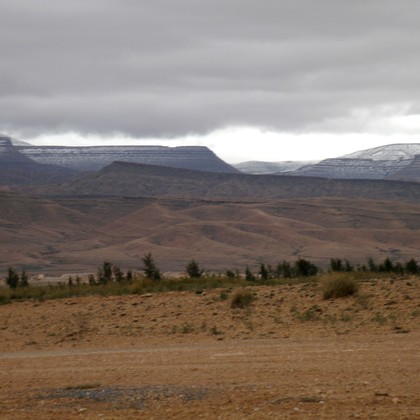
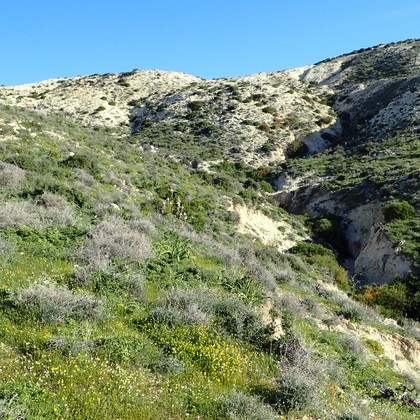
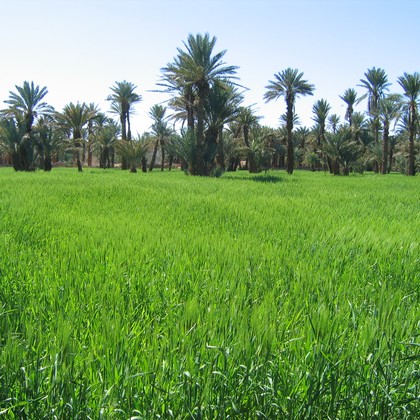
Dry, open plains with low, sparse vegetation: steppe and semi-desert, alfa steppe, bare fields, fallow and stubble, dried-out salt flats and coastal plains. On migration also in full desert, on lawns and in oases.
Where the bird is most at home, classified by the habitats of North Africa and the Middle East.
Range and movements
Breeds in almost the whole Maghreb from Morocco to Tunisia, mainly on the high plateaux and at the edge of the Sahara, in northern Libya, in the Levant (Israel, Judea and Samaria, Jordan, Lebanon and Syria) and in Iraq; a rare breeder in Saudi Arabia. In April–May and August–October a very numerous passage migrant throughout the region, including Egypt and the whole Arabian Peninsula. It winters mainly in the Sahel, but is also a common winter visitor in Saudi Arabia and the Gulf states. Beyond the region it breeds from southern Europe and Turkey to Central Asia and Mongolia.
- Resident
- Summer visitor (c. Apr–Sep)
- Winter visitor (c. Oct–Mar)
- Passage (Mar–Apr, Oct–Nov)
- dark = core range, pale = thinly spread
How and when to look
In Morocco it can be seen in April–June on the Tagdilt plateau and the plains around Missour and Midelt. On migration flocks near Eilat, in the Negev and along the Gulf coast are a common sight; search them for Mediterranean Short-toed Lark.
Conservation status
Not threatened. In Europe the species has declined steeply through agricultural intensification and loss of steppe; in North Africa and the Middle East it is still common, but overgrazing and the conversion of steppe to irrigated farming reduce habitat locally.
Scientific name
Calandrella brachydactyla | (Leisler, 1814)
Leisler described the species in 1814 as Alauda brachydactila; because it was later moved to another genus, the author and year stand in brackets. The genus Calandrella was introduced in 1829 by Kaup. Calandrella is a diminutive of Greek kalandros, the calandra lark, so 'little calandra lark'. brachydactyla is from Greek brakhus 'short' and daktulos 'toe', after the short toes. The specimen the first description was based on came from Montpellier, France.