All species › Passerines › Tits › Great Tit
Great Tit | Parus major
Koolmees | Carbonero común
The largest and most widespread tit in the region, a noisy resident of woodland, olive groves, parks and gardens. It is common in the Maghreb and the Levant, right into the city parks of Tel Aviv, Beirut and Rabat, but absent from the deserts of Egypt and Arabia.
Voice
Very varied. The familiar song is a loud, repeated tee-cher tee-cher or see-chew see-chew, like a bicycle pump; also a rich repertoire of calls, including a finch-like pink, a scolding churrrr and a nasal tsee-tsee-chair-chair.
Recording: Xavier Riera — CC BY-NC-SA 4.0 · converted to mono · xeno-canto
Identification
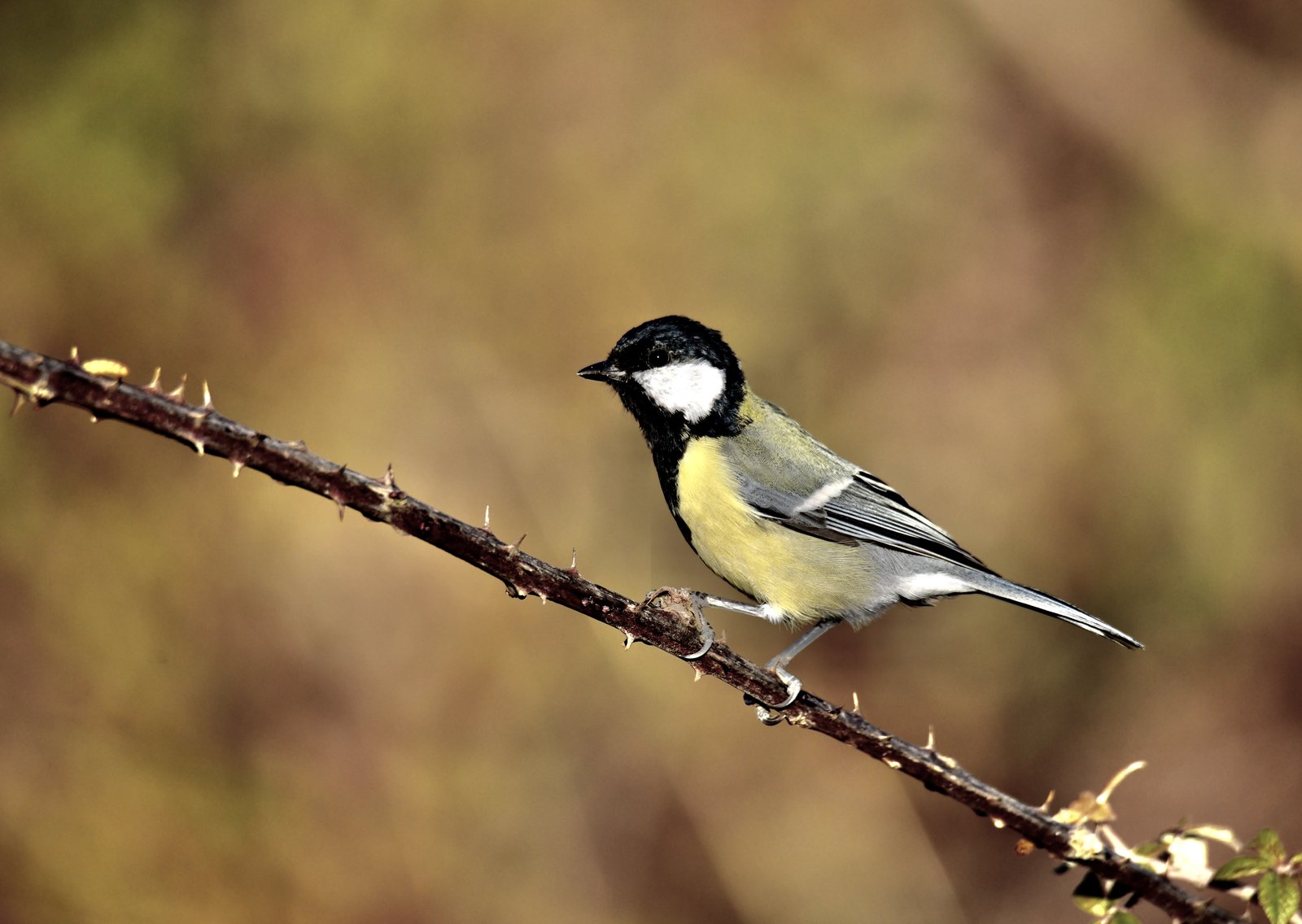
13.5–15 cm. A robust tit with a glossy black head and throat, a large white cheek and a black stripe running down the centre of the yellow breast and belly: broad in the male, reaching between the legs, narrower and broken in the female. Mantle greenish, rump and wings blue-grey with a white wing-bar, tail blue-grey with white outer edges. The North African form excelsus is brightly coloured with a vivid yellow belly; Levant birds (terraesanctae) are somewhat paler. Juveniles have a brownish-black head and yellowish cheeks.
Confusion species
Eurasian Blue Tit (Cyanistes caeruleus) and African Blue Tit (Cyanistes teneriffae) are smaller and show blue on crown, wings and tail. Coal Tit (Periparus ater) is smaller, lacks yellow and has a white nape patch. Sombre Tit (Poecile lugubris) has an equally large black cap and bib, but grey-brown upperparts and a dirty white belly without yellow or a black belly stripe.
Habitat
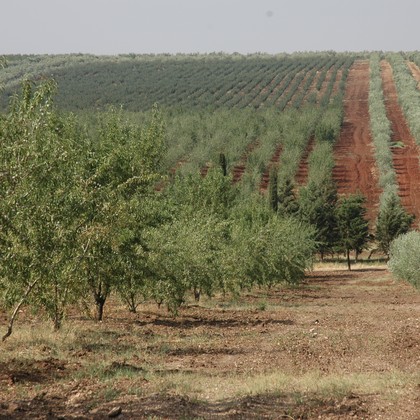
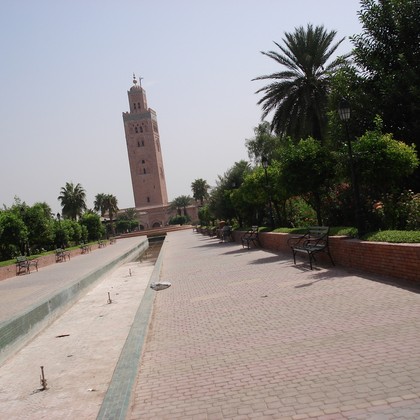
Almost any landscape with trees: Mediterranean woodland and maquis, oak and cedar forest in the mountains, riverine woodland, olive groves and orchards, citrus plantations, parks and gardens in villages and towns. In Morocco even into the date-palm groves on the edge of the Sahara. Nests in tree holes, wall cavities, pipes and nest boxes.
Where the bird is most at home, classified by the habitats of North Africa and the Middle East.

Range and movements
In Morocco common in the north and the Atlas, south to the Anti-Atlas and the oases of the desert edge; widespread in northern Algeria and Tunisia. In Libya recent data are almost lacking. In the Levant common in Lebanon, western Syria, Israel (south to the edge of the Negev) and the western highlands of Jordan. In Iraq mainly in Kurdistan and the north. In Egypt only a few old records in northern Sinai (El Arish, Rafah); in Kuwait and Saudi Arabia at most a vagrant. Beyond the region from Europe and north-west Africa across Asia to Siberia.
- Resident
- Summer visitor (c. Apr–Sep)
- Winter visitor (c. Oct–Mar)
- Passage (Mar–Apr, Oct–Nov)
- dark = core range, pale = thinly spread
How and when to look
Anywhere with trees, especially in winter when small parties roam with other tits. In Israel and Lebanon it is a common park bird; the Moroccan excelsus is easily seen in the cedar forest near Azrou or in the gardens of Marrakesh.
Conservation status
Not globally threatened and common in the region, locally increasing through tree planting, the spread of parks and gardens and the provision of nest boxes. Local declines occur where old woodland and orchards disappear or are heavily sprayed with pesticides.
Scientific name
Parus major | Linnaeus, 1758
Linnaeus described the species in 1758 and placed it straight away in the genus where it still stands. He introduced the genus Parus in that same work. Parus is the Latin word for 'tit'. major is Latin for 'larger': the great tit is the largest of the European tits. The specimen the first description was based on came from Europe.