All species › Passerines › Reed warblers › Great Reed Warbler
Great Reed Warbler | Acrocephalus arundinaceus
Grote karekiet | Carricero tordal
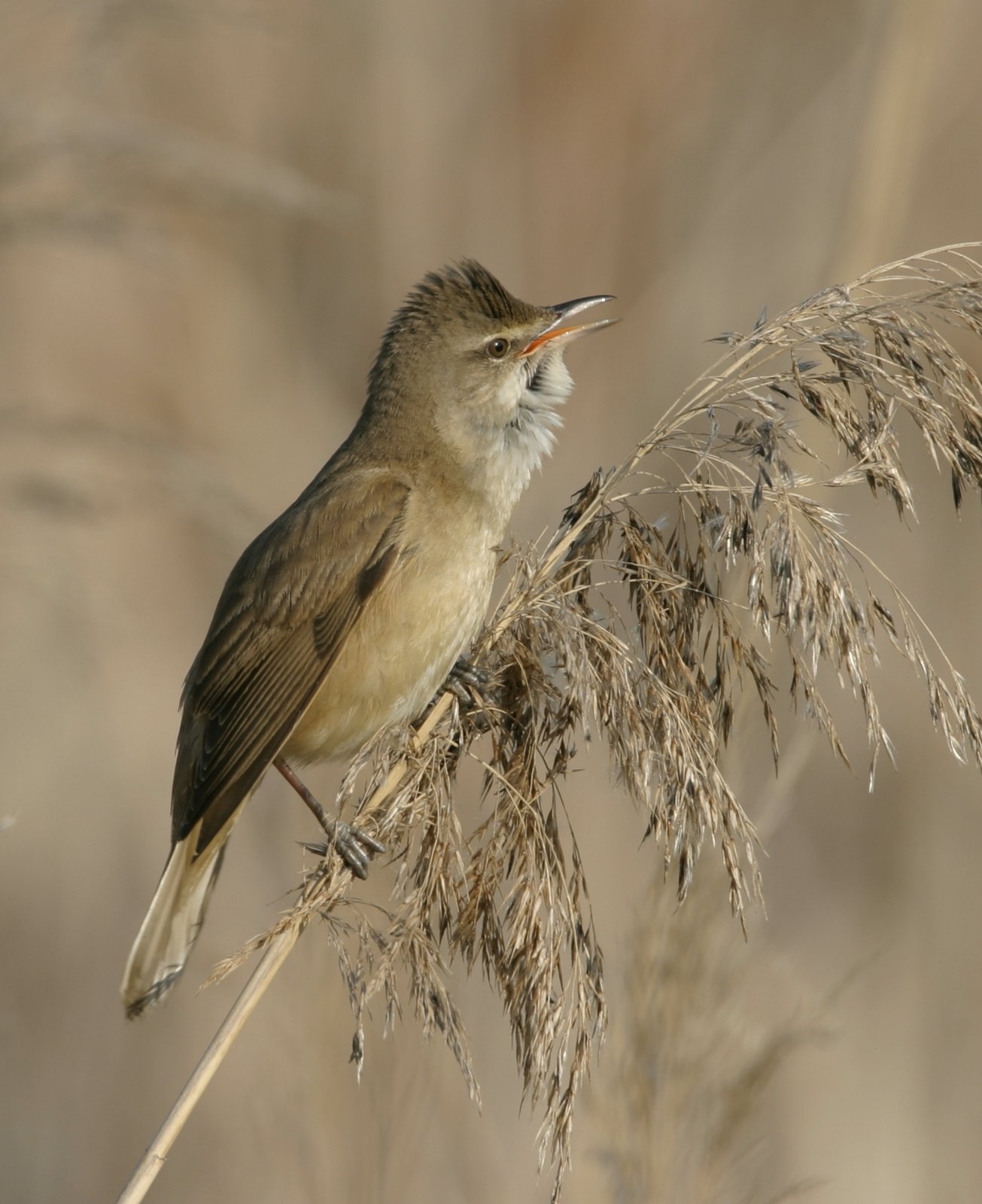
The Great Reed Warbler is the largest reed warbler of the region, a bulky, warm-brown bird with a loud, grating song that carries across the whole marsh. It breeds in the large reed marshes of the Maghreb, the Levant and Mesopotamia and migrates in large numbers through the whole region to sub-Saharan Africa.
Voice
The song is loud, low and grating, with short, repeated motifs, like a frog trying to sing: karra-karra-kit-kit, gurk-gurk, kerra-kerra-kit. Often sings from the top of a reed stem, also at night. The call is a hard chak and a harsh, rattling krrr.
Recording: Meena Haribal — CC BY-NC-SA 4.0 · shortened to the first 60 s, mono · xeno-canto
Identification
18–20 cm. Looks like an enlarged Eurasian Reed Warbler, the size of a thrush. Upperparts warm brown, the rump slightly warmer; underparts off-white with buff flanks, the throat sometimes finely streaked grey. A distinct pale supercilium to behind the eye and a dark lore. The bill is long, strong and thick at the base. Long primary projection. Legs grey-brown. The eastern form zarudnyi (Iraq and further east) is colder olive-brown and paler below than western birds.
Confusion species
Clamorous Reed Warbler (Acrocephalus stentoreus), resident in the Nile valley, the Levant and along the Red Sea and the Gulf, has a longer, thinner bill, shorter, rounder wings with a short primary projection, a less distinct supercilium and a more melodious, less grating song. Basra Reed Warbler (Acrocephalus griseldis) is smaller and slimmer, cold grey-brown with white underparts and a slender bill. Eurasian Reed Warbler (Acrocephalus scirpaceus) is much smaller, with a finer bill and a fainter supercilium.
Habitat
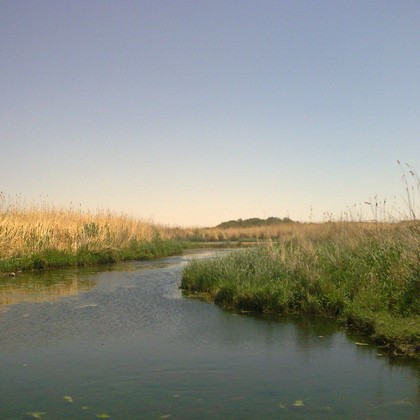
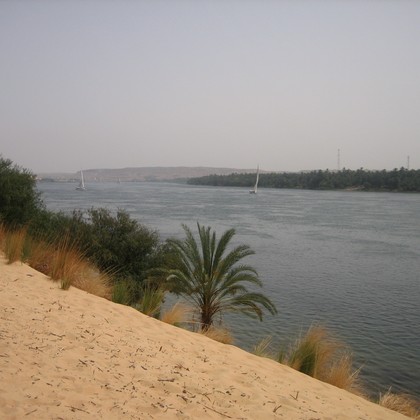
Broad, tall reedbeds along open water: lakes, marshes, river banks, reservoirs, fish ponds and sewage works, also in oases with reeds. On passage also in bushes, tamarisks and gardens far from water.
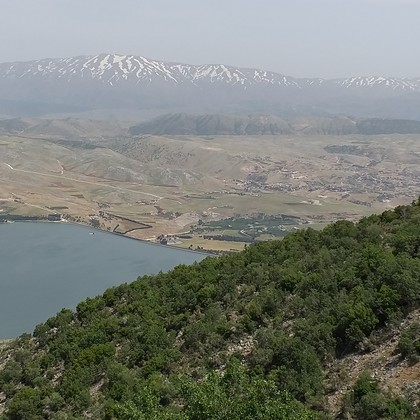
Where the bird is most at home, classified by the habitats of North Africa and the Middle East.
Range and movements
Breeds in the reed marshes of Morocco, northern Algeria and Tunisia, Israel, Jordan, Lebanon, Syria and Iraq, in the last as the form zarudnyi and common in the Mesopotamian marshes. A common passage migrant throughout the region, from the oases of the Sahara, Libya and Egypt to Saudi Arabia, Yemen, Oman, the United Arab Emirates and the other Gulf states; in spring conspicuous in Sinai, Eilat and the Jordan Valley. The odd bird winters in Egypt and Arabia. Beyond the region from Iberia and Europe to Central Asia; winters in sub-Saharan Africa.
- Summer visitor (c. Apr–Sep)
- Winter visitor (c. Oct–Mar)
- Passage (Mar–Apr, Oct–Nov)
- dark = core range, pale = thinly spread
How and when to look
In May at a reedbed at Merja Zerga, the Hula or the Mesopotamian marshes: the loud grating carries far and the singer often sits in view on a reed plume. On passage it can turn up anywhere, even in a bush in the middle of a desert oasis.
Conservation status
Not globally threatened. Locally declined through drainage of marshes, loss of broad, old reedbeds and desiccation, in the region mainly in North Africa and Mesopotamia.
Scientific name
Acrocephalus arundinaceus | (Linnaeus, 1758)
Linnaeus described the species in 1758 as Turdus arundinaceus; because it was later moved to another genus, the author and year stand in brackets. The genus Acrocephalus was introduced in 1811 by Naumann & Naumann. Acrocephalus is Greek, from akros 'topmost, pointed' and kephalē 'head'; the Naumanns, who introduced the genus, called these birds Spitzkopf 'pointed head', so they read akros as 'pointed'. arundinaceus is Latin for 'like a reed', from arundo, genitive arundinis, 'reed'. The specimen the first description was based on came from northern Europe.