All species › Passerines › Wagtails and pipits › Gray Wagtail
Gray Wagtail | Motacilla cinerea
Grote gele kwikstaart | Lavandera cascadeña
The Gray Wagtail is the long-tailed wagtail of running water: fast streams in the Atlas and the mountains of the Levant, and in winter every trickle, irrigation channel and dripping wadi deep into Arabia. Its tail pumps almost incessantly and far up and down.
Voice
The call is a sharp, metallic tzitzit or zizziss, harder and shorter than that of White Wagtail, often given in flight over water. The song is a series of high, fast notes interspersed with calls, zi-zi-zi-tchirr, delivered from a stone or in song flight.
Recording: Shaun Micklewright — CC BY-NC-SA 4.0 · shortened to the first 60 s, mono · xeno-canto
Identification
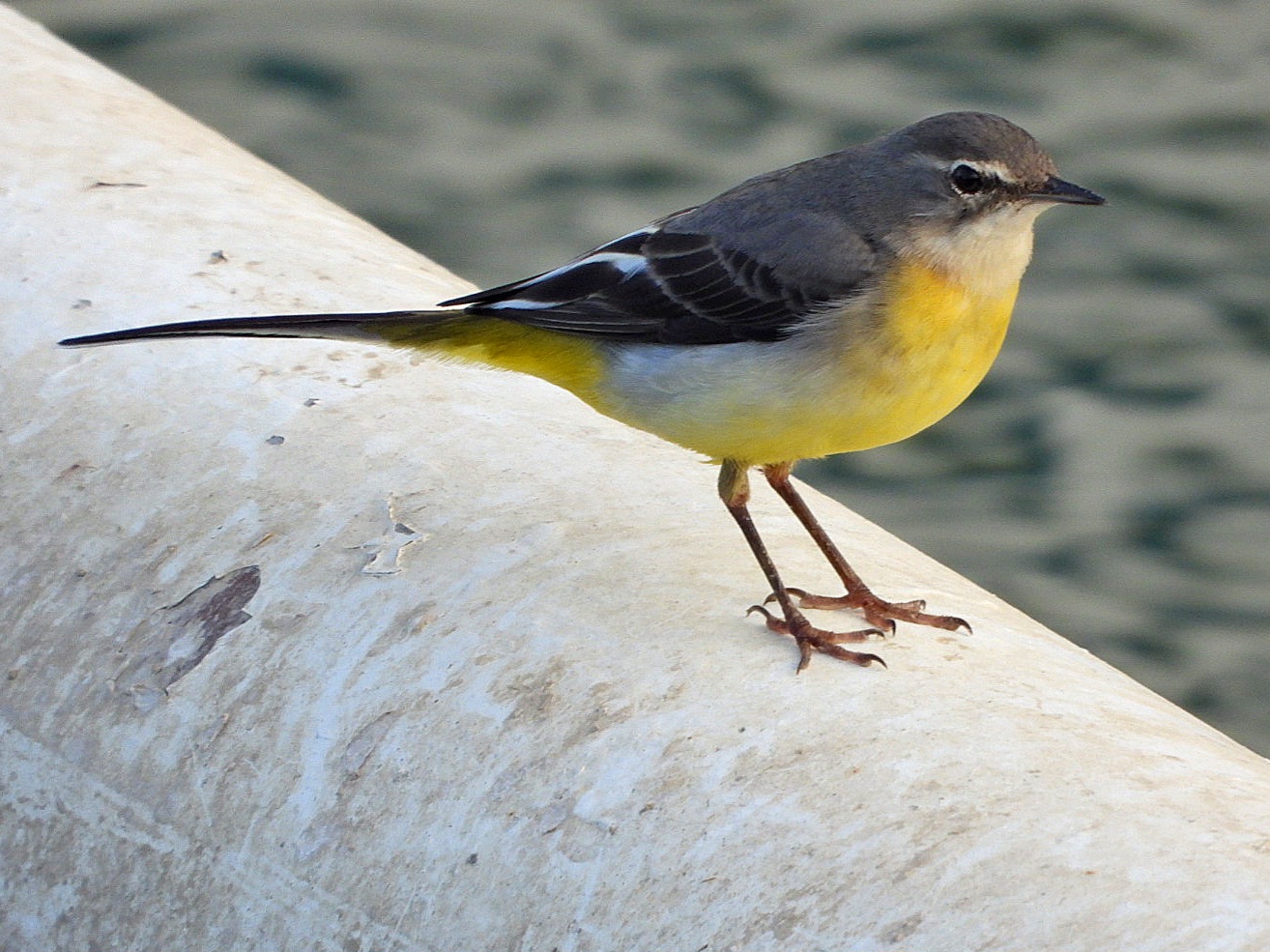
17–20 cm, almost half of it tail; the longest and slimmest wagtail of the region. The upperparts are blue-grey, the rump and undertail coverts bright yellow, and the wing is blackish with a narrow white bar across the secondaries that shows only in flight. The legs are flesh-coloured to pink. The breeding male has a black throat between a white supercilium and white moustachial stripe, and a bright yellow breast. Females and winter birds have a white or pale throat and a breast varying from dirty white to pale yellow, but always keep the vivid yellow vent and rump. The flight is strongly undulating, showing off the long tail.
Confusion species
Western Yellow Wagtail (Motacilla flava) and Citrine Wagtail (Motacilla citreola) have a much shorter tail, black legs and a green or grey back respectively without the contrast of a bright yellow rump; they also prefer open, flat ground. A young Citrine Wagtail is grey above but has broad white wingbars and a white undertail. Gray Wagtail is always told by the combination of grey back, yellow undertail, pink legs and the exceptionally long tail.
Habitat
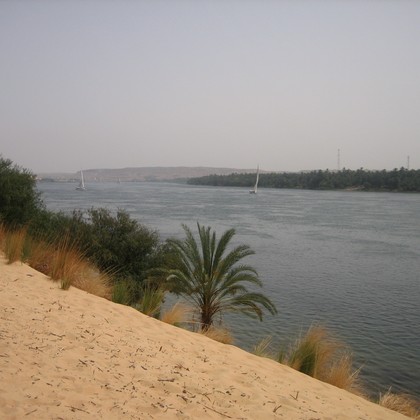
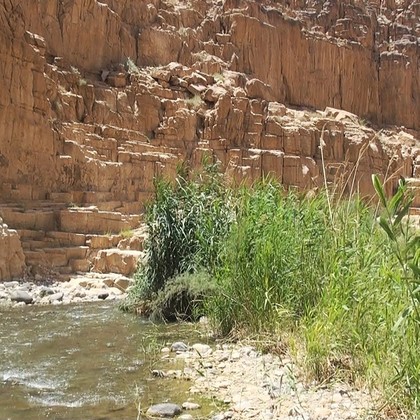
When breeding, fast-flowing streams and rivers with stones, waterfalls and overhanging banks, mainly in the mountains, also at mills, bridges and irrigation channels. In winter more widely: river banks, flowing canals, springs and wadis with permanent water, sewage works, park ponds and even fountains and sprinklers in towns and hotels. It feeds on aquatic insects and their larvae, picked from stones or caught in short sallies.
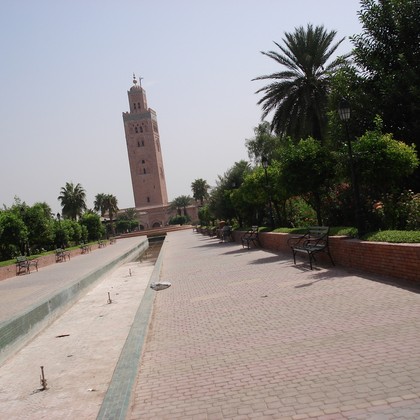
Where the bird is most at home, classified by the habitats of North Africa and the Middle East.
Range and movements
Breeds in Morocco in the Rif and the High, Middle and Anti-Atlas, in northern Algeria and Tunisia, and in Lebanon, western Syria and the mountains of northern Iraq; very scarce in Israel. In winter and on passage across almost the whole region: common in the Maghreb, along the Nile and in the Levant, and scattered in Arabia in wadis with running water, in the mountains of Yemen and Oman, in Dhofar and in the Gulf states; scarce in the Libyan and Algerian Sahara away from oases. Beyond the region it breeds across Europe and Asia to Japan, and winters south to East Africa, India and South-East Asia.
- Resident
- Summer visitor (c. Apr–Sep)
- Winter visitor (c. Oct–Mar)
- Passage (Mar–Apr, Oct–Nov)
- dark = core range, pale = thinly spread
How and when to look
In winter the easiest place to find one is any stretch of running water: a wadi with a stream in Oman, an irrigation channel in an oasis or the edge of a hotel pool on the Gulf. In the breeding season along any mountain stream in the Atlas: it is common in the Ourika valley and at the Ouzoud falls. The sharp tzitzit over the water usually announces it.
Conservation status
Not globally threatened and widespread in the region. Locally it suffers where streams and springs dry up through water abstraction, but it adapts well to artificial running water in gardens, parks and farmland.
Scientific name
Motacilla cinerea | Tunstall, 1771
Tunstall described the species in 1771 and placed it straight away in the genus where it still stands. The genus Motacilla was introduced in 1758 by Linnaeus. Motacilla was the Roman name for the wagtail; it is really a diminutive of motare 'to move about', but from medieval times -cilla was wrongly taken to mean 'tail'. cinerea is Latin for 'ash-grey', from cinis 'ashes', after the grey upperparts. The specimen the first description was based on came from Wycliffe, England.