All species › Passerines › Chats and flycatchers › Finsch's Wheatear
Finsch's Wheatear | Oenanthe finschii
Finsch' tapuit | Collalba de Finsch
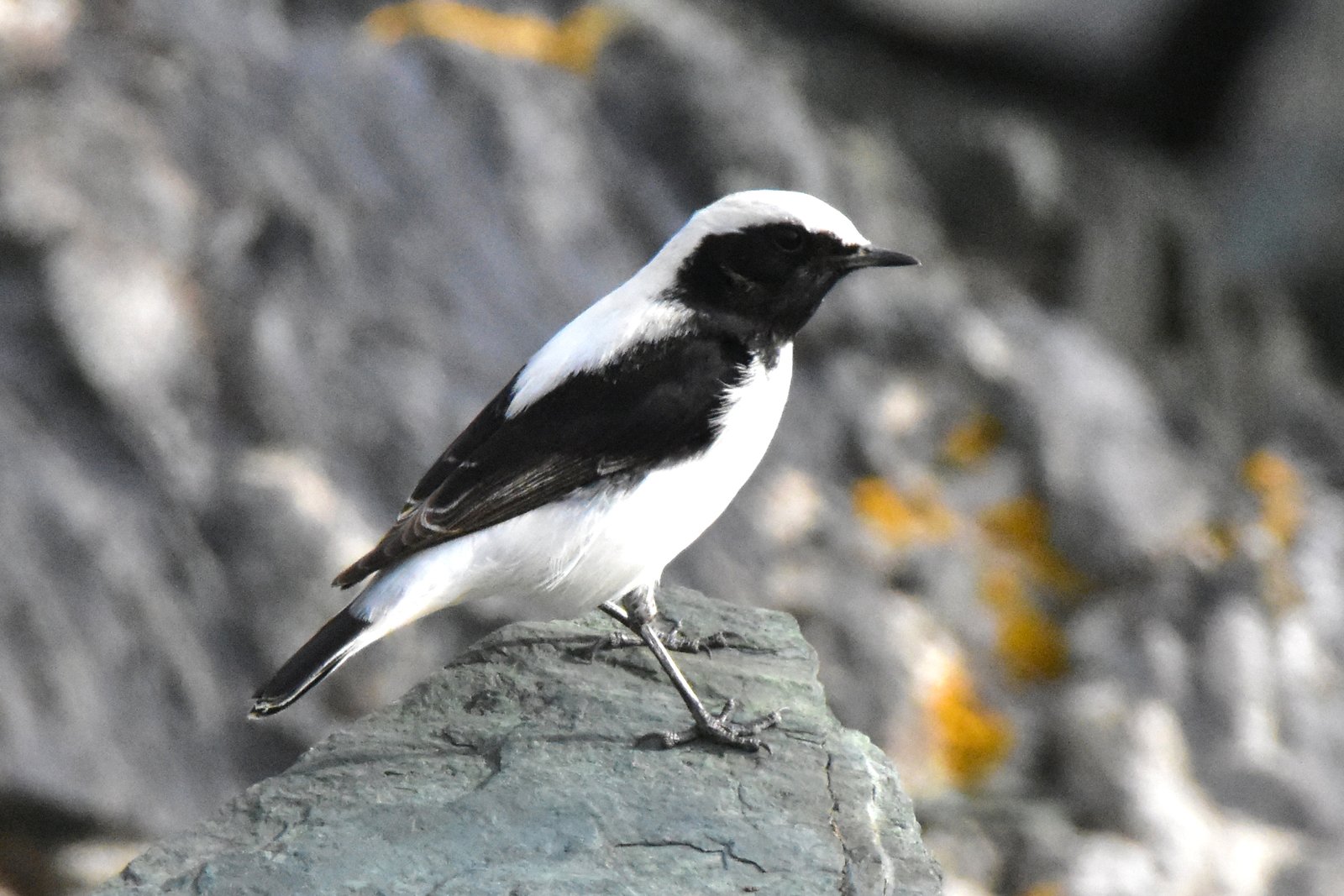
Finsch's Wheatear is a compact black-and-white wheatear of stony slopes and dry hills, which moves in winter from Anatolia and the Iranian Plateau to the Levant, Iraq and northern Arabia. In the region it is chiefly a winter bird: between November and March a black-and-white wheatear with a white back on a barren slope in the Levant is almost always this species.
Voice
The call is a hard chak, often in series, and a thin hweet. The song is a short phrase of scratchy notes leading into a few clear, rather plaintive whistles, given from a stone or in a short song flight; in the winter quarters it sometimes sings from February.
Recording: Frantz Barrault — CC BY-NC-SA 4.0 · converted to mono · xeno-canto
Identification
15–16.5 cm. Bulky and somewhat top-heavy, with a large head, a thick neck and short wings. The male has a white crown, nape, mantle and back forming one pale band from head to rump; face, throat and sides of neck are black, the black joining the black wings without a break. Underparts and rump are white, as are the undertail-coverts. The tail is white with black central feathers and a broad black terminal band that creeps a little up the outer feathers. In fresh winter plumage the white of the back is tinged buff and the black parts are narrowly fringed pale. The female is grey-brown to sandy, with a pale crown, often a greyish to blackish throat and cheek patch, and the same broad terminal tail band.
Confusion species
The male Pied Wheatear (Oenanthe pleschanka) also has a white crown and a black throat, but a black mantle and back, a slimmer build, longer wings and a narrower terminal band; in the Levant it occurs only on spring and autumn passage and does not winter. Mourning Wheatear (Oenanthe lugens) also has a black mantle and in addition orange-buff undertail-coverts. Hooded Wheatear (Oenanthe monacha) has a black back, a longer tail without a real terminal band and a longer bill. The black-throated form of the male Western Black-eared Wheatear (Oenanthe hispanica) has a sandy back and a much whiter tail. Females resemble female Northern Wheatear (Oenanthe oenanthe) and Pied Wheatear; note the compact build, short primary projection and broad terminal band.
Habitat
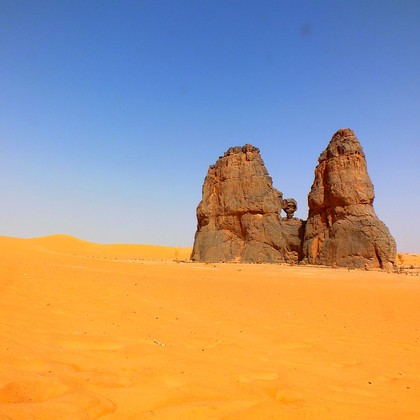
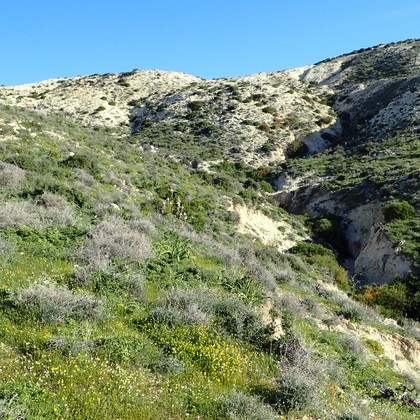
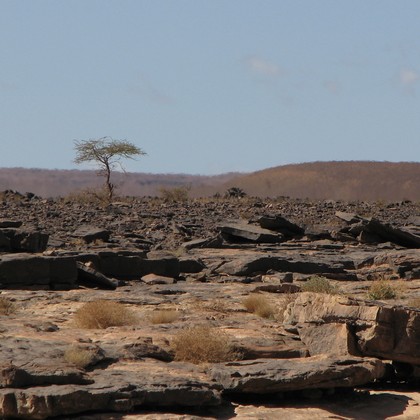
Open stony slopes and hills with low, scattered vegetation, limestone plateaus, the edges of stony desert and dry field margins; in winter also low hill country and roadsides with stone walls. Breeds in holes between stones and in rock crevices on dry mountain slopes. Holds its own territory in winter.
Where the bird is most at home, classified by the habitats of North Africa and the Middle East.
Range and movements
A local breeder in the uplands of Kurdistan in northern Iraq and, scarcely, in northern Syria. In winter fairly common in Syria, Lebanon, northern and central Israel (especially the edges of the Judean Desert, the Golan and the northern Negev) and Jordan, and further in Iraq, Kuwait and northern and central Saudi Arabia. Rare in Sinai and northern Egypt, a vagrant further south in Arabia and in the Gulf states. Beyond the region it breeds from Anatolia and the Caucasus across the Iranian Plateau to Central Asia, and also winters on Cyprus and in southern Iran.
- Resident
- Summer visitor (c. Apr–Sep)
- Winter visitor (c. Oct–Mar)
- Passage (Mar–Apr, Oct–Nov)
- dark = core range, pale = thinly spread
How and when to look
Look for it in winter on bare stony slopes with walls in northern Israel and the Jordanian highlands, for example around Arad and the western edge of the Judean Desert. It perches conspicuously on a stone or wall and defends its winter patch against other wheatears; a white back on a black-and-white wheatear in December or January is the key feature.
Conservation status
Not globally threatened. Fairly common in its Levant winter quarters; little is known about the breeders in Iraq and Syria, where war and insecurity make counts almost impossible.
Scientific name
Oenanthe finschii | (Heuglin, 1869)
Heuglin described the species in 1869 as Saxicola Finschii; because it was later moved to another genus, the author and year stand in brackets. The genus Oenanthe was introduced in 1816 by Vieillot. Oenanthe was used by Aristotle for a bird that can no longer be identified; the word comes from the Greek oinos, oinoē 'wine, vine' and anthos 'flower, bloom'. finschii honours the German naturalist Otto Finsch (1839–1917). The specimen the first description was based on came from Syria.