All species › Kingfishers, bee-eaters and rollers › Rollers › European Roller
European Roller | Coracias garrulus
Scharrelaar | Carraca europea
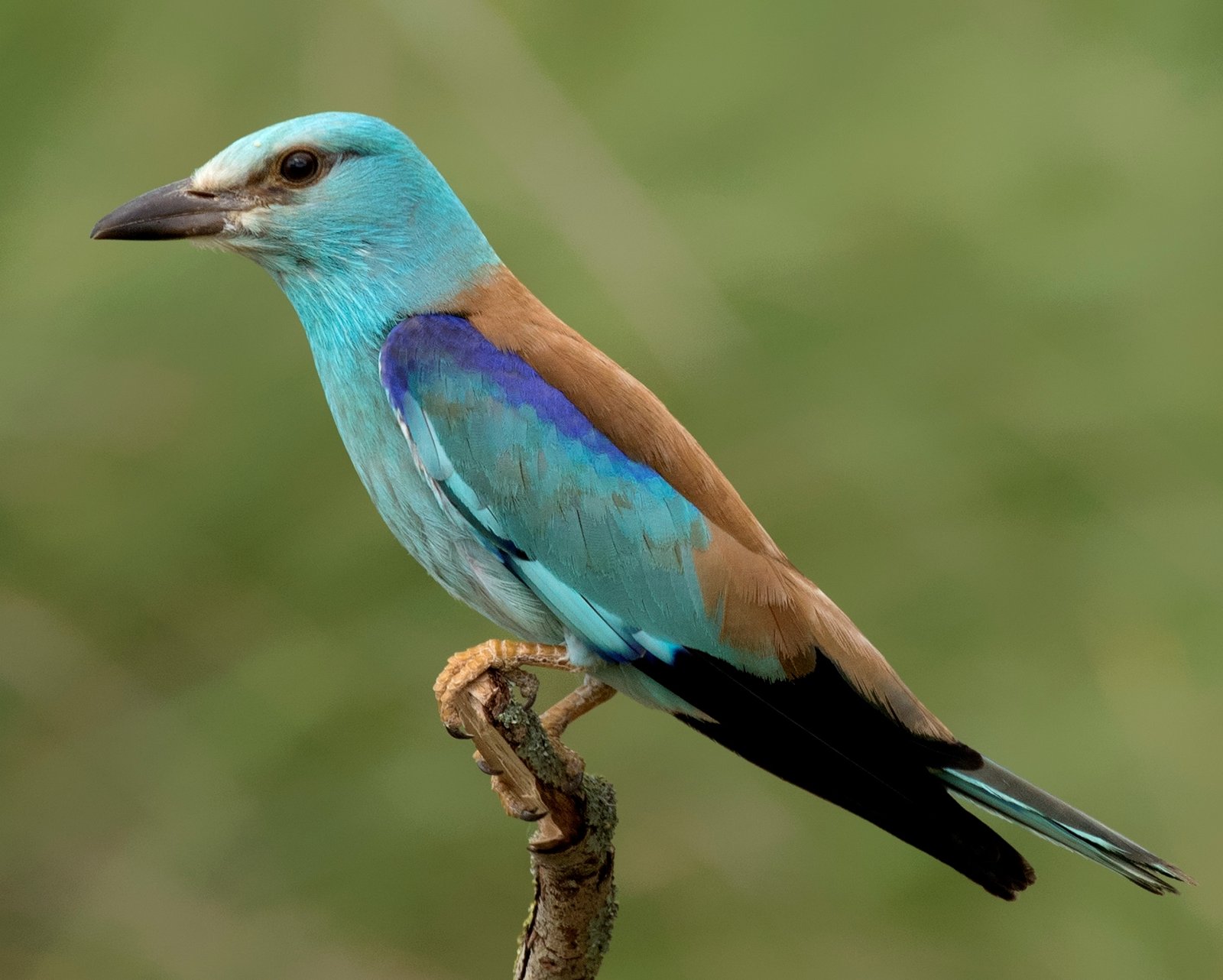
A jackdaw-sized, bright turquoise-blue bird with a cinnamon back, which in summer sits watching from wires and dead branches in open, warm country. It breeds in the north of the Maghreb and in the Levant, and passes through the Middle East in large numbers: in spring and autumn a large share of the European and Asian breeders streams through Arabia to and from southern Africa.
Voice
A harsh, hoarse, crow-like rak-rak or kshrak, and a raw, rattling rrrak-rak-rak in the display flight, in which the bird tumbles and rolls sideways out of the sky, hence the name. Usually silent on passage.
Recording: Esperanza Poveda — CC BY-NC-SA 4.0 · shortened to the first 60 s, mono · xeno-canto
Identification
Head, neck and underparts bright light blue to turquoise, mantle and scapulars warm cinnamon-brown. In flight a strong contrast between the black flight feathers, the deep violet-blue forewing and the light blue underwing coverts. The tail is blue-green with dark corners, square-ended, without streamers. The heavy black bill has a slightly hooked tip; small black eye stripe. Sexes alike. Juveniles are duller and browner, with a dull greenish-blue head and pale streaks on throat and breast. Often sits upright and motionless, dropping from its lookout to the ground to seize prey.
Confusion species
Indian Roller (Coracias benghalensis), in the east of the region, has a brown breast with a lilac throat, a dark blue crown and, in flight, a pale blue band across the dark flight feathers. Abyssinian Roller (Coracias abyssinicus) of south-west Arabia has long tail streamers and a whitish forehead. White-throated Kingfisher (Halcyon smyrnensis) and the bee-eaters, such as Blue-cheeked Bee-eater (Merops persicus), are also blue and green but slimmer and differently patterned; the kingfisher has a red bill and a brown belly.
Habitat
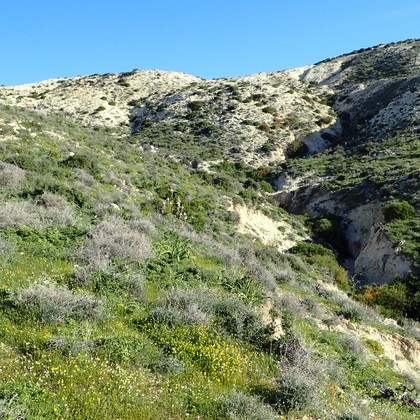
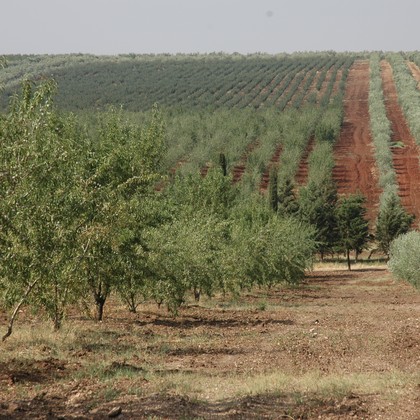
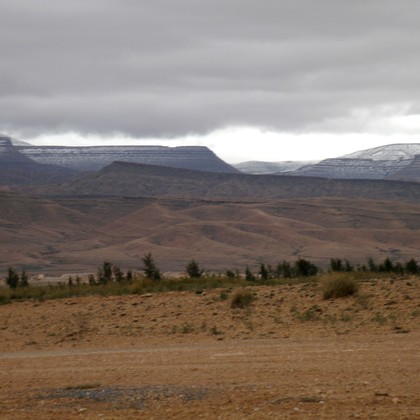
Warm, open, dry country with scattered trees, holes and perches: old olive groves, farmland with hedges and telephone wires, garrigue and open oak woodland, steppe and riverbanks with hollow trees or steep sand banks. Hunts large insects from a perch, especially grasshoppers and beetles, but also lizards and small rodents. Nests in tree holes, old woodpecker holes, holes in walls and banks. On passage also in wadis, thorn scrub and irrigated fields in the desert.
Where the bird is most at home, classified by the habitats of North Africa and the Middle East.
Range and movements
Breeds in northern Morocco (Atlantic plains, the edge of the Middle Atlas and the east), in northern Algeria from the Tell to the high plateaux, and in northern Tunisia; in Libya formerly in Tripolitania, now rare at most. In the east it breeds scarcely in Israel (mainly the north and the Hula area), Jordan, Lebanon and Syria, and in northern Iraq. On passage throughout the region: in North Africa mainly in April – May and August – September, also across the Sahara; in the Middle East in large numbers along the Red Sea and especially through eastern Arabia (Kuwait, eastern Saudi Arabia, Qatar, the Emirates and Oman, and Yemen), peaking in April and September. Also breeds from southern and eastern Europe to Central Asia, and winters in eastern and southern Africa.
- Resident
- Summer visitor (c. Apr–Sep)
- Winter visitor (c. Oct–Mar)
- Passage (Mar–Apr, Oct–Nov)
- dark = core range, pale = thinly spread
How and when to look
In April and May migrants often sit on power lines along irrigated fields and in the date gardens of eastern Arabia; in the Emirates and Oman mid-September is the best time. In Morocco and Algeria look for breeding birds in June and July in old olive groves and on the high plateaux, perched on roadside posts.
Conservation status
No longer globally threatened: from 2005 to 2016 it was listed as Near Threatened, but nest-box projects in Europe have turned the decline around. In the region it suffers from the loss of old trees and holes, agricultural intensification, pesticides and hunting on passage, including in Lebanon, Syria and Egypt.
Scientific name
Coracias garrulus | Linnaeus, 1758
Linnaeus described the species in 1758 and placed it straight away in the genus where it still stands. He introduced the genus Coracias in that same work. Coracias comes from Ancient Greek korakias, from korax 'raven, crow'; the Greeks used it of a corvid, probably the red-billed chough. garrulus is Latin for 'chattering, noisy', from garrire 'to chatter', after the harsh call. The specimen the first description was based on came from Sweden.