All species › Kingfishers, bee-eaters and rollers › Bee-eaters › European Bee-Eater
European Bee-Eater | Merops apiaster
Bijeneter | Abejaruco europeo
A multicoloured bird of chestnut, gold and turquoise, with a scimitar bill and short tail streamers. It breeds in the northern Maghreb and the Levant, and passes through the whole region in hundreds of thousands in spring and autumn, also straight across the Sahara and the Arabian desert.

Voice
A liquid, rolling, far-carrying prruup or kroo-kroo, usually from a flock passing invisibly high overhead. Given almost continuously in flight; at the colony there is also a busy, gurgling chatter.
Recording: Stanislas Wroza — CC BY-NC-SA 4.0 · shortened to the first 60 s, mono · xeno-canto
Identification
Slim, with long pointed triangular wings, a long slightly decurved bill and central tail feathers projecting 2–3 cm. Chestnut crown and mantle grade into golden-yellow scapulars, which show as a pale V in flight; the underparts are turquoise. The bright yellow throat is bordered by a narrow black band, and a black eye-stripe runs below a white and green forehead. The female has greener scapulars. Juveniles are duller and greener, with a pale throat and no streamers. Fast beats alternate with long glides.
Confusion species
Blue-cheeked Bee-Eater (Merops persicus) is mainly grass green, with a rufous throat and much longer streamers, and has a hoarser call. European Roller (Coracias garrulus) is equally colourful but bulkier, with a straight black bill, sky-blue underparts without a yellow throat and a heavy flight. High-flying flocks are often taken for swallows on shape alone, until the calls arrive.
Habitat
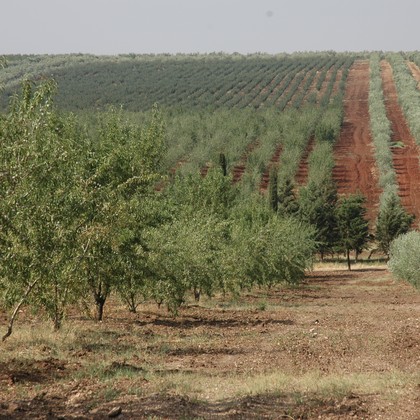
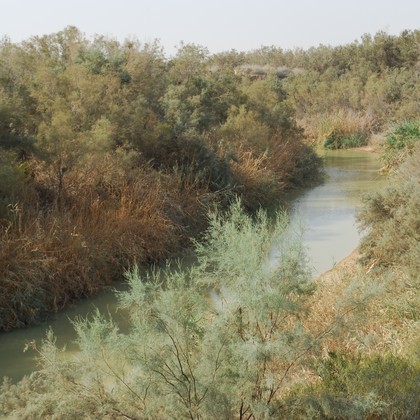
Warm open and half-open country with sandy or loamy vertical faces: river banks, sunken lanes, sand pits and wadi banks, surrounded by flowery steppe, olive groves, orchards or extensive farmland. On migration anywhere, including over bare desert, resting in oases, gardens and along rivers. Hunts bees, wasps and dragonflies high in the air.
Where the bird is most at home, classified by the habitats of North Africa and the Middle East.

Range and movements
Breeds in northern Morocco, Algeria and Tunisia, from the coast to the High Atlas and the northern edge of the Sahara, and in Tripolitania and Cyrenaica in Libya; in the east in Israel, Jordan, Lebanon, Syria and northern and central Iraq, locally into northern Saudi Arabia. On passage, March – May and August – October, throughout the region: in large numbers along the Nile, through Sinai, the Jordan Valley and past Eilat, over the Saharan oases and through Arabia and the Gulf states to Yemen and Oman. Outside the region it breeds in southern and eastern Europe and western and central Asia, and winters in West and southern Africa.
- Resident
- Summer visitor (c. Apr–Sep)
- Winter visitor (c. Oct–Mar)
- Passage (Mar–Apr, Oct–Nov)
- dark = core range, pale = thinly spread
How and when to look
Look for colonies from May along sandy river banks and sunken lanes in northern Morocco, the Tunisian Tell or the Jordan Valley. For mass migration go to Eilat or the Arava in late April and early September, when thousands sometimes pass in a day: listen upwards, the call almost always comes before the sighting.
Conservation status
Not globally threatened. In the region locally persecuted by beekeepers, who regard it as harmful to bees, and harmed by the removal of earth banks and by insecticides. On migration birds also die in the nets along the Egyptian coast.
Scientific name
Merops apiaster | Linnaeus, 1758
Linnaeus described the species in 1758 and placed it straight away in the genus where it still stands. He introduced the genus Merops in that same work. Merops is Greek and means 'bee-eater'. apiaster says the same in Latin, from apis 'bee'; the name thus means 'bee-eater' twice. The specimen the first description was based on came from southern Europe.