All species › Passerines › Crows and jays › Eurasian Jay
Eurasian Jay | Garrulus glandarius
Gaai | Arrendajo euroasiático
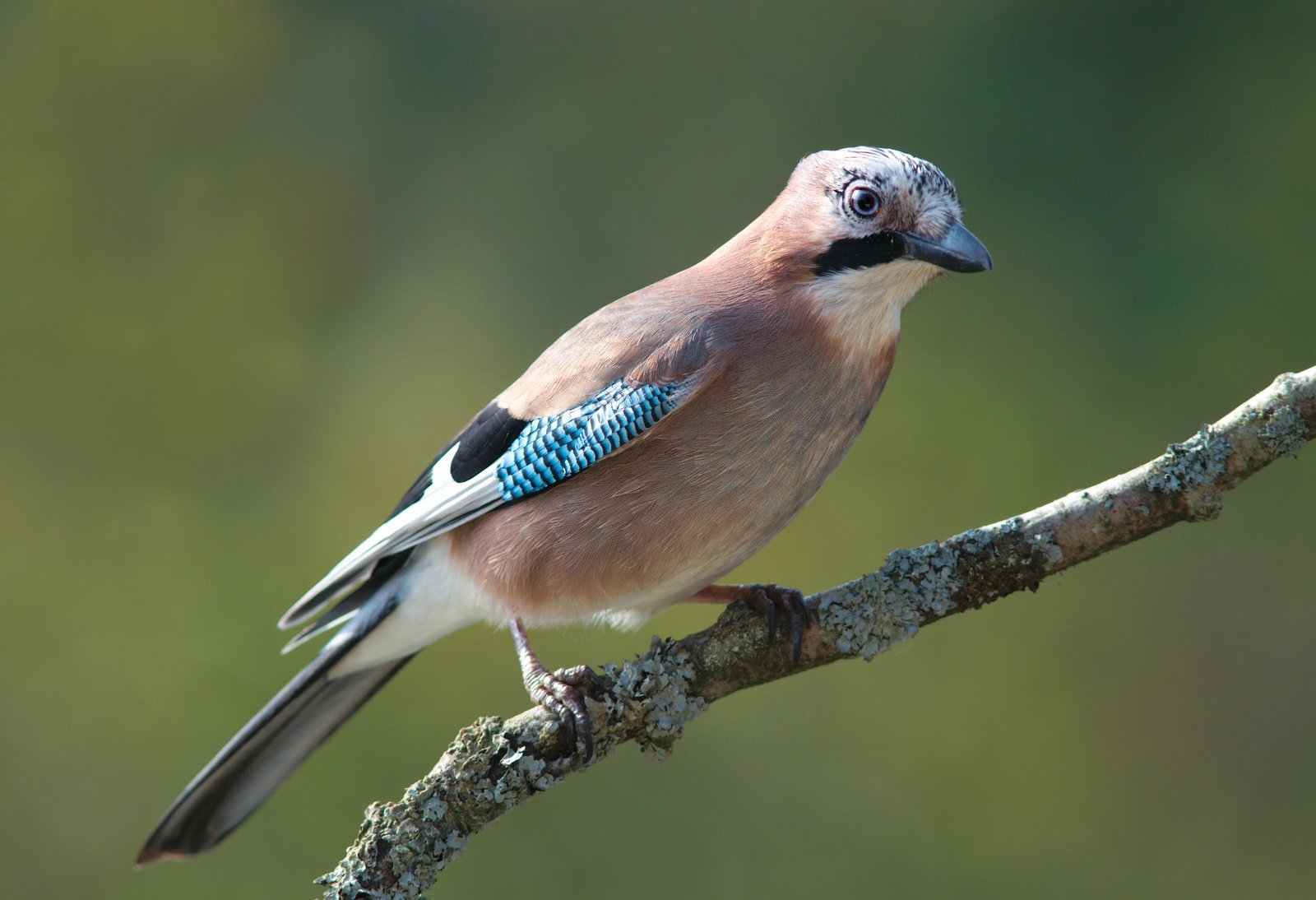
A colourful, noisy corvid of woodland and parks. Strikingly different subspecies occur in the region: in the Maghreb forms with a black crown and rufous nape, in the Levant the pale subspecies with an all-black cap and white cheeks. In Israel it is now a common city bird.
Voice
A harsh, rasping skraaak, often the first clue; also a mewing peeoo and fine imitations of raptors such as buzzards. The song is a soft, varied chattering that is rarely noticed.
Recording: Walter Wallner — CC BY-NC-SA 4.0 · converted to mono · xeno-canto
Identification
32–35 cm. Body pinkish to greyish brown, a bright white rump contrasting sharply with the black tail, black wings with a white patch and blue-and-black barred wing-coverts, and a black moustachial stripe. North African forms have a black crown, whitish face and rufous nape; in Tunisia and eastern Algeria the head is palest and the nape most rufous. The Levantine form has a glossy black cap extending over the forehead, white cheeks and throat and a pale greyish body. Flies rather clumsily and undulating on rounded wings, showing the white rump.
Confusion species
Hardly confusable. At a glance through woodland Eurasian Hoopoe (Upupa epops), with black-and-white wings and undulating flight, may recall a jay, but has a long decurved bill and a crest. Observers who know the European jay should not take the different head patterns in the region for another species.
Habitat
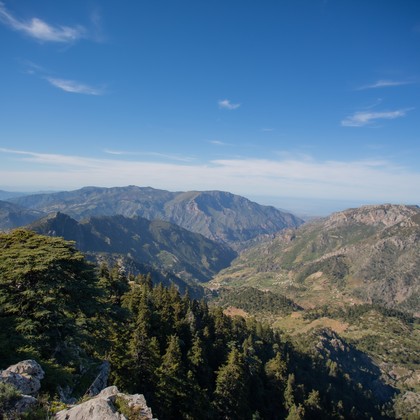
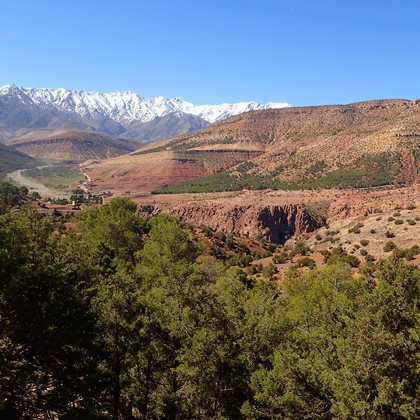
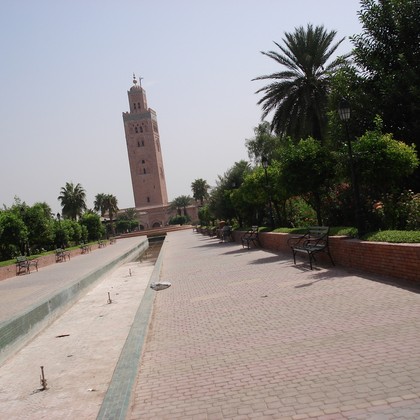
Oak, cork oak, cedar and pine forest and dense maquis, in the Atlas to about 2,000 m. In the Levant also olive groves, orchards, city parks and gardens, right into the centres of Jerusalem and Tel Aviv. Caches acorns in autumn by burying them; also eats insects, eggs and nestlings.
Where the bird is most at home, classified by the habitats of North Africa and the Middle East.
Range and movements
In Morocco in the forests of the Rif, Middle Atlas and High Atlas and in the cork oak forests of the Atlantic lowlands. In Algeria in the forests of the Tell, from Kabylia to Constantine, and in Tunisia in Kroumirie and the Mogods in the north-west. In the Levant in Israel (Galilee, Carmel, the Judean hills and the cities of the coastal plain), Samaria and Judea, Lebanon, western Syria and the north-western highlands of Jordan; also in the oak forests of Kurdistan in northern Iraq. Beyond the region from Europe and Turkey east across Asia to Japan and South-East Asia.
- Resident
- Summer visitor (c. Apr–Sep)
- Winter visitor (c. Oct–Mar)
- Passage (Mar–Apr, Oct–Nov)
- dark = core range, pale = thinly spread
How and when to look
In the Levant it is nowhere easier than in the parks of Jerusalem and Tel Aviv. In Jordan, Dibbeen forest near Jerash is a good site. In Morocco the rasping calls give it away in the cedar forests around Azrou and Ifrane.
Conservation status
Not globally threatened. In Israel it has increased strongly since the second half of the twentieth century and moved into the cities. In North Africa it is tied to forest, which is declining through logging, overgrazing and fire.
Scientific name
Garrulus glandarius | (Linnaeus, 1758)
Linnaeus described the species in 1758 as Corvus glandarius; because it was later moved to another genus, the author and year stand in brackets. The genus Garrulus was introduced in 1760 by Brisson. Garrulus is Latin for 'chattering' or 'noisy', after the bird's harsh calls. glandarius is Latin for 'of acorns', after the acorns the jay gathers and buries. The specimen the first description was based on came from Sweden.